






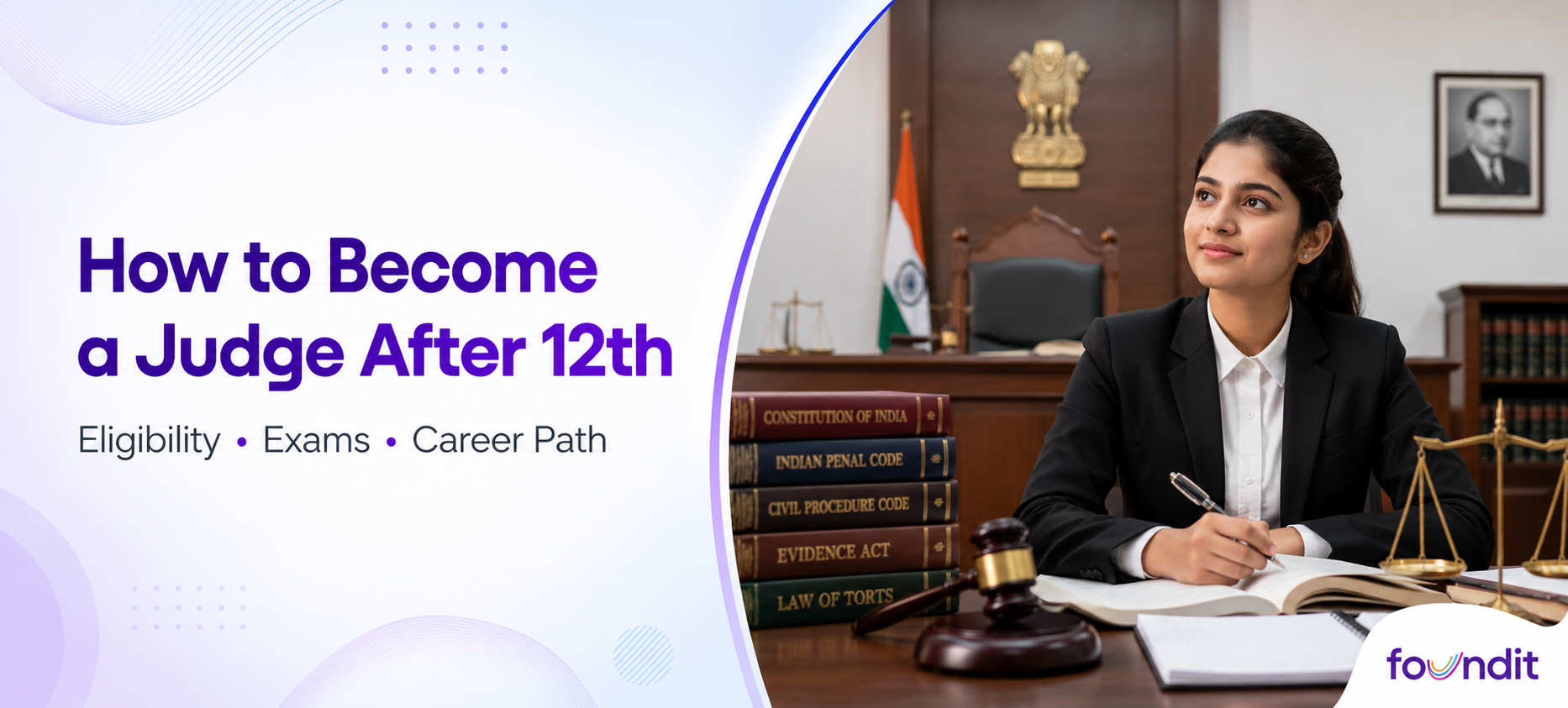
The Indian judiciary continues to expand, improving access to justice across the country. In August 2026, the Lok Sabha passed a Bill increasing the sanctioned strength of the Supreme Court from 34 to 38 judges, including the Chief Justice of India, reflecting the growing need for judicial capacity.
For students interested in law and public service, this development highlights the long-term demand for qualified judicial professionals. While becoming a judge requires years of legal education and experience, the journey begins with choosing the right course after Class 12.
This guide explains how to become a judge after 12th, covering eligibility, law courses, the judicial services examination, salary, career path, and the skills required to become a judge in India.
Eligibility Criteria to Become a Judge in India
The first thing in building a career in judiciary is knowing the eligibility criteria. Having passed Class 12th doesn’t make one eligible for becoming a judge. However, it makes students eligible to take the first step toward their career through a recognised law course.
Having passed the law course, one needs to fulfill the eligibility criteria set out by the respective High Court/Public Service Commission.
| Criteria | Requirement |
| Educational Qualification | LLB or integrated BA LLB/BBA LLB/BCom LLB from a recognised university |
| Minimum Qualification After 12th | Class 12 from a recognised board |
| Age Limit | Generally 21–35 years (varies by state and category) |
| Citizenship | Indian citizen |
| Experience | Fresh graduates eligible for Civil Judge exams in many states; higher judiciary requires legal practice |
| Examination | Judicial Services Examination (State Judiciary Exam) |
Eligibility rules differ slightly across states. Candidates should always verify the latest notification issued by the respective High Court or State Public Service Commission before applying.
Read Also: List of Law Courses after 12th in India
Step-by-Step Process: Judiciary Career Path After 12th
To become a judge, one has to undergo several steps which include legal education, examinations, and judicial training.
Step 1: Complete Class 12
Students from Arts, Commerce, or Science can pursue a judicial career. Any stream is acceptable for admission to law courses.
Step 2: Enrol in a Law Course
Choose either a five-year integrated law programme after Class 12 or a three-year LLB after graduation.
Step 3: Complete Your Law Degree
Develop knowledge of constitutional law, civil law, criminal law, procedural laws, and legal drafting during the programme.
Step 4: Prepare for the Judicial Services Examination
Most states recruit Civil Judges through the judicial services examination consisting of Preliminary, Mains, and Interview stages.
Step 5: Complete Judicial Training
The chosen candidates after appearing in the exam get trained in judicial academies prior to being posted as judges for the first time.
Step 6: Start Your Judicial Career
The majority of candidates start off their careers as Civil Judge (Junior Division) or Judicial Magistrate followed by promotions over time.
Read Also: Company Secretary After 12th: Complete CS Course Guide
Law Courses After 12th to Become a Judge
Picking the right law courses after 12th for judiciary is the cornerstone of a career. The options of pursuing a joint law programme including a bachelor’s degree along with LLB and a three-year LLB programme are available after Class 12.
The choice depends on your educational stage and career goals. Both pathways are recognised for appearing in the judicial services examination, provided the degree is obtained from a recognised institution.
| Course | Duration | Eligibility | Suitable For |
| BA LLB | 5 years | Class 12 from a recognised board | Students interested in law and humanities |
| BBA LLB | 5 years | Class 12 | Students interested in business and corporate law |
| BCom LLB | 5 years | Class 12 | Students planning careers in taxation and commercial law |
| BSc LLB | 5 years | Class 12 with Science | Students interested in science-related legal fields |
| LLB | 3 years | Graduation in any discipline | Graduates changing to a legal career |
Integrated law programmes enable students to get started on their legal education soon after class 12. The integrated programme entails the combination of graduation with professional legal education and takes one year less than if gra’duation was done first.
Whichever course a student opts for, he or she needs to select the one that is accredited by the Bar Council of India (BCI). This is because accreditation of law degree is required for admission as an advocate and also judge eligibility.
Read Also: 15 Jobs AI Cannot Replace: Future-Proof Careers for 2026
Types of Judges in India and Their Roles
There are various types of judges in India’s judiciary system, and each type of judge deals with certain types of cases. Judicial career starts from the subordinate judiciary and then moves up to higher judicial positions through promotions or appointments.
| Type of Judge | Court | Primary Responsibilities |
| Civil Judge (Junior Division) | District Courts | Handles civil disputes of lower pecuniary value |
| Judicial Magistrate | District Courts | Conducts criminal trials and hears criminal cases |
| Civil Judge (Senior Division) | District Courts | Deals with higher-value civil matters |
| District Judge | District & Sessions Court | Supervises district judiciary and hears major civil and criminal cases |
| High Court Judge | High Court | Decides appeals and constitutional matters |
| Supreme Court Judge | Supreme Court of India | Interprets the Constitution and decides matters of national importance |
Most judiciary aspirants begin their careers as Civil Judges or Judicial Magistrates after clearing the judicial services examination. Promotions are based on experience, performance, vacancies, and service rules.
Higher judicial positions involve greater responsibility, including constitutional interpretation, appellate jurisdiction, and supervision of lower courts.
Over time, experienced judges may be elevated to High Courts and, in exceptional cases, to the Supreme Court of India.
Read Also: What are Oratory Skills? Definition, Importance, Strategies to Improve with Examples
What Does a Judge Do? Key Roles and Responsibilities
It is the responsibility of judges to make sure that the law is applied in a just manner without any discrimination and that the individual or organisation has its rights protected.
No matter how much duties differ from one court to another, all judges are supposed to adhere to judicial ethics and remain neutral.
Key responsibilities of a judge include:
- Hearing civil, criminal, constitutional, and family law cases.
- Examining evidence and legal documents presented before the court.
- Interpreting laws and judicial precedents while deciding cases.
- Delivering reasoned judgments based on legal principles.
- Ensuring fair trials and protecting the rights of all parties.
- Managing courtroom proceedings and maintaining order.
- Issuing orders, warrants, injunctions, and other judicial directions.
- Resolving disputes through lawful and unbiased decision-making.
Judges also contribute to the development of legal precedents through their judgments. Their decisions influence future cases and help strengthen the consistency of India’s legal system.
Skills Required to Become a Successful Judge
A successful judicial career depends on more than academic qualifications. Judges must possess strong analytical abilities, integrity, sound legal knowledge, and the ability to make balanced decisions under pressure.
The following skills are essential for aspiring judges:
- Strong understanding of constitutional, civil, and criminal laws.
- Analytical and logical reasoning abilities.
- Excellent legal research and drafting skills.
- Clear written and verbal communication.
- Impartiality and ethical decision-making.
- Attention to detail while examining evidence.
- Time management and case management skills.
- Emotional resilience and patience.
- Problem-solving and critical thinking abilities.
- Confidence in delivering reasoned judgments.
These skills develop through legal education, courtroom exposure, continuous reading of judgments, and practical experience during legal practice or judicial training.
Read Also: Analytical Skills: Meaning, Examples, Resume Tips & How to Improve
Top Law Colleges in India for Judiciary Aspirants
Choosing a reputed law college helps students build a strong academic foundation and prepares them for competitive examinations such as the judicial services examination.
| College | Location | Popular Law Programmes |
| National Law School of India University (NLSIU) | Bengaluru | BA LLB (Hons), LLM |
| National Law University (NLU) Delhi | New Delhi | BA LLB (Hons), LLM |
| NALSAR University of Law | Hyderabad | BA LLB (Hons), LLM |
| The West Bengal National University of Juridical Sciences (WBNUJS) | Kolkata | BA LLB (Hons), LLM |
| Gujarat National Law University (GNLU) | Gandhinagar | BA LLB (Hons), BCom LLB (Hons), LLM |
| Symbiosis Law School | Pune | BA LLB (Hons), BBA LLB (Hons), LLM |
| Jamia Millia Islamia, Faculty of Law | New Delhi | BA LLB (Hons), LLM |
| SOA National Institute of Law | Bhubaneswar | BA LLB (Hons), BBA LLB (Hons), LLM |
| Babasaheb Bhimrao Ambedkar University | Lucknow | BA LLB (Hons), LLM |
| KIIT School of Law | Bhubaneswar | BA LLB (Hons), BBA LLB (Hons), LLM |
In the process of choosing a college, consider factors such as Bar Council of India recognition, faculty, internship programs, moot court facilities, placement assistance, and judiciary preparation facilities. These may help you build up your legal education and move towards your future aim of becoming a judge.
Judge vs Lawyer: Which Career Path is Right for You?
Although judges and lawyers both work within the legal system, their responsibilities and career paths differ significantly. Lawyers represent clients and provide legal advice, while judges hear cases and deliver impartial decisions based on the law.
Many judges begin their careers as lawyers before entering the higher judiciary. However, there is also another way to get into the subordinate judiciary right after graduating from law school by passing the judicial services examination.
| Aspect | Judge | Lawyer |
| Primary Role | Delivers judgments and interprets laws | Represents clients and provides legal advice |
| Appointment | Through Judicial Services Examination or elevation | Enrolment with State Bar Council after LLB |
| Independence | Neutral decision-maker | Represents one party in a dispute |
| Workplace | Courts | Courts, law firms, companies, government offices |
| Main Responsibility | Conducts trials and delivers judgments | Drafts legal documents, argues cases, advises clients |
| Career Progression | Civil Judge → District Judge → High Court → Supreme Court | Advocate → Senior Advocate → Legal Consultant → Judicial appointments (where applicable) |
Students interested in public service, impartial decision-making, and the judiciary may find a judicial career suitable.
Those who find advocacy, client interaction, and legal practice interesting may prefer becoming a lawyer before exploring other opportunities within the legal profession.
Read Also: Top Degree Courses After 12th: Stream wise with Career options
Judge Salary in India: What to Expect at Every Level
Judicial salaries vary according to the level of the court, years of service, and government pay revisions. In addition to basic pay, judges receive various allowances and benefits as per applicable service rules.
| Judicial Position | Approximate Monthly Salary |
| Junior Civil Judge / First Class Magistrate (Entry) | 77,840 – 1,36,520 |
| Senior Civil Judge (Entry) | 1,11,000 – 1,63,030 |
| District Judge (Entry) | 1,44,840 – 1,94,660 |
| High Court Judge | ₹2.25 lakh |
| Supreme Court Judge | ₹2.50 lakh |
* Salary of high court and supreme court judges are subject to statutory judicial pay provisions
Disclaimer: The salary ranges mentioned are approximate and may vary based on factors such as location, company, individual skills, educational background, and market demand. These figures are indicative of entry-level roles and should not be considered guaranteed compensation.
Benefits and Perks of a Judicial Career in India
A judicial career offers professional stability, public responsibility, and opportunities for continuous learning. Besides financial compensation, judges receive several service-related benefits during their tenure.
Some common benefits include:
- Stable government service with structured career progression.
- Competitive salary and applicable allowances.
- Pension and retirement benefits as per service rules.
- Official accommodation or housing benefits, where applicable.
- Medical facilities for eligible officers and dependants.
- Paid leave and other service-related entitlements.
- Opportunities for judicial training and professional development.
- Respect associated with serving the justice system.
Read Also: Top 5 Government Jobs After 12th: Complete Guide 2026
Conclusion
Understanding how to become a judge after 12th begins with selecting the right law course, building legal knowledge, and preparing for the judicial services examination. Consistent learning and practical experience strengthen your foundation.
A judicial career offers the opportunity to uphold the law, resolve disputes, and contribute to the justice system. Understanding judge eligibility criteria in India and the selection process helps you plan each stage with clarity.
Whether you pursue a five-year integrated law programme or another recognised legal pathway, patience and dedication remain essential. With the right preparation, you can work towards a rewarding and respected career in the Indian judiciary.
FAQs
The journey typically takes 6–8 years. Students first complete an LLB degree, enrol with the Bar Council if required, and qualify for the Judicial Services Examination or gain the experience needed for higher judicial posts.
The minimum age generally ranges from 21 to 23 years for entry-level judicial services, while the upper age limit is usually between 35 and 40 years, depending on the state's recruitment rules and reservation policies.
No. An LLM is not mandatory for most judicial service examinations. An LLB degree from a recognised university is the essential qualification, though a postgraduate degree may support academic and career advancement.
A District Judge generally earns between ₹1,44,840 - ₹1,94,660 lakh per month, depending on seniority, state pay structure, and applicable allowances, along with several government benefits and retirement provisions.
Candidates must qualify for the Judicial Services Examination conducted by individual State Public Service Commissions or High Courts. Higher judicial appointments may also require legal practice experience and separate selection procedures.
Yes. A BA LLB degree fulfils the educational requirement for most entry-level judicial service examinations. After graduation, candidates can apply for the Judicial Services Examination if they meet the prescribed eligibility criteria.
Qualifying marks vary across states because each Judicial Services Examination follows its own recruitment rules. Candidates should refer to the official notification issued by the respective High Court or State Public Service Commission.
District Judges are selected either through direct recruitment from experienced advocates or through promotion from the subordinate judiciary. The appointment is made by the Governor in consultation with the concerned High Court.
 Beware of Scammers
