




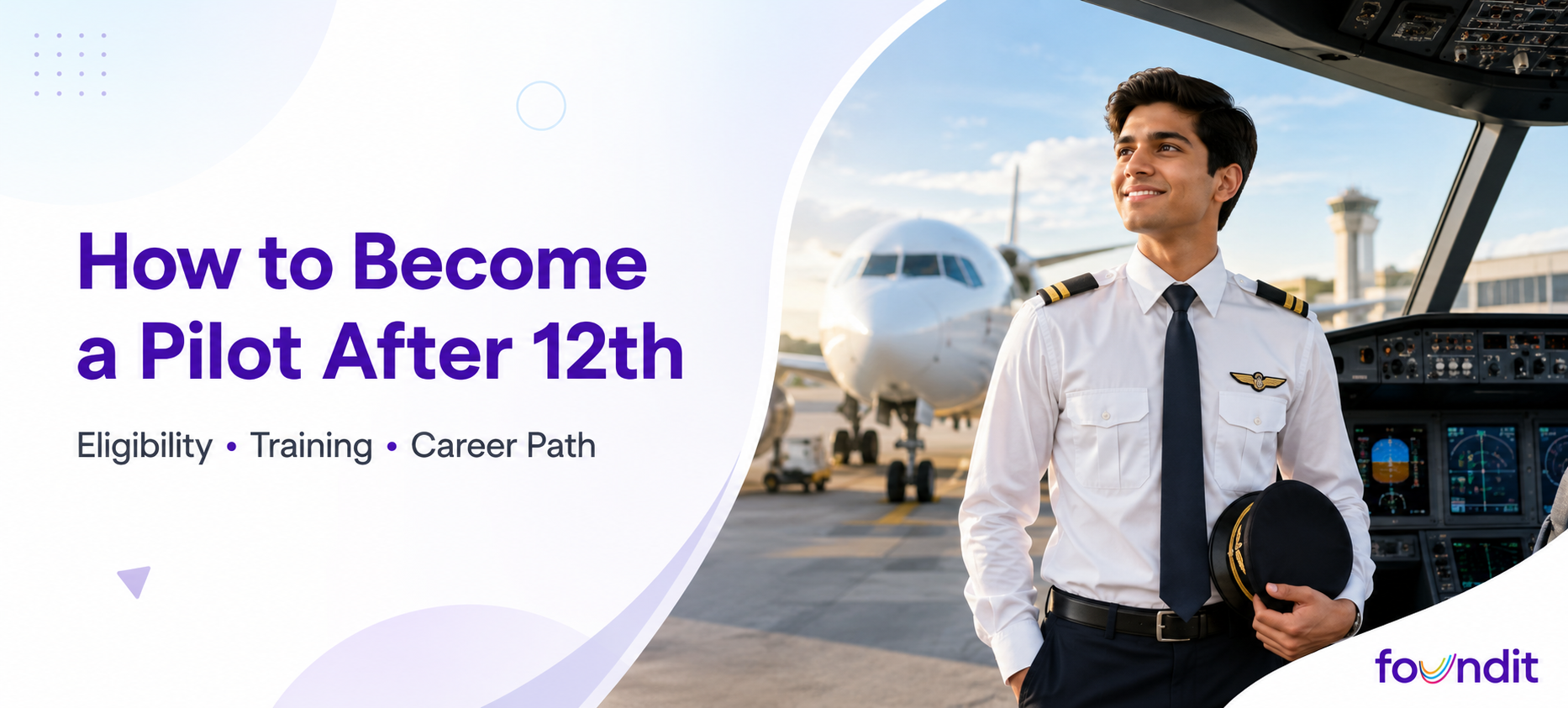
How to become a pilot after 12th is a common question among students who aspire to build a career in aviation. The steps include passing the pilot eligibility criteria after 12th, undergoing flight training and obtaining a Commercial Pilot Licence (CPL).
The Indian aviation industry is expanding at an unprecedented pace with a demand of approximately 35,000 new pilots by 2035. The government is also working to enhance the infrastructure of pilot training that will support this expansion.
Choosing the right commercial pilot course after 12th requires careful planning. Understanding the training pathway, DGCA requirements, and the skills needed for the profession can help students make informed decisions.
This article provides you with the details of how to become a pilot after 12th, the pilot eligibility criteria, the pilot training courses available, the fees for pilot courses, how to get admission to pilot courses after 12th, salary after 12th and career options in the aviation industry.
Pilot Eligibility Criteria in India: What You Need Before Training
The candidate who wants to attend a flying school should fulfil the pilot eligibility criteria prescribed by the Directorate General of Civil Aviation (DGCA) after 12th standard.
By meeting these requirements prior to the application, delays at the time of admission and licence approval can be avoided.
Eligibility requirements
- Age
- Minimum 16 years to apply for a Student Pilot Licence (SPL).
- Minimum 18 years to obtain a Commercial Pilot Licence (CPL).
- There is no prescribed upper age limit for CPL, although airline recruitment policies may differ.
- Educational qualification
- Candidates must have passed Class 12 or equivalent from a recognised board.
- Physics and Mathematics are compulsory subjects.
- A minimum of 50% marks in Physics and Mathematics is generally required for CPL eligibility.
- Can non-PCM students become pilots?
- Yes. Students from Arts or Commerce backgrounds can complete Physics and Mathematics through the National Institute of Open Schooling (NIOS) or another recognised equivalent pathway, subject to DGCA norms.
- This may add around 6–12 months to the overall training timeline.
- Medical fitness
- A Class 2 Medical Certificate is required before starting flight training.
- A Class 1 Medical Certificate is mandatory before obtaining a CPL.
- Medical examinations assess vision, hearing, cardiovascular health, and overall fitness.
- English language proficiency
- Candidates must meet the ICAO English Language Proficiency (ELP) requirement, generally Level 4 or above, for CPL issuance.
- Nationality
- Indian citizens can enrol in DGCA-approved flying schools.
- Foreign nationals and OCI/PIO card holders may also be eligible, subject to visa and DGCA requirements.
Pilot eligibility criteria after 12th at a glance
| Criteria | Requirement |
| Minimum age (SPL) | 16 years |
| Minimum age (CPL) | 18 years |
| Educational qualification | Class 12 with Physics and Mathematics |
| Minimum marks | 50% in Physics and Mathematics (for CPL eligibility) |
| Non-PCM students | Eligible after completing Physics and Mathematics through NIOS or an equivalent recognised pathway |
| Medical requirement | Class 2 Medical (training), Class 1 Medical (CPL) |
| English proficiency | ICAO ELP Level 4 or above |
| Nationality | Indian citizens, OCI/PIO card holders, and eligible foreign nationals |
Read Also: Aviation Courses after 12th: Fee, Duration, Career Prospects
Step-by-Step Process to Become a Pilot After 12th in India
Once you understand the steps to become a pilot after 12th, you can plan your career with confidence.
The process from meeting pilot eligibility criteria (12th) to getting a Commercial Pilot Licence (CPL) typically takes 2-4 years of training depending on weather conditions, flying school and an individual’s training speed.
Step 1: Complete Class 12 with Physics and Mathematics
Pass class 12 from recognised board with Physics & Mathematics. The candidates must have scored around 50% marks in these subjects to qualify for the DGCA CPL requirement India.
Students who are not taking PCM can take these subjects in NIOS or other recognised equivalent prior to application.
Step 2: Obtain DGCA Medical Clearance
Before joining a flying school, obtain a Class 2 Medical Certificate from a DGCA-approved medical examiner. This certifies medical fitness for flight training.
Timeline: Around 1–2 weeks.
Step 3: Register on the DGCA eGCA Portal
Register on the official eGCA Portal and get a DGCA Computer Number. This registration is required for exams, licence applications, and flight record keeping. To prevent delays during the training, do this step early.
Step 4: Join a DGCA-Approved Flying School
Select a Flying Training Organisation (FTO) that is approved by the DGCA. Training at approved institutes only will be recognised for licence requirements.
The overall pilot training cost in India can also be determined by the institute chosen as the cost of pilot training differs depending on the various aircraft fleets, place of the institute, and the facilities provided.
Step 5: Complete Ground School Training
Students are trained for the DGCA theory examination in ground school. Subjects generally include:
- Air Navigation
- Meteorology
- Air Regulations
- Technical General
- Radio Telephony
Duration: Around 6–12 months.
Step 6: Complete Flight Training
The most significant aspect of the commercial pilot course after 12th is practical flying. Students work through the various stages of licences and build up to them over the flight hours.
- Student Pilot Licence (SPL): Student flies solo under supervision.
- Private Pilot Licence (PPL): Gains experience in flying.
- Commercial Pilot Licence (CPL): It requires 200 hours of flying time as per DGCA norms.
- Duration: Around 1–2 years.
Step 7: Clear DGCA Theory Examinations
Theory exams prescribed by DGCA CPL requirements India should be passed out. These are usually navigation, meteorology, air regulations, technical subjects, and radio telephony.
Theory preparation during flight training can help to shorten the total training time.
Step 8: Apply for the Commercial Pilot Licence (CPL)
Once meeting the necessary flying hours, passing all examinations and getting the class 1 medical certificate, candidates are allowed to apply for their Commercial Pilot Licence via eGCA.
Read Also: Cabin Crew Job Description, Key Skills & Salary
Types of Pilot Licences You Can Earn After 12th
Students who want to become a pilot after 12th pass go through the different types of pilot’s licenses before shifting to becoming an airline pilot.
Each licence gives the individual more flying privileges and is a training step towards the next one. The below-mentioned licences are usually completed in order by students enrolled in the commercial pilot course following 12th grade.
| Licence | Purpose | Minimum Requirement |
| Student Pilot Licence (SPL) | Allows supervised solo flight during training | Minimum age of 16 years and Class 2 Medical Certificate |
| Private Pilot Licence (PPL) | Permits non-commercial flying | Around 40 flight hours and successful completion of training requirements |
| Commercial Pilot Licence (CPL) | Allows pilots to fly commercially and earn a salary | Minimum 200 flight hours, Class 1 Medical Certificate, and fulfilment of DGCA CPL requirements India |
| Airline Transport Pilot Licence (ATPL) | Required to serve as the Captain of a commercial aircraft | Minimum 1,500 flight hours and additional DGCA requirements |
Student Pilot Licence (SPL)
Student Pilot Licence (SPL) is the first licence awarded to trainee pilots. It lets students start training for flying and start soloing under supervision after fulfill the minimum age requirement, medical fitness, and other pilot eligibility requirements.
Private Pilot Licence (PPL)
The Private Pilot Licence (PPL) allows pilots to fly aircraft for personal and recreational purposes. In general, it takes about 40 hours of flight time and leads to the attainment of an Commercial Pilot Licence.
Commercial Pilot licence (CPL)
Commercial Pilot Licence (CPL) grants commercial flying and allow pilots to be paid for their work. The candidates who want to get this licence must have at least 200 flying hours, they should have passed the theory exams and satisfy the DGCA CPL requirements India.
Academic Co-ordinator (ATPL)
The highest pilot Licence in India is Airline Transport Pilot Licence (ATPL). It must be accomplished by being the captain of a commercial aircraft and typically involves 1500 flight hours plus other tests and airline experience.
Read Also: Aerospace Engineer Job Description
How Much Does It Cost to Become a Pilot in India After 12th?
The training cost for pilot depends on the flying school, the aircraft used, the training place, and the extra qualifications.
The cost of a commercial pilot course after 12th typically ranges from ₹45 lakh to ₹60 lakh. This usually covers the training required to obtain a Commercial Pilot Licence (CPL). The total cost may be higher if you choose to train abroad or pursue additional ratings and certifications.
Estimated pilot training cost in India
| Training Component | Estimated Cost |
| Ground school training | ₹2 lakh – ₹5 lakh |
| Flight training (Single Engine) | ₹25 lakh – ₹30 lakh |
| Flight training (Multi Engine) | ₹10 lakh – ₹15 lakh |
| Simulator training, DGCA exams and licence fees | ₹3 lakh – ₹5 lakh |
| Estimated total CPL cost in India | ₹45 lakh – ₹60 lakh |
| CPL training abroad (including DGCA conversion) | ₹50 lakh – ₹70 lakh |
| Type Rating (optional) | ₹12 lakh – ₹25 lakh |
| CPL with Type Rating | ₹65 lakh – ₹85 lakh |
Disclaimer: Details are based on available information. Candidates should check the official source for updates.
What is included in the total cost?
The total pilot training cost in India generally covers:
- Ground school and DGCA theory classes
- Flight training and the required flying hours
- Simulator sessions
- DGCA examination and licence fees
- Training on single-engine and multi-engine aircraft
Accommodation, travel, uniforms, medical examinations, and study materials may be charged separately by some flying schools.
Can education loans help?
Education loans for DGCA approved pilot training program can be availed by many banks and financial institutions on eligibility basis.
Prior to applying, candidates should ensure that they compare loan amounts, interest rates, repayment terms, and the list of approved flying schools.
Read Also: Top 5 Government Jobs After 12th: Complete Guide 2026
Pilot Salary in India: From First Officer to Captain
The pilot salary in India per month varies based on the experience, type of Aircrafts, and employer as well as the number of flying hours. New CPL holders typically take on entry-level positions, and seasoned Captains command much higher wages with airlines.
The majority of airlines have a mix of fixed pay, flying hour allowances, and more. The salary of the captain tends to increase as the pilot acquires more experience and shifts from First Officer to becoming a Captain.
Average pilot salary in India
| Experience Level | Approx. Monthly Salary | Approx. Annual Salary |
| Fresh CPL Holder (0–1 year) | ₹30,000 – ₹1.2 lakh | ₹4 lakh – ₹14 lakh |
| Junior First Officer | ₹1.5 lakh – ₹3 lakh | ₹18 lakh – ₹36 lakh |
| Senior First Officer | ₹3 lakh – ₹5 lakh | ₹36 lakh – ₹60 lakh |
| Captain | ₹5 lakh – ₹8 lakh | ₹60 lakh – ₹96 lakh |
| Senior Captain | ₹8 lakh – ₹10 lakh+ | ₹1 crore+ |
Salary across leading airlines
The pilot salary in India per month also varies between airlines, aircraft operated, and the number of flying hours completed.
| Airline | First Officer Salary (Monthly) | Captain Salary (Monthly) |
| IndiGo | ₹2 lakh – ₹3 lakh | ₹6 lakh – ₹9 lakh |
| Air India | ₹2.5 lakh – ₹3.5 lakh | ₹7 lakh – ₹10 lakh |
| Vistara | ₹2 lakh – ₹3 lakh | ₹5.5 lakh – ₹8 lakh |
| Akasa Air | ₹1.8 lakh – ₹2.5 lakh | ₹5 lakh – ₹7.5 lakh |
| SpiceJet | ₹1.5 lakh – ₹2 lakh | ₹4.5 lakh – ₹6.5 lakh |
Disclaimer: The salary ranges mentioned above are approximate and may vary based on factors such as location, company, individual skills, educational background, and market demand. These figures are indicative of entry-level roles and should not be considered guaranteed compensation.
Read Also: Your Career After 12th – Guide and Options
Career Paths After Getting Your CPL: What Comes Next?
Completing a commercial pilot course after 12th and earning a Commercial Pilot Licence (CPL) opens up opportunities across different areas of the aviation industry. The career path chosen depends on individual interests, experience, and long-term career goals.
Commercial Airline Pilot
Most CPL holders start their jobs as a First Officer in domestic airlines like IndiGo, Air India, Akasa Air and SpiceJet. Captains can advance to this position with experience and further flying hours. In addition, it is one of the best pilots’ salary in India per month.
Flight Instructor
A typical role for new pilots is to become a flight instructor. It enables them to prepare aspiring pilots, get valuable flying experience for airline recruitment.
Cargo Pilot
Cargo pilots fly cargo planes rather than planes filled with passengers. Skilled pilots are recruited by companies regularly such as Blue Dart Aviation and SpiceXpress. This job position typically has a steady work routine with stable career advancement.
Charter and Corporate Pilot
Business and charter pilots operate private aircraft for businesses, organisations, and individual customers. These positions may include traveling domestically and internationally and often work flexible hours.
Helicopter Pilot
After acquiring the appropriate qualifications, pilots may specialise in helicopter operations. They can work in emergency medical services, tourism, offshore operations, government agencies, and rescue services.
Indian Air Force Pilot
For those wanting to take up defence aviation, there are two entry methods into the Indian Air Force: NDA and AFCAT. This is a different career path from the DGCA Commercial Pilot career and requires different requirements and training.
Each of these career options offers different responsibilities, work environments, and growth opportunities. Candidates should choose a path based on their interests, career aspirations, and long-term professional goals.
Read Also: Top 9 Jobs for People who Love to travel
Top DGCA-Approved Flying Schools in India to Consider
One crucial step that can be taken in becoming a pilot after 12th is selecting the proper flying school.
The duration of training as well as the cost of pilot training in India can be impacted by the quality of training, the experience of the instructors, availability of aircraft and infrastructure.
It is highly recommended that candidates always check whether the Flying Training Organisation (FTO) is approved by the DGCA before taking admission in a course for a commercial pilot.
Top DGCA-approved flying schools in India
| Flying School | Location | Type |
| Indira Gandhi Rashtriya Uran Akademi (IGRUA) | Amethi, Uttar Pradesh | Government |
| Government Aviation Training Institute (GATI) | Bhubaneswar, Odisha | Government |
| Government Flying Training School (GFTS) | Bengaluru, Karnataka | Government |
| Haryana Institute of Civil Aviation (HICA) | Karnal, Haryana | Government |
| Rajiv Gandhi Academy for Aviation Technology (RGAAT) | Thiruvananthapuram, Kerala | Government |
| Redbird Flight Training Academy | Baramati, Maharashtra | Private |
| FSTC (Flight Simulation Technique Centre) | Gurugram, Haryana | Private |
| Chimes Aviation Academy | Dhana, Madhya Pradesh | Private |
| Ahmedabad Aviation & Aeronautics Ltd. | Ahmedabad, Gujarat | Private |
| Orient Flight School | Puducherry | Private |
Government flying schools
Generally, government-owned flying school institutions will offer lower training fees compared to private flying school institutions. However, seats are limited, and applications are competitive. There may also be entrance tests and/or interviews at some institutes.
Private flying schools
Private Flying Training Organisations (FTOs) often offer more training slots, modern aircraft, and flexible admission schedules. But fees are usually higher and leads to a higher total pilot training cost in India.
Factors to consider before choosing a flying school
Before selecting a flying school, candidates should evaluate:
- DGCA approval status
- Aircraft fleet and maintenance standards
- Instructor experience
- Average CPL completion time
- Ground school and DGCA exam support
- Student-to-instructor ratio
- Training location and weather conditions
- Placement assistance and alumni outcomes
Read Also: Top Courses after 12th Non-Medical in India [High Salary]
Conclusion
How to become a pilot after 12th involves meeting the required educational and medical qualifications, completing flight training at a DGCA-approved flying school, and earning a Commercial Pilot Licence (CPL).
While the journey requires time, commitment, and financial planning, it offers rewarding career opportunities across commercial airlines, cargo aviation, corporate flying, and flight training.
Before enrolling in a commercial pilot course after 12th, candidates should compare flying schools, understand the pilot training cost in India, and verify the latest DGCA guidelines to make an informed career decision.
FAQs
To become a pilot after 12th, candidates must complete Class 12 with Physics and Mathematics, meet the pilot eligibility criteria after 12th, obtain the required DGCA medical certificates, complete flight training at a DGCA-approved flying school, and earn a Commercial Pilot Licence (CPL).
The pilot eligibility criteria after 12th generally include passing Class 12 with Physics and Mathematics, meeting the minimum age requirement, obtaining the required DGCA medical certificates, and demonstrating English language proficiency as prescribed by DGCA.
The estimated training cost for a Commercial Pilot Licence (CPL) in India is between ₹45 lakh to ₹60 lakh, depending on the flying school, the type of aircraft and training facilities.
Typically, it takes 2–4 years to become a pilot after 12th. This time varies depending on the training schedule of the flying school, weather, aircraft availability, and the time spent achieving the necessary flying hours.
Yes. Students who do not have Physics and Mathematics in Class 12 may be eligible by enrolling in these subjects through the National Institute of Open Schooling (NIOS) or any other recognised equivalent method as per the latest guidelines of DGCA
 Beware of Scammers
