






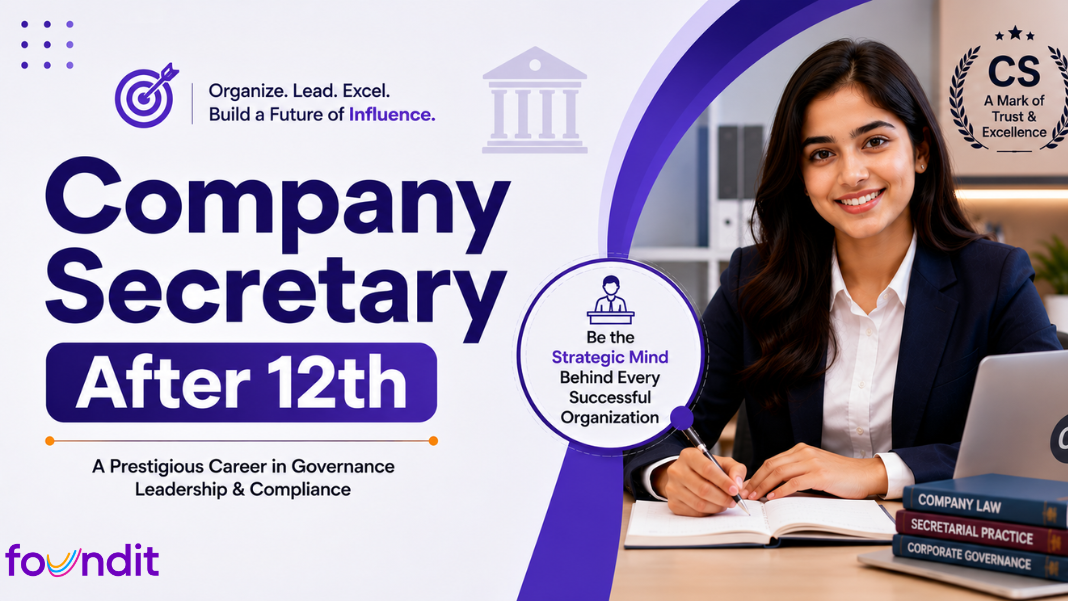
Company Secretary after 12th is a professional career pathway that trains students in corporate law, company regulations, governance practices, and compliance management.
The Company Secretary profession plays an important role in helping organisations operate within legal and regulatory frameworks. The role of a Company Secretary involves ensuring compliance with corporate laws, regulatory requirements, and governance standards.
The profession combines legal, managerial, and administrative responsibilities, making it a suitable option for students interested in corporate affairs and business management.
This CS after 12th guide explains the Company Secretary course, eligibility criteria, registration process, required skills, salary prospects, and career opportunities.
Understanding the CS course structure and professional responsibilities can help students evaluate whether the Company Secretary profession aligns with their career goals.
Who is the Company Secretary?
A company secretary (CS) is an expert tasked with making sure a business complies with all applicable laws and regulations.
In short, they monitor compliance, maintain documentation, and support the board’s decision-making. They act as go-between for management and authorities.
This career path blends corporate operations with legal knowledge. Because of its relevance and structured character, it is seen by many students as one of the best career alternatives.
Why Choose Company Secretary After 12th?
Starting a company secretary after the 12th gives a clear advantage. Students have more time to comprehend ideas and develop their competence.
Since the course is broken into levels, learning is logical and progressive. This aids in laying on a solid basis for long-term professional advancement.
It is also one of the recognised professional courses in India. The qualifications are widely accepted across industries.
Read Also: Courses After 12th Commerce
Company Secretary Eligibility
The following outlines the eligibility criteria for pursuing a career as a Company Secretary after 12th.
- Students must complete 12th from a recognised board.
- All streams are allowed, including Commerce, Science, and Arts.
- There is no strict minimum percentage requirement.
This flexible qualification criteria makes it easier compared to many competitive exams in India pathways.
Company Secretary Course Details
After the 12th grade, there is a defined, continuous path for the corporate secretary course. Each level gradually increases one’s understanding of the law, business, and compliance.
Stages of Company Secretary courses
| Level | Stage | Eligibility |
| Level 1 | CSEET (Entrance Test) | Students who have completed 12th from any stream except Fine Arts |
| Level 2 | CS Executive Programme | Candidates who have cleared CSEET or completed graduation |
| Level 3 | CS Professional Programme | Candidates who have successfully cleared the Executive Programme |
CSEET (Company Secretary Executive Entrance Test) – Entry Level
This is the starting point for CS after Class 12. It helps you get comfortable with basic concepts before moving tougher subjects.
The preparation process typically takes four months. There is no need to hurry at this point because the emphasis is on grasping the fundamentals.
- Eligibility: After Class 12, students from most streams aside from fine arts may apply. It is therefore accessible to many students.
- Exam frequency: There is some flexibility because the exam is given multiple times a year. You still have another chance if things do not go as planned.
- Subjects covered: Subjects include business communication, basic law, economic environment, and simple aptitude. These are introductory topics meant to build your foundation.
- The main goal here is to make you comfortable with the subject. Once this base is clear, the next level feels easier.
CS Executive Programme – Intermediate Level
After clearing CSEET, you move to the Executive level. This is where things become more detailed and serious.
It usually takes about nine months to prepare properly. The syllabus is wider, so regular study becomes important.
- Eligibility: You need to clear CSEET to enter this level. Some graduates can directly start from here, which saves time.
- Subjects covered: You will study company law, accounting, taxation, and other business laws. These subjects help you understand how companies’ function.
- Learning focus: The focus is not just on reading but on understanding and applying concepts. You start connecting the theory with practical situations.
- Exam pattern: Exams at this stage check both your knowledge and how well you can use them. Regular revision helps a lot here.
CS Professional Programme – Final Level
This final phase of the course concentrates on more complex subjects.
- Duration: The preparation process takes ten months, but it requires more work than previous levels.
- Eligibility: You must have a solid foundation by the time you begin at this stage, which is only possible after passing the executive level.
- Subjects covered: Subjects include governance, compliance, restructuring, and strategic finance. These are areas used in real work situations.
- Learning focus: Practical comprehension is the main emphasis. You gain experience making judgements and managing actual business problems.
- Outcome: You can start working for firms or establish your own practice after passing this level and finishing your training.
Registration Process
The registration process for company secretary after 12th is simple and done online. The ICSI (Institute of Company Secretaries of India) website is where students must register. This involves creating an account, providing personal data, and uploading files.
Once the form is submitted and the fee is paid, registration is verified. Students can then sit for the CSEET exam. It is essential to regularly monitor official updates because timeframes and specifications are susceptible to change.
Duration of Company Secretary Course
The CS course follows a structured timeline based on various stages. In most cases, the course takes around three to four years if exams are cleared without delays. This includes completing all levels and training.
However, because of the difficulty of exams or the requirement for revision, many students take four to five years. This is a typical and necessary component of learning. Completing the course in two years is not feasible. Each step calls for careful planning and comprehension.
| CS Course | Approximate Duration |
| CSEET | 4 to 6 months |
| CS Executive Programme | 9 to 12 months |
| CS Professional Programme | 10 to 12 months |
| Practical Training | 21 months |
| Total Course Duration | Around 3 to 5 years |
Subjects Covered in CS Course
The course includes a mix of law, finance, and management topics. Students study company law, tax law, governance, and auditing. These subjects form part of structured education courses in India.
At first, the syllabus may feel detailed and slightly overwhelming. There is a lot to cover, and it can take time to adjust. Over time, with regular study and consistent practice, it becomes more manageable. Concepts start to connect, and the overall learning process feels much easier.
Skills Required to Become a Company Secretary
The abilities required to become a corporate secretary are acquired through systematic learning and practical experience throughout time. Even small mistakes can lead to issues later. Every document must be carefully examined by a company secretary to ensure accuracy.
The role necessitates regular communication with management, stakeholders, and regulators. Clear and direct communication is essential for effective legal explanation. Here are some other skills you must focus on and try improving them with time.
- Critical Thinking: Understanding rules and regulations is one of the most crucial parts of the job. Strong cognitive skills facilitate their appropriate application in a variety of situations.
- Time management: A corporate secretary frequently manages several projects with due dates. Effective planning guarantees that all tasks are finished on schedule.
- Legal Knowledge: It is crucial to have a solid grasp of corporate law. Through research and real-world experience, this knowledge grows over time.
- Organisational Skills: Managing numerous documents and records is a requirement for the position. Maintaining organisation facilitates information access and helps prevent mistakes.
Job Roles of a Company Secretary
After 12th grade, a company secretary may consider a variety of positions based on their experience.
These CS job roles involve handling company records, legal duties, compliance work, and business operations efficiently.
- Compliance Officer: A compliance officer makes sure the business complies with all applicable laws and regulations. This involves keeping track of filings and ensuring that nothing is overlooked.
- Corporate Governance Advisor: This position helps the board adhere to appropriate governance procedures. It aids in bringing corporate policies into compliance with moral and legal requirements.
- Legal Advisor: A legal advisor advises the business on legal issues, paperwork, and risks. This aids the company in making wise and secure judgements.
- Company Secretary in Companies: A business secretary oversees meetings, maintains firm records, and makes sure the law is followed. Additionally, they serve as a channel between the business and authorities.
- Corporate Consultant: A corporate consultant offers businesses advice on how to enhance their compliance and governance procedures. Building robust and legal systems is the main goal.
- Secretarial Auditor: To ensure legal conformity, a secretarial auditor examines business documents and procedures. This promotes transparency and helps find shortcomings.
Salary Structure of Company Secretary
Experience, company size, and skill level all affect a company secretary’s salary. In fact, pay increases gradually as duties rise.
| Experience Level | Monthly Salary (Approx) | Annual Salary (Approx) |
| Fresher (0–2 years) | ₹25,000 – ₹50,000 | ₹3 lakh – ₹6 lakh |
| Mid-Level (3–7 years) | ₹50,000 – ₹1,20,000 | ₹6 lakh – ₹14 lakh |
| Senior Level (8+ years) | ₹1,50,000+ | ₹18 lakh+ |
Disclaimer: The salary ranges mentioned above are approximate and may vary based on factors such as location, company, individual skills, educational background, and market demand. These figures are indicative of entry-level roles and should not be considered guaranteed compensation.
Job Opportunities and Industry Demand
The demand for company secretary remains steady across industries. Companies need compliance support, which creates consistent industry demand.
This applies to corporate firms, financial institutions, and consulting organisations. In practice, this ensures stable job opportunities over time.
Career Growth and Future Scope
The career scope of a Company Secretary is structured and progressive. With experience, professionals move into senior roles such as compliance heads or corporate advisors.
Growth depends on skills and performance. There are strong future opportunities as businesses expand, and regulations evolve.
Real-World Example
A company secretary after 12th career becomes clearer with a practical example. When a company expands operations, the Company Secretary ensures approvals, filings, and compliance are completed correctly.
Without this, companies may face penalties. This shows how important the role is in managing business operations.
Is Company Secretary a Good Career After 12th?
For those interested in business and law, becoming a company secretary is a career choice. It adheres to an organised curriculum that gradually advances knowledge.
The position is crucial to businesses since it deals with governance, legal matters, and compliance. This creates steady demand across different industries.
Career growth is gradual but stable. With experience, professionals can move into senior roles or advisory positions. Some also choose to work independently or as consultants. Over time, it can become one of the high salary jobs.
The course requires regular study and consistency. Maintaining discipline is crucial because the tests are thorough. Given the circumstances, it is a solid career option for students who are prepared to work hard and get significant skills.
Common Challenges in CS Course
There are several difficulties with the course. The syllabus is broad and extensive, which may seem difficult at first. Students require time to adapt.
Exams are more concerned with understanding than memorisation. This requires a different study approach. Time management can also be difficult, especially with other commitments.
With consistency, these challenges become manageable.
Tips to Succeed in CS After 12th
Success as a company secretary after the 12th grade requires a steady approach and good habits.
Start Early and Remain Consistent
It will have enough time to properly understand each subject if you start early. It also reduces last-minute exam-related stress.
Regular study sessions, even for brief periods of time, eventually provide superior outcomes. Over time, consistency fosters the development of a solid understanding.
Focus on Concepts and Sample Papers
It is simpler to apply knowledge in tests when you concentrate on learning concepts. It is more beneficial than depending solely on memorisation.
Completing previous assignments and mock tests helps improve accuracy and speed. It also builds confidence and prepares students for the exam pattern.
Manage Time and Review Frequently
Consistent review helps ensure that important ideas are kept throughout time. It also improves clarity and reduces confusion.
Creating a study plan makes covering every subject easier and less stressful. Additionally, it promotes a proper balance between study and revision.
CS Vs CA: Which is Better?
Students often compare CS vs CA, which is better after 12th while planning a career planning guide. Both are recognised professions but focus on different areas.
Here is a simple comparison to understand the difference clearly:
| Basis | Company Secretary (CS) | Chartered Accountant (CA) |
| Core Focus | Corporate law and compliance | Accounting and finance |
| Work Area | Governance, legal filings, board support | Auditing, taxation, financial reporting |
| Course Structure | CSEET → Executive → Professional | Foundation → Intermediate → Final |
| Skill Requirement | Legal understanding, communication | Numerical ability, analytical skills |
| Work Environment | Corporate firms, legal departments | Audit firms, finance departments |
| Career Direction | Compliance and advisory roles | Finance and accounting roles |
In simple terms, students interested in law, governance, and corporate structure may prefer CS. Those inclined towards numbers and finance may find CA (Chartered Accountant) more suitable.
Read Also: Basics of Accounting: Terminology, Concepts, Importance, and Tips
Conclusion
Company Secretary after 12th offers a clear and structured career path for students interested in corporate law and compliance. It begins with simple eligibility and progress through defined stages of learning and training.
In practice, this career provides stability and long-term growth. It is not just about clearing exams but understanding how companies operate within legal frameworks.
Given the circumstances, it is a solid option in any career planning guide. It can result in worthwhile and secure career prospects with the correct strategy and persistent work.
FAQs
Yes, students can start after completing 12th from any stream.
CS in India can earn around ₹50,000 to ₹150,000 per month, depending on experience, location, and company size.
Both are different. CS focuses on law; CA focuses on finance.
Yes, students can register for the entrance exam.
CS is more specialised and focuses on corporate law, compliance, and governance, while MBA is broader and focuses on management, business, and leadership roles. The better option depends on individual career goals.
No, the course usually takes at least 3–4 years.
The company secretary is usually appointed by the Board of Directors of the company. The appointment is made through a board resolution in accordance with the provisions of the Companies Act.
 Beware of Scammers
