




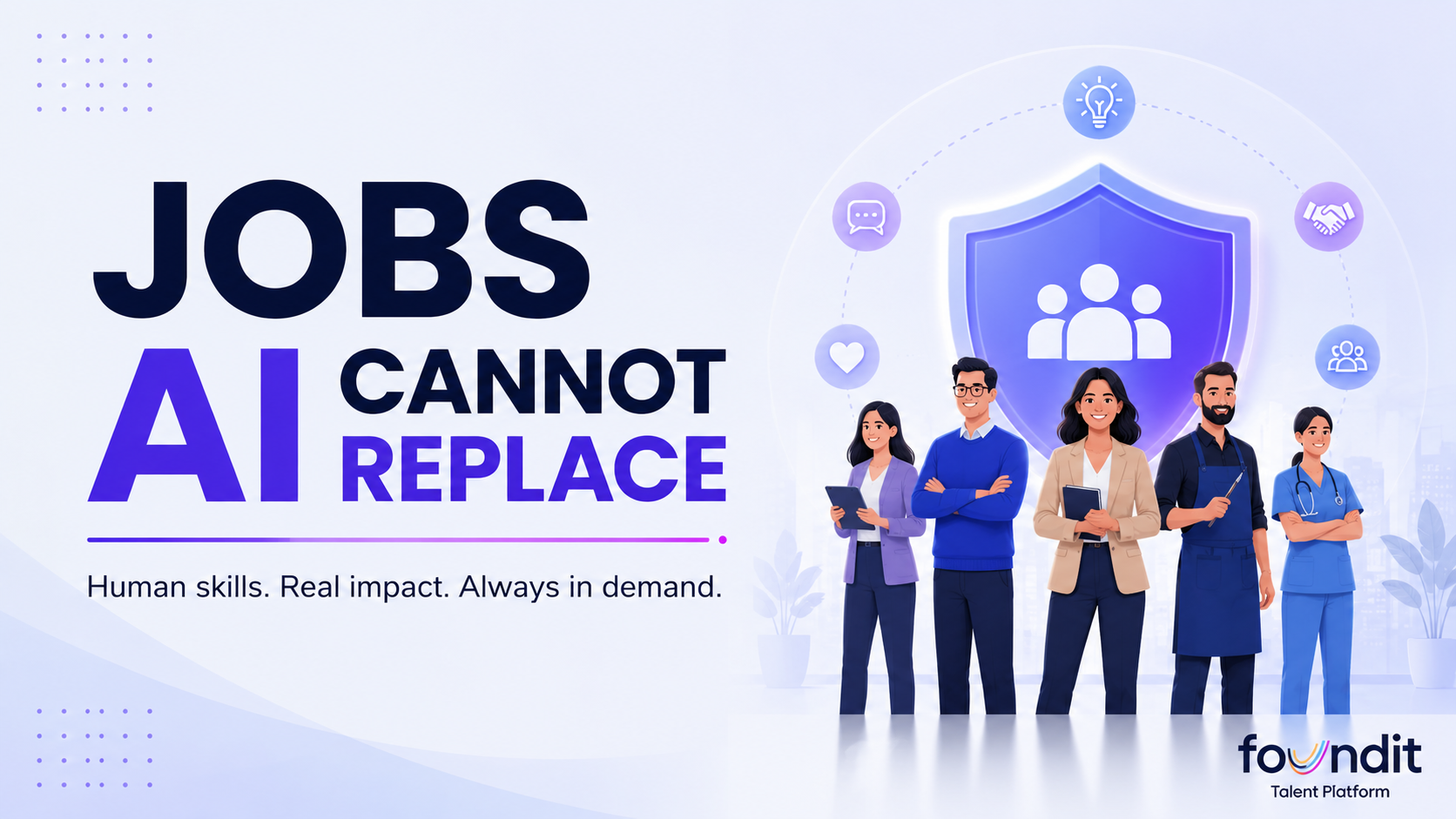
Jobs AI cannot replace easily tend to involve responsibilities that demand human judgement, direct care, unpredictable physical work, interpersonal relationships or professional accountability. Nurses, teachers, electricians and emergency responders are examples of careers where automating individual tasks is different from replacing the complete occupation.
According to the World Economic Forum’s Future of Jobs Report 2025, global labour-market changes could create 170 million jobs and displace 92 million by 2030, producing a projected net increase of 78 million jobs. These figures reflect technological, demographic, economic and other changes, not the effects of AI alone.
The International Labour Organization’s 2025 occupational exposure study estimates that approximately one in four workers worldwide are employed in occupations with some exposure to generative AI. Its findings indicate that transformation of jobs is more likely than complete replacement in many occupations, although exposure varies considerably across roles.
This article examines 15 careers that may be more resilient to AI-driven automation in 2026, explaining which responsibilities are harder to automate, how AI can support each profession and which skills job seekers in India can develop. No career is guaranteed to remain unaffected by technological change, so the focus is on relative resilience rather than permanent immunity to AI.
Jobs AI Cannot Replace: Key Highlights
- Career examples: Nursing, mental health care, teaching, cybersecurity, skilled trades, emergency response, law, scientific research and management.
- Why some jobs are harder to automate: They involve physical interaction, complex judgement, trust, safety responsibilities or decisions under uncertainty.
- AI exposure: ILO research estimates that around one-quarter of global employment involves occupations with some generative AI exposure, but this does not mean one-quarter of jobs will disappear.
- Human skills that matter: Critical thinking, communication, emotional intelligence, ethical decision-making, adaptability and hands-on expertise.
- Career strategy: Choose roles based on qualifications, labour-market demand and personal strengths, while learning to use relevant AI tools responsibly.
Why Are Some Jobs Harder for AI to Replace?
The likelihood of AI affecting a profession depends on the tasks performed within it, the available technology and the practical conditions of implementation. A job can include automatable activities while still requiring human expertise for its most consequential responsibilities. Four characteristics help explain why some occupations are harder to automate completely.
1. Emotional Intelligence and Human Relationships
Healthcare workers, counsellors, teachers and social workers frequently respond to people’s individual needs. Their work involves building trust, recognising changes in behaviour, managing sensitive information and adjusting support to circumstances that may not be fully captured in a digital record.
For example, a counsellor may need to evaluate a client’s emotional response, assess whether additional clinical support is necessary and adapt treatment within professional guidelines. AI may assist with documentation or general information, but human practitioners retain responsibility for appropriate care.
2. Practical Skills in Unpredictable Physical Environments
Electricians, plumbers, mechanics and emergency responders often work in locations where equipment, access, hazards and physical conditions vary. Repairing an electrical fault in an older building or responding to a damaged vehicle requires practical inspection, tool handling and immediate safety assessment.
Robotics, sensors and automated diagnostics can assist with specific tasks, particularly in controlled environments. However, reliably replacing all the physical and decision-making responsibilities of these occupations across varied real-world conditions is a substantially different challenge.
3. Ethical Judgement, Safety and Professional Accountability
Doctors, lawyers, senior managers and other regulated professionals make decisions that affect health, legal rights, financial interests and public safety. AI can help analyse information and identify possible options, but its outputs require evaluation against evidence, professional standards and applicable regulations.
For these occupations, the question is not simply whether AI can produce an answer. It is whether the proposed action is appropriate, who is authorised to make the decision and who remains responsible for the consequences.
4. Creative Direction and Strategic Problem-Solving
AI can produce drafts, designs, software code and possible business solutions. However, creative directors, researchers, product managers and organisational leaders must also identify the underlying problem, evaluate competing priorities and decide whether a proposed solution is useful, accurate and appropriate for its audience.
These responsibilities involve context, domain knowledge, experimentation and accountability. AI may considerably change how professionals perform them without making the entire occupation unnecessary.
15 Jobs AI Cannot Replace Easily and Why
The following 15 career areas involve responsibilities that are difficult to automate completely with current AI systems. They are not guaranteed protection against job losses, and their relative resilience can change as AI and robotics develop. The important distinction is between automating individual tasks and replacing an entire occupation.
1. Nurses and Frontline Healthcare Workers
Nurses and frontline healthcare professionals provide direct patient care, monitor health conditions, administer prescribed treatments and coordinate with medical teams. Their responsibilities combine clinical knowledge, physical procedures, communication and responses to changing patient needs.
Why AI cannot easily replace the role: Nursing involves physical examination, recognising changes in patient condition, responding to emergencies and making decisions within professional responsibilities. Patients also need reassurance, explanation and support that depend on the circumstances of their care.
How AI can help: AI-assisted systems may support clinical documentation, patient monitoring, scheduling and the identification of patterns in medical records. Nurses remain responsible for checking relevant information and delivering appropriate care.
Skills to develop: Clinical assessment, patient communication, emergency response, infection prevention, digital health literacy and interdisciplinary teamwork. Nursing careers in India require the applicable recognised qualifications and professional registration.
2. Therapists, Counsellors and Mental Health Professionals
Mental health professionals help individuals manage psychological, emotional and behavioural difficulties. Depending on their qualifications, their work may include assessment, counselling, psychotherapy, crisis intervention and coordination with other healthcare or social support services.
Why AI cannot easily replace the role: Therapeutic relationships depend on trust, confidentiality, continuity of care and professional judgement. Practitioners must interpret individual circumstances, recognise warning signs and determine when intervention, referral or additional support is necessary.
How AI can help: Digital tools can assist with appointment management, clinical administration and access to general educational resources. AI-generated advice should not be treated as equivalent to assessment or treatment by an appropriately qualified professional.
Skills to develop: Active listening, evidence-based counselling approaches, ethical decision-making, cultural awareness, safeguarding and crisis assessment. Eligibility for clinical and other regulated mental health roles depends on the applicable professional requirements.
3. Teachers and Early Childhood Educators
Teachers explain concepts, plan lessons, evaluate student learning and manage classroom activities. Early childhood educators also support language development, social interaction and foundational skills through supervised activities and age-appropriate learning experiences.
Why AI cannot easily replace the role: Teaching requires educators to recognise individual learning needs, respond to behavioural and emotional difficulties, maintain safe classrooms and communicate with parents or guardians. Effective instruction involves adapting lessons to real student responses rather than merely delivering information.
How AI can help: AI tools can support lesson planning, practice-question generation, differentiated learning materials and administrative tasks. Teachers still need to verify accuracy, assess learning and decide how technology should be used with students.
Skills to develop: Subject expertise, inclusive teaching, classroom management, student assessment, communication and educational technology. Teaching appointments in India may require prescribed teacher education qualifications and eligibility examinations.
4. Cybersecurity Professionals
Cybersecurity professionals protect networks, applications, cloud environments and sensitive information. Roles include security analyst, incident responder, security engineer, penetration tester and security architect, each with different responsibilities.
Why AI cannot easily replace the role: Cybersecurity threats change as attackers adapt their methods. Investigating an incident can require understanding interconnected systems, distinguishing false alerts from real attacks, coordinating with stakeholders and making decisions about operational, financial and legal risks.
How AI can help: AI-enabled security platforms can correlate alerts, detect suspicious patterns, summarise investigation data and automate selected response tasks. Human specialists are still needed to validate findings, decide on containment measures and manage complex incidents.
Skills to develop: Network security, cloud security, incident response, threat modelling, security automation, scripting and risk communication. AI-assisted threat detection is increasingly relevant, but professionals also need strong security fundamentals.
5. Product Managers and UX Designers
Product managers identify customer problems, prioritise product improvements and coordinate development across design, engineering and business teams. User experience (UX) designers research user behaviour, design interactions, test prototypes and improve product usability.
Why AI cannot easily replace these roles: Product and design decisions involve trade-offs between user needs, technical constraints, business goals, accessibility and available resources. Professionals must interpret research in context, evaluate competing solutions and take responsibility for product decisions.
How AI can help: AI tools can accelerate research synthesis, initial wireframes, prototype exploration, documentation and analysis of feedback. However, AI-generated insights must be checked against actual user evidence and product requirements.
Skills to develop: User research, product strategy, usability testing, interaction design, accessibility, data interpretation and stakeholder communication. A portfolio demonstrating research and decision-making can help candidates show practical capabilities.
6. Software Architects and DevOps Engineers
Software architects design the structure of applications and technology platforms. DevOps engineers work on software deployment, infrastructure, monitoring, automation and operational reliability. Both roles require an understanding of how technical systems behave in production environments.
Why AI cannot easily replace these roles: Complex software systems involve dependencies, performance constraints, security risks and operational decisions that extend beyond writing code. Engineers must investigate failures, evaluate architecture choices and understand their effects on users and business operations.
How AI can help: AI coding assistants can generate scripts, suggest infrastructure configurations, explain logs and support troubleshooting. Engineers remain responsible for reviewing generated outputs, testing changes and protecting system reliability and security.
Skills to develop: Distributed systems, software architecture, cloud platforms, CI/CD, infrastructure as code, observability, security engineering and incident response. Routine coding and operational tasks may become more automated, making architecture and reliability expertise particularly relevant.
7. AI Engineers and Machine Learning Specialists
AI engineers and machine learning specialists develop, integrate, test and maintain systems that use artificial intelligence. Their responsibilities can include preparing training data, selecting models, designing evaluations, deploying applications and monitoring model behaviour after release.
Why AI cannot easily replace these roles: AI projects require decisions about data quality, model suitability, reliability, security, costs and acceptable risk. Professionals must also investigate failures, evaluate real-world performance and determine whether an AI system meets its intended purpose.
How AI can help: AI-assisted development can generate code, suggest experiments, support data analysis and create initial test cases. These capabilities also automate parts of AI engineering itself, so the profession is not immune to technological change.
Skills to develop: Python, statistics, machine learning fundamentals, data engineering, model evaluation, MLOps, system integration and responsible AI. Prompt design is useful, but broader engineering and domain knowledge provide a more substantial technical foundation.
8. Creative Directors, Content Strategists and Authors
Creative directors establish the overall direction of campaigns, branding and other creative work. Content strategists research audience needs and plan how information should be developed, organised and evaluated. Authors create narratives, analysis and other original material for readers.
Why AI cannot easily replace these roles: Creative leadership depends on interpreting an audience, selecting a meaningful perspective, evaluating cultural and business context, and making editorial decisions. Professionals must also manage factual accuracy, intellectual property considerations and the quality of published work.
How AI can help: Generative AI can support research organisation, brainstorming, draft development, visual exploration and routine production. It may also reduce demand for certain standardised creative tasks, making higher-level strategy and original judgement more important.
Skills to develop: Audience research, storytelling, creative direction, editorial judgement, brand strategy, fact-checking and AI-assisted production. Candidates should be able to demonstrate the decisions and research behind their finished work.
9. Senior Leaders, Managers and Business Founders
Senior leaders and managers set organisational priorities, allocate resources, manage teams and make decisions affecting employees, customers and business operations. Founders also take responsibility for building products or services, managing financial risks and establishing business relationships.
Why AI cannot easily replace these roles: Leadership involves making decisions under uncertainty, negotiating conflicting interests and accepting accountability for outcomes. Managers must understand organisational culture, employee concerns and the practical consequences of strategic decisions.
How AI can help: AI tools can assist with reporting, forecasting, scenario analysis, meeting preparation and operational planning. They can also automate some coordination tasks, but leaders remain responsible for decisions and their implementation.
Skills to develop: Strategic planning, financial literacy, negotiation, communication, people management, change management and ethical decision-making. These responsibilities generally require experience and should not be treated as entry-level career pathways.
10. Electricians, Plumbers and Skilled Mechanics
Electricians install and maintain electrical systems. Plumbers work on water supply, drainage and related infrastructure, while mechanics diagnose and repair vehicles or industrial equipment. Their work combines technical knowledge with physical inspection and practical problem-solving.
Why AI cannot easily replace these roles: Repair sites vary in layout, equipment, accessibility and safety conditions. Workers must identify unexpected faults, use tools in confined or difficult spaces and adapt procedures to the actual condition of installations and machinery.
How AI can help: Diagnostic software, sensors, predictive maintenance systems and AI-assisted troubleshooting can help identify faults or recommend maintenance procedures. These systems do not automatically perform every physical inspection, installation or repair.
Skills to develop: Trade-specific technical knowledge, fault diagnosis, safety procedures, equipment maintenance and digital diagnostic tools. In India, relevant ITI courses, apprenticeships and recognised vocational training can provide entry routes, depending on the trade.
11. Medical Specialists and Surgeons
Medical specialists diagnose and manage conditions within their areas of expertise. Surgeons perform procedures involving clinical assessment, technical precision, patient communication and monitoring before and after treatment.
Why AI cannot easily replace these roles: Medical care requires evaluation of individual symptoms, examination findings, treatment risks and unexpected complications. Surgical practice also involves physical procedures, immediate responses to changing conditions and professional responsibility for patient safety.
How AI can help: AI-assisted systems can support medical imaging, clinical documentation, surgical planning and analysis of patient information. Robotic systems can assist trained surgeons with certain procedures, but robotic assistance should not be confused with fully autonomous medical care.
Skills to develop: Clinical reasoning, procedural expertise, patient communication, medical ethics and relevant digital health technologies. Medical practice in India requires prescribed recognised qualifications and professional registration, with additional qualifications for specialist roles.
12. Firefighters, Paramedics and Emergency Responders
Firefighters and paramedics respond to emergencies involving fires, accidents, injuries and other threats to public safety. Their responsibilities involve assessing immediate risks, assisting affected people, coordinating with emergency services and carrying out practical interventions.
Why AI cannot easily replace these roles: Emergency environments are unpredictable. Responders must operate around damaged infrastructure, uncertain hazards, restricted access and changing information while making rapid decisions that affect human safety.
How AI can help: AI-enabled systems can assist with incident mapping, emergency call prioritisation, resource allocation and hazard analysis. Drones and robotics may support surveillance or search operations, but human responders remain necessary for many rescue and treatment tasks.
Skills to develop: Emergency assessment, first aid or advanced life support as required, rescue procedures, hazard management, crisis communication and teamwork. Formal training, physical standards and professional requirements depend on the particular role.
13. Scientific Researchers and Strategic Data Scientists
Scientific researchers investigate questions through observation, experimentation and analysis. Strategic data scientists combine statistics, programming and domain knowledge to understand complex problems and support decisions in areas such as healthcare, finance, engineering and public policy.
Why AI cannot easily replace these roles: Research involves identifying useful questions, designing appropriate methods, judging evidence quality and recognising limitations. Data scientists must determine whether analytical results reflect the real-world problem and whether conclusions are reliable enough to support action.
How AI can help: AI systems can accelerate literature searches, coding, data preparation, simulation and hypothesis generation. They may also automate routine analytical work, increasing the importance of research design, interpretation and independent validation.
Skills to develop: Statistics, research methodology, experimental design, programming, data ethics, domain knowledge and critical evaluation. Advanced research positions often require specialised postgraduate or doctoral qualifications, depending on the field.
14. Lawyers and Legal Professionals
Lawyers interpret legislation, advise clients, prepare legal arguments, negotiate disputes and represent individuals or organisations where authorised. Legal careers cover areas such as litigation, corporate law, employment law, intellectual property and regulatory compliance.
Why AI cannot easily replace these roles: Legal work requires applying rules to individual circumstances, assessing evidence, explaining risks and acting within professional obligations. Negotiation, advocacy and client representation also involve relationships, strategy and accountability.
How AI can help: Legal AI tools can assist with document searches, contract analysis, case summarisation and initial drafting. However, generated material can misstate legal provisions or invent authorities, so independent verification remains essential.
Skills to develop: Legal research, statutory interpretation, drafting, negotiation, advocacy, client counselling and legal technology. Practising law in India requires meeting the relevant educational, enrolment and professional eligibility requirements.
15. HR Specialists, Employee Relations Professionals and Community Organisers
Human resources specialists work on recruitment, employee relations, workplace policies, performance processes and learning and development. Community organisers coordinate people, resources and activities around shared social, institutional or local needs.
Why AI cannot easily replace these roles: Employee disputes, workplace complaints and community concerns require an understanding of individual circumstances, confidentiality, fairness and organisational responsibilities. Managing relationships and resolving sensitive situations involves judgement beyond routine administrative processing.
How AI can help: AI can automate parts of recruitment administration, scheduling, employee surveys, reporting and training-content development. Sensitive employment decisions and cases involving discrimination, privacy or legal compliance require appropriate human oversight.
Skills to develop: Conflict resolution, employment law awareness, communication, employee relations, stakeholder management, mediation and ethical decision-making. Entry requirements vary, with some professional positions favouring relevant HR, management, psychology or social work qualifications.
What these careers have in common: They combine specialised knowledge with responsibilities involving safety, trust, contextual decisions, physical work or accountability. Their resilience is relative rather than permanent. Professionals should expect some tasks to change through AI adoption and continue developing capabilities relevant to their occupation.
7 Human Skills That Make Careers More Resistant to AI
Career resilience depends not only on choosing a profession but also on developing capabilities that remain useful as technology changes how work is performed. Skills involving judgement, relationships, creativity and practical expertise can complement AI tools across different occupations.
The World Economic Forum’s Future of Jobs Report 2025 identifies analytical thinking as a leading core skill among surveyed employers. It also highlights resilience, flexibility, leadership and creative thinking. These findings reflect employer expectations rather than a guarantee that individual skills or occupations will remain unaffected by automation.
1. Critical Thinking and Complex Problem-Solving
Critical thinking involves examining evidence, challenging assumptions and deciding whether information is reliable enough to support action. It becomes particularly important when AI-generated outputs are incomplete, contradictory or incorrect.
For example, a cybersecurity analyst investigating suspicious activity must distinguish genuine threats from false alerts. An AI system may identify unusual patterns, but the analyst must evaluate their significance, investigate the affected systems and determine an appropriate response.
How to develop it: Practise analysing case studies, evaluating competing explanations, checking source reliability and documenting the reasons behind important decisions.
2. Emotional Intelligence and Empathy
Emotional intelligence includes recognising emotional cues, understanding different perspectives and responding appropriately during interpersonal situations. It supports healthcare, education, counselling, management and customer-facing responsibilities.
A teacher supporting a struggling student or a manager responding to an employee’s concerns must consider context, communication and the continuing relationship. AI may help organise relevant information, but interpersonal decisions still require care and judgement.
How to develop it: Practise active listening, seek constructive feedback, improve conflict-resolution skills and reflect on how different communication approaches affect others.
3. Creativity and Innovation
Creativity involves identifying problems, developing useful ideas and deciding how they can be applied. AI can generate alternative designs, text or technical approaches, but producing options is different from establishing which solution meets a genuine need.
For example, a UX designer may use AI to generate interface concepts before evaluating them through user research, accessibility checks and usability testing. The professional must interpret the findings and select an appropriate design.
How to develop it: Study real user problems, experiment with alternative solutions, build portfolios and evaluate results against clear objectives rather than relying only on the number of ideas generated.
4. Ethical Judgement and Professional Accountability
Ethical judgement involves considering fairness, privacy, safety, professional responsibilities and the possible consequences of a decision. It is relevant to healthcare, law, recruitment, finance, education and AI development.
For instance, an HR professional using automated candidate-screening software must consider whether its recommendations are accurate, relevant and consistent with applicable recruitment standards. An automated result should not be treated as sufficient justification for a sensitive employment decision.
How to develop it: Learn the professional standards governing your role, practise identifying conflicts of interest, understand relevant privacy requirements and document decisions that have significant consequences.
5. Communication, Negotiation and Relationship Building
Communication involves explaining information clearly, understanding others’ concerns and coordinating action. Negotiation and relationship building are especially important where people have different priorities or where decisions require agreement and trust.
A project manager, for example, may need to explain technical limitations to business stakeholders, resolve disagreements over deadlines and coordinate several teams. AI can prepare meeting summaries or draft messages, but successful collaboration involves more than information delivery.
How to develop it: Practise presentations, structured writing, negotiation, active listening and giving feedback. Cross-functional projects can help professionals learn to communicate with people from different specialisations.
6. Adaptability, Leadership and Continuous Learning
Adaptability helps professionals respond when technologies, job requirements or organisational priorities change. Leadership involves setting direction, coordinating people and helping teams make decisions under uncertainty.
As AI tools take over selected routine tasks, employees may need to learn new systems, review automated outputs or take on responsibilities requiring greater technical or domain knowledge. The ability to keep learning is valuable even within occupations considered relatively resistant to automation.
How to develop it: Take responsibility for unfamiliar projects, learn tools relevant to your profession, seek mentorship and periodically reassess your skills against actual employer requirements.
7. Practical and Hands-On Technical Expertise
Practical expertise involves applying knowledge through physical examination, equipment handling, installation, repair or other real-world procedures. It is important in skilled trades, healthcare, emergency response and technical maintenance.
For example, an electrician investigating a fault must inspect the installation, identify safety risks, select appropriate tools and carry out repairs under relevant technical standards. AI-assisted diagnostics may support the process, but cannot necessarily perform the required physical work.
How to develop it: Pursue recognised vocational training, apprenticeships, supervised practice or industry-relevant technical qualifications. Combine practical experience with digital tools used in the occupation.
Career takeaway: These seven capabilities are complementary rather than exclusive. A healthcare professional may need clinical expertise and empathy, while an engineer may need technical knowledge, critical thinking and communication. Their value depends on the responsibilities of the role and how technology is adopted.
Which Jobs Are Most Vulnerable to AI Automation?
Jobs with a high proportion of repetitive, predictable or digitally structured tasks may face greater automation pressure. Examples include routine data entry, standard document processing, scripted customer interactions and selected administrative activities. However, task automation does not automatically mean that an entire occupation will disappear.
The OECD Employment Outlook 2023 estimates that occupations at the highest risk of automation account for approximately 27% of employment across OECD countries. This measure concerns broader automation risk, not exclusively generative AI, and does not predict that 27% of jobs will be eliminated.
The distinction matters because employment outcomes depend on adoption costs, employer decisions, regulation, customer expectations and whether technology replaces tasks or increases the amount of work an organisation can perform.
Examples of Tasks More Exposed to AI Automation
The following comparison identifies activities that may be easier to automate and responsibilities where human involvement remains important. It is a qualitative comparison, not a measured ranking of job-loss probabilities.
| Industry | Tasks More Exposed to Automation | Responsibilities Requiring Human Involvement |
|---|---|---|
| Administration | Routine data entry, document classification and standard reporting | Exception handling, operational judgement and stakeholder coordination |
| Customer Support | Standard FAQs, ticket categorisation and scripted responses | Complex complaints, sensitive cases and customer relationship management |
| Finance and Accounting | Transaction matching, routine bookkeeping and standardised reports | Financial interpretation, fraud investigation and complex risk assessment |
| Software and IT | Boilerplate code, selected routine tests and basic documentation | Architecture, production incident response and security decisions |
| Healthcare | Scheduling, transcription and selected administrative documentation | Clinical assessment, direct patient care and treatment decisions |
| Manufacturing | Repetitive assembly, standardised inspection and routine monitoring | Complex maintenance, unexpected fault diagnosis and safety management |
| Legal Services | Document searches, initial contract review and standard drafting | Client advice, negotiation, evidence assessment and advocacy |
| Marketing and Content | Template-based copy, image variations and routine performance reports | Original research, brand strategy and editorial accountability |
Some activities in the right-hand column can also be supported or partially automated by AI. The table illustrates differences in task characteristics and current practical requirements; it does not imply that human involvement will remain unchanged indefinitely.
AI Exposure vs Actual Job Displacement
AI exposure describes the extent to which a profession’s tasks could be affected by AI capabilities. Job displacement refers to employment being reduced or eliminated. These are different measures, and high exposure does not necessarily result in an equivalent decline in employment.
For example, software developers may use AI to generate routine code while continuing to work on testing, architecture, security and complex integrations. Similarly, healthcare organisations may automate scheduling or documentation without replacing staff responsible for direct patient care.
Automation can also alter hiring requirements, reduce demand for particular tasks or increase productivity without removing a complete job title. Job seekers should therefore assess how responsibilities are changing rather than relying on lists of occupations described as entirely safe or unsafe.
AI-Resistant Career Opportunities in India
In India, career decisions should consider the qualifications required, hiring opportunities, practical job responsibilities and the effect of AI on each occupation. Healthcare, skilled trades, cybersecurity, education and several other fields involve work that is not easily reduced to standardised digital tasks.
The World Economic Forum’s Future of Jobs Report 2025 identifies AI and big data, networks and cybersecurity, and technological literacy among the fastest-growing skills globally. It also reports employer demand for analytical thinking, resilience, flexibility and leadership. These findings describe global trends and do not establish specific salary or employment-growth guarantees for India.
Career Options and Entry Requirements in India
The following table compares career areas discussed in this guide with skills and qualifications worth considering. These are representative entry requirements rather than substitutes for individual institution, licensing or employer criteria.
| Career Area | Example Roles | Skills or Qualifications to Consider |
|---|---|---|
| Healthcare | Nurse, doctor, physiotherapist | Recognised professional qualifications, applicable registration and clinical training |
| Mental Health | Counsellor, psychologist, mental health professional | Role-specific psychology, counselling or clinical qualifications and applicable professional requirements |
| Cybersecurity | Security analyst, security engineer, incident responder | Networking, operating systems, security fundamentals, cloud security and incident response |
| AI and Machine Learning | AI engineer, ML engineer, model evaluation specialist | Python, statistics, machine learning, model evaluation and MLOps |
| Product Management and UX | Product manager, UX researcher, UX designer | User research, prototyping, accessibility, product strategy and data analysis |
| Skilled Trades | Electrician, plumber, maintenance technician | Relevant ITI or vocational qualifications, apprenticeships and practical safety training |
| Education | Teacher, special educator, early childhood educator | Prescribed teaching qualifications, subject knowledge and applicable eligibility requirements |
| Legal Services | Lawyer, legal adviser, compliance professional | Relevant legal education, applicable enrolment requirements and legal research |
| Human Resources | HR business partner, employee relations specialist | Employee relations, employment law awareness, communication and relevant HR experience |
| Creative and Marketing | Creative director, brand strategist, content strategist | Audience research, portfolios, editorial judgement and campaign strategy |
| Emergency Services | Firefighter, paramedic, emergency responder | Role-specific training, physical or medical standards and emergency response skills |
Qualification matters: Regulated professions such as medicine, nursing, law and certain teaching or mental health positions require prescribed education, registration or other authorisation. Completing a short AI-related course does not replace these professional qualifications.
How to Evaluate Career Opportunities in India
Rather than choosing a career solely because it appears on an AI-resistant jobs list, compare the actual entry requirements, employment opportunities, work conditions and long-term learning needs. A profession may be difficult to automate while still having limited vacancies, demanding training or substantial competition.
- Check entry qualifications: Identify the relevant degree, vocational training, certification, licence or professional registration.
- Review actual job descriptions: Compare responsibilities, experience requirements and technical tools used by employers in your preferred location.
- Assess AI-related changes: Identify tasks already being automated and the responsibilities that are becoming more important.
- Evaluate training costs and duration: Consider the time needed to qualify, particularly for regulated professions and advanced technical occupations.
- Compare career progression: Review opportunities for specialisation, further education, professional development and advancement.
Career resilience is not the same as guaranteed employment. The most useful choice is a profession that matches your abilities and interests, has a realistic route to entry, and offers opportunities to develop as its tools and responsibilities evolve.
How to Build a Future-Ready Career in the Age of AI
Choosing a career that is relatively resistant to automation is only one part of long-term career planning. AI can change the tasks, skills and hiring requirements within almost any profession, including those that depend heavily on human judgement or practical expertise.
A useful starting point is to identify how technology may affect your preferred occupation, develop the qualifications employers require and learn to work effectively with relevant AI tools. The following six steps apply to students, fresh graduates and experienced professionals considering their next career move.
Step 1: Identify Which Tasks AI Could Automate
Begin by listing the main responsibilities of your current or target role. Separate repetitive or standardised activities from work involving direct interaction, complex problem-solving, physical procedures or professional judgement.
For example, a human resources professional might spend time screening applications, coordinating interviews, resolving employee concerns and advising managers. AI can assist with parts of recruitment administration, but sensitive employee relations and decisions involving fairness or confidentiality require appropriate oversight.
Practical action: Review three to five current job descriptions for the role. Identify recurring responsibilities and note which tasks employers already expect candidates to complete using digital or AI-enabled systems.
Step 2: Strengthen Skills Relevant to Your Profession
Choose skills based on the responsibilities you want to perform rather than following every new technology trend. A nurse may benefit from developing clinical assessment and digital health skills, while a cybersecurity professional might prioritise incident response, cloud security and threat analysis.
For regulated professions, recognised qualifications and professional requirements remain essential. Learning AI tools does not replace the education, supervised training, licensing or registration needed for roles such as doctor, nurse, lawyer or certain mental health professionals.
Practical action: Select two or three skills directly connected to your preferred occupation and identify a suitable course, certification, practical project or supervised training opportunity for each.
Step 3: Learn to Use AI Tools Responsibly
AI literacy is increasingly relevant across technical and non-technical careers. Professionals may encounter AI applications for research, writing, coding, data analysis, scheduling, document review or workplace automation.
The goal is not simply to generate outputs faster. Users must understand the limitations of AI systems, including inaccurate information, biased recommendations, privacy concerns and the risk of relying on answers without checking their sources.
For example, a content strategist can use AI to organise research or compare draft approaches, but must still verify facts, understand the audience and take responsibility for the final publication. A software engineer must test AI-generated code before deploying it into a production environment.
Practical action: Identify one recurring task where an AI tool could support your work. Test it using non-sensitive information, review the output critically and document whether it improves accuracy, efficiency or quality.
Step 4: Evaluate Job Demand and Entry Requirements in India
A profession being difficult to automate does not mean that vacancies will always be available. Recruitment demand depends on employers, geographical location, economic conditions, qualifications and the availability of trained candidates.
Compare current job descriptions for your chosen role across relevant Indian locations. Review the required education, technical knowledge, experience, professional registration where applicable and any specialised certifications. For vocational occupations, investigate recognised training institutes and apprenticeship pathways.
Also consider the time and cost required to qualify. For example, entering a medical speciality usually involves several years of formal study and training, whereas some technical support or vocational pathways may have different qualification durations and requirements.
Practical action: Create a comparison of two or three career options using the same criteria: qualifications, training duration, local opportunities, daily responsibilities and possible progression.
Step 5: Combine Domain Expertise with Technical Knowledge
Domain expertise means understanding the problems, standards, people and practical constraints of a particular profession. Technical knowledge helps professionals use appropriate tools to solve those problems.
A financial analyst with strong accounting knowledge can use data tools to investigate unusual transactions. A teacher who understands learning difficulties can evaluate whether an AI-generated lesson is suitable for a particular class. An engineer with practical maintenance experience can assess whether automated fault-detection results are credible.
These combinations are useful because technological capability alone does not establish whether a proposed solution is appropriate for a specific situation.
Practical action: Complete a project that combines a core professional skill with a relevant digital tool. Record the problem, your approach, how you verified the results and what you learned.
Step 6: Review and Update Your Career Plan Regularly
Career resilience requires ongoing learning. As employers adopt new systems, some tasks may become less important while new responsibilities emerge. Reviewing changes in your profession can help you identify useful training and career opportunities before your existing skills become outdated.
Pay attention to changes in job descriptions, employer requirements, professional regulations and technologies used within your field. Industry research and feedback from experienced professionals can provide additional context, but broad predictions about entire occupations should be treated cautiously.
Practical action: Revisit your career development plan every six months. Record which skills you have developed, which responsibilities are changing and what experience or qualifications you need next.
A Practical Checklist for Choosing an AI-Resistant Career
Before committing to a career or training programme, use the following questions to evaluate whether the option is suitable for your circumstances.
- Responsibilities: Does the role involve work that cannot easily be reduced to repetitive digital tasks?
- Qualifications: Can you realistically meet the required education, training or professional registration conditions?
- Employment opportunities: Are employers recruiting for the role in locations where you are willing to work?
- Technology: Which responsibilities are already changing through AI, robotics or other automation systems?
- Career progression: Are there opportunities to specialise, develop expertise or take on greater responsibility?
- Personal suitability: Do the working conditions, professional responsibilities and training requirements match your interests and abilities?
A career that scores well on these considerations may be a more practical choice than one selected solely because it appears on a list of jobs described as safe from AI.
Conclusion
The 15 jobs AI cannot replace easily examined in this guide share responsibilities involving human judgement, relationships, physical expertise, creativity or professional accountability. Healthcare, education, skilled trades, cybersecurity, emergency response and several other career areas continue to depend on these capabilities, even as technology changes how their work is performed.
However, no occupation is guaranteed to remain unaffected by AI. Automation may change the number and nature of available positions, reduce demand for certain tasks or create new skill requirements. For job seekers in India, the most useful approach is to compare realistic career opportunities, gain the necessary qualifications and build a combination of professional expertise, adaptability and responsible AI literacy.
FAQs
Jobs that are harder to automate completely include nurses, teachers, electricians, plumbers, firefighters, therapists, cybersecurity professionals and medical specialists. These roles involve physical work, human relationships, complex judgement or professional accountability, although AI can automate some tasks.
AI can generate code, automate routine tests and assist with debugging, but software engineering also involves architecture, security, integration and production reliability. These responsibilities still require human oversight, although AI may reduce demand for some coding tasks.
Work involving repetitive data entry, standardised documentation, scripted customer support, routine bookkeeping and template-based content production is more exposed to automation. However, automating these tasks does not necessarily mean that the entire occupation will disappear.
Options worth exploring include healthcare, teaching, cybersecurity, skilled trades, emergency services, legal professions and specialised engineering. The best choice depends on educational qualifications, local hiring demand, training requirements and how AI is changing the profession.
Focus on critical thinking, communication, emotional intelligence, practical expertise, ethical judgement and adaptability. Combine these capabilities with relevant technical knowledge and responsible AI literacy. No individual skill guarantees protection against technological changes or job displacement.
There is no reliable basis for claiming AI will replace most jobs by 2030. The World Economic Forum projects substantial global job creation and displacement from several economic and technological trends, while ILO research suggests job transformation is more likely than complete replacement for many occupations.
 Beware of Scammers
