





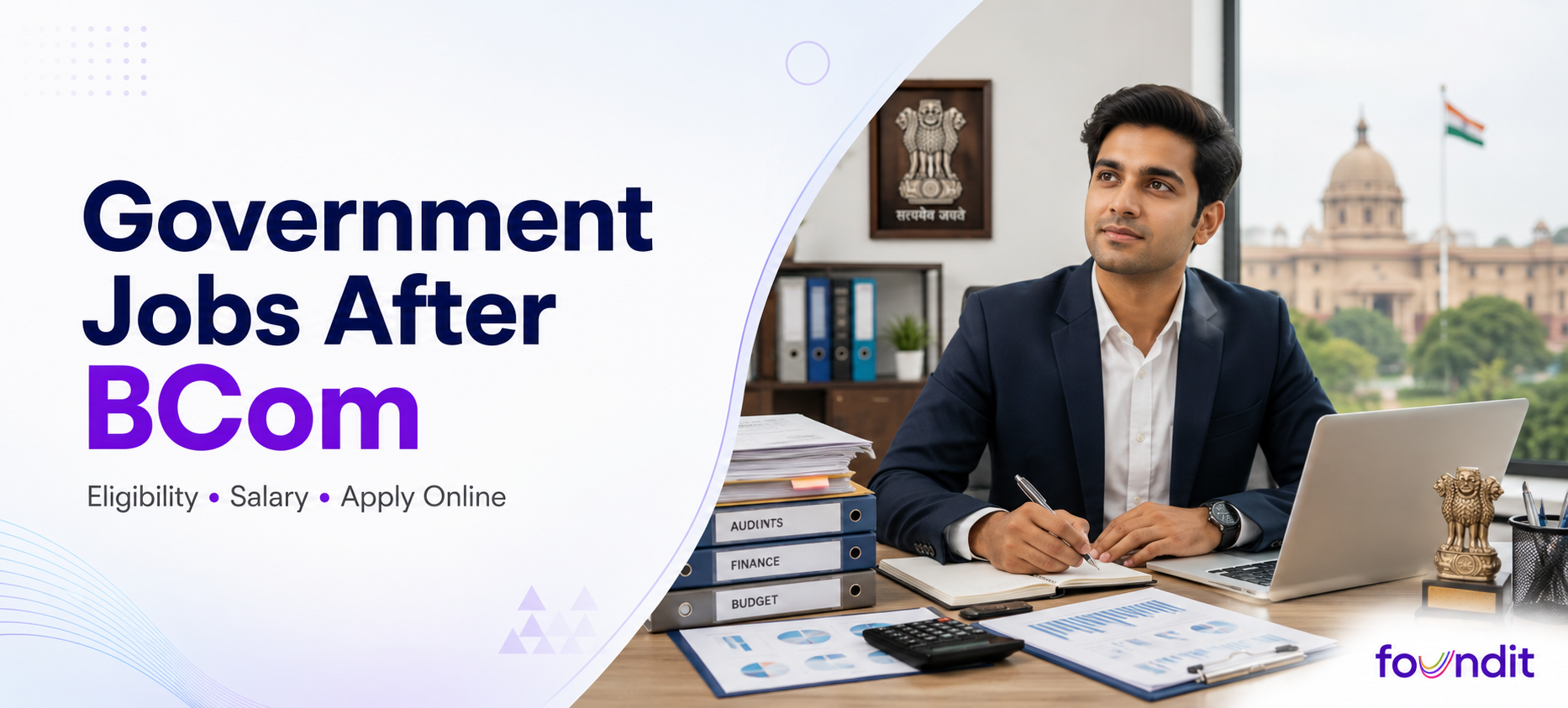
The government jobs after Bcom provide a stable career with competitive salaries and a bright future for commerce graduates in banking, tax, finance, insurance, railways, and public sector organisations.
Every year, a number of opportunities can be found for Commerce graduates. More than 50,000 candidates were selected in IBPS for public sector banks in FY 2025-26, which proves the ongoing demand for the government banking jobs for graduates.
In the public sector, commerce students have several prospects, ranging from bank jobs after Bcom to careers in taxation, auditing, railway, insurance, and civil services.
This article describes the best government jobs after Bcom, the list of government exams after Bcom, eligibility criteria, and government exam salary details.
Why Bcom Graduates Excel in Government Job Exams
The knowledge and skills that a Bcom degree offers can be directly applied to the syllabus for many competitive exams conducted by the government.
Accounting, economics, taxation, business law and finance courses educate students for careers in banking, taxation, auditing, and financial administration.
This is why commerce graduates are suitable candidates for a variety of jobs present in the list of government exams.
A number of competitive examinations also feature questions on quantitative aptitude, logical reasoning, and data interpretation.
Students of Bcom tend to acquire these skills in their studies and are at an advantage when it comes to competitive exams like SSC CGL (Commerce), IBPS PO, RBI Grade B, or any other exam held by the public sector.
Here are the key reasons why Bcom graduates perform well in government job exams:
- Good subject knowledge: Bcom comprises subjects that are relevant to many government exam syllabuses such as accounting, economics, taxation, and business studies.
- Numerical ability: Commerce students are aware of quantitative aptitude, data interpretation, and analytical reasoning which are part of competitive exams.
- Eligibility: Bcom degree from any recognised university is considered as a broad educational qualification in most central and state government recruitment exams.
- Common opportunities across sectors: Banking and Insurance, Railways, Public Sector Undertakings (PSUs), Taxation, Civil Services, etc. with a common qualification.
- Career progression: Many of the highest-paid government careers available for Bcom graduates have a predictable career path that includes career progression, allowances, pension benefits (if any) and job security.
- Competitive salaries: The salary of Bcom government jobs in India varies depending on the role and institution, but there are numerous positions at entry-level that are paid well and include government benefits.
Read Also: Make a career in the Government Sector!
Top Government Jobs for Bcom Graduates: Roles, Exams & Salaries
There are many government job opportunities available for commerce graduates in areas like banks and finance, taxation and auditing, insurance, and civil service.
Many of them pay decent wages, provide a clear career path, and secure jobs that provide a lifetime of employment. There are candidates who can choose a role according to their interest, eligibility, and competitive exams required for those positions.
The following table lists some of the top government jobs available to Bcom students with their respective recruitment authorities, selection procedures, and approximate annual salary.
| Government Job | Recruiting Authority | Selection Process | Approximate Salary* |
| RBI Grade B Officer | Reserve Bank of India (RBI) | Phase I, Phase II, Interview | ₹18–24 LPA |
| SEBI Grade A Officer | Securities and Exchange Board of India (SEBI) | Phase I, Phase II, Interview | ₹17–22 LPA |
| UPSC Civil Services Officer (IAS/IRS/IAAS and other services) | Union Public Service Commission (UPSC) | Preliminary, Main, Interview | ₹12–20+ LPA |
| IBPS Probationary Officer (PO) | Institute of Banking Personnel Selection (IBPS) | Preliminary, Main, Interview | ₹8–12 LPA |
| Assistant Audit Officer (AAO) | Staff Selection Commission (SSC CGL) | SSC CGL Examination | ₹8–11 LPA |
| LIC Assistant Administrative Officer (AAO) | Life Insurance Corporation of India (LIC) | Preliminary, Main, Interview | ₹8–10 LPA |
Disclaimer: The salary ranges mentioned above are indicative and may vary depending on factors such as grade, pay level, location of posting, applicable allowances, and periodic revisions as per government pay commissions and regulations. These figures are provided for general guidance only and do not represent guaranteed or fixed remuneration.
Banking Careers: IBPS PO, SBI PO & RBI Grade B
Students having Bcom degree are well-prepared to crack Banking recruitment exams as it gives them a strong base in accounting, finance, economics, and quantitative skills.
The age range of most of the PSU banking exam is open for graduates from 20-30 years (relaxation will be available for eligible categories).
| Job Role | Recruiting Body | Selection Process | Key Responsibilities | Approximate Salary |
| IBPS Probationary Officer (PO) | Institute of Banking Personnel Selection (IBPS) | Preliminary Exam, Main Exam, Interview | Manage customer relationships, process loans, oversee branch operations, and provide financial services. | ₹8–12 LPA |
| SBI Probationary Officer (PO) | State Bank of India (SBI) | Preliminary Exam, Main Exam, Interview | Handle branch administration, customer service, credit processing, and business development. | ₹52,000–₹60,000 per month (including allowances) |
| RBI Grade B Officer | Reserve Bank of India (RBI) | Phase I, Phase II, Interview | Regulate the banking sector, implement monetary policy, supervise financial institutions, and conduct economic research. | ₹18–24 LPA |
SSC CGL: Best Exam for Commerce Graduate
The SSC CGL for commerce graduates is one of the most popular recruitment examinations for candidates seeking careers in finance, taxation, auditing, and accounts within central government departments.
It is also one of the most important exams included in the Bcom government exam list.
| Job Role | Department | Key Responsibilities | Approximate Salary |
| Assistant Audit Officer (AAO) | Indian Audit & Accounts Department | Audit government accounts, examine public expenditure, and ensure financial compliance. | ₹47,600 to 1,51,100 |
| Auditor | Central government departments | Audit financial records and verify government expenditure. | Rs. 29,200 to Rs. 92,300 |
| Income Tax Inspector | Central Board of Direct Taxes (CBDT) | Assess tax compliance, conduct investigations, and assist with direct tax administration. | Rs. 44,900 to Rs. 1,42,,900 |
| GST Inspector | Central Board of Indirect Taxes & Customs (CBIC) | Monitor GST compliance, inspect businesses, and support indirect tax administration. | ₹70,000 – ₹90,000 |
UPSC Civil Services, LIC AAO & Other Key Exams
Other than government exams, Bcom students have options like UPSC, LIC, SEBI, RRB, PSUs, and state public service commissions in the field of recruitment.
These exams provide opportunities in administration, finance, insurance, accounting, and public sector management.
| Job Role | Recruiting Body | Key Responsibilities | Approximate Salary |
| UPSC Civil Services (IAS, IRS, IAAS and other services) | Union Public Service Commission (UPSC) | Formulate and implement government policies, manage public administration, taxation, finance, and governance. | Starting salary: ₹56,100/month + allowances and benefits |
| LIC Assistant Administrative Officer (AAO) | Life Insurance Corporation of India (LIC) | Manage policy administration, underwriting support, claims processing, and customer services. | Starting salary: ₹63,000/month (including benefits) |
| SEBI Grade A Officer | Securities and Exchange Board of India (SEBI) | Regulate securities markets, ensure investor protection, and monitor financial compliance. | The average salary ranges from ₹17–22 LPA. |
| Railway Recruitment Board (RRB) Graduate Posts | Railway Recruitment Board (RRB) | Work as Junior Accounts Assistant, Commercial Apprentice, Goods Guard, or Station Master in railway operations and administration. | As per 7th Pay Commission (varies by post) |
| Government Accounting & Finance Jobs | Central and State Government Departments | Handle accounting, auditing, budgeting, financial reporting, and treasury operations. | ₹4–9 LPA |
| Public Sector Undertakings (PSUs) | ONGC, BHEL, GAIL, SAIL and other PSUs | Work as Finance Executive, Accounts Officer, or Management Trainee in government-owned enterprises. | ₹8–15 LPA |
| Insurance Sector Jobs | LIC and other Government Insurance Organisations | Manage insurance operations, policy servicing, claims, customer support, and business development. | ₹4–9 LPA |
Read Also: High Paying Government Jobs in India: Top Roles, Salaries & How to Apply in 2026
Government Exam Eligibility: Who Can Apply After Bcom?
Candidates who are interested in government Job after Bcom should check the eligibility for the exam they are going to attempt.
After completing a Bcom course from a recognised university, candidates are eligible to appear for most of the recruitment exams conducted by central or any state government.
Requirements such as age limits, minimum marks, and other eligibility criteria vary across recruiting organisations.
General Eligibility Criteria
Most exams included in the Bcom government exam list have the following eligibility requirements:
- Education qualification: Bachelor’s degree in Commerce or any other recognised university by UGC. Most competitive exams like IBPS PO, SBI PO, SSC CGL, LIC AAO, UPSC CSE do not specify any minimum percentage.
- Age criteria: Age eligibility is generally between 20 and 30 years, but may vary from exam to exam.
- Citizenship: The candidates should be generally citizens of India. In some exams, certain types of candidates might also be allowed as mentioned in the notification.
- Age relaxation: Age relaxation for reserved category as per Government of India rules. These are mostly 3 years for OBC, 5 years for SC/ST and 10 years for PwD candidates (as per the respective recruitment notification).
Eligibility Criteria for Major Government Exams
| Exam | Age Limit (General Category) | Educational Qualification | Minimum Marks |
| IBPS PO | 20–30 years | Bachelor’s degree | Not specified |
| SBI PO | 21–30 years | Bachelor’s degree | Not specified |
| RBI Grade B | 21–30 years | Bachelor’s degree | 60% (General category) |
| SSC CGL for commerce graduates | 18–32 years | Bachelor’s degree | Not required |
| LIC AAO | 21–30 years | Bachelor’s degree | Not specified |
| SEBI Grade A | 21–30 years | Bachelor’s degree | 60% (General category) |
| UPSC Civil Services Examination | 21–32 years | Bachelor’s degree | Not specified |
| RRB NTPC (Graduate) | 18–33 years | Bachelor’s degree | Not specified |
Note-Eligibility criteria may vary by recruitment cycle, post, category and recruiting organisation. Candidates should refer to the latest official notification before applying.
Read Also: Top 10 Career Options after B.Com 2026
How to Prepare for government jobs after Bcom: Step-by-Step Strategy
It is important to have a strategy and consistent practice in order to prepare yourself for government jobs after Bcom.
Many competitive exams share similar subjects, therefore, candidates can study for several exams at once by creating a proper study schedule. The steps below can help improve preparation and increase the chances of success.
Step 1: Choose the Right Government Exam
Start by choosing one or two exams that align with career interests and goals.
IBPS PO, SBI PO, RBI Grade B are the ideal options available for candidates seeking bank jobs after Bcom, while SSC CGL for commerce graduates is the recommended option for those interested in finance, taxation, and auditing jobs.
Many banking and SSC exams test similar subjects, including:
- Quantitative Aptitude
- Reasoning Ability
- English Language
- General Awareness
Preparing these common topics first makes it easier to appear for multiple exams from the Bcom government exam list.
Step 2: Understand the Syllabus and Exam Pattern
Download the latest syllabus and Exam pattern from the official recruitment website before beginning the preparation. This enables the candidates to know the number of sections, marking schemes and important topics.
The following are some useful official portals:
- SSC – https://ssc.gov.in/
- IBPS – https://www.ibps.in/
- UPSC – https://upsc.gov.in/
Studying the official syllabus also helps candidates choose the right books and avoid spending time on topics that are not part of the exam.
Step 3: Create a Realistic Study Plan
Depending on the candidate’s background and their daily study routine, the preparation period required for most banking and SSC exams is 6–12 months.
One could have a simple study routine of:
- Morning: Verbal Ability and Non-Verbal Ability
- Afternoon: Commerce, Accounting, Economics
- Evening: English Language and Current Affairs
- Weekend: Revision and full-length mock tests
Bcom graduates should take advantage of their knowledge of accounting, economics, taxation and finance and prepare for accounting, commerce and banking examinations.
Step 4: Practise Mock Tests and Previous Year Papers
Regular practice is essential for improving speed and accuracy. After completing each subject, candidates should begin solving sectional tests before moving to full-length mock tests.
To improve performance:
- Practice test timed mock tests frequently.
- Solve previous years’ question papers.
- Review errors following each test.
- Make changes to weak topics prior to next mock.
The mock test will assists the candidates to understand the exam pattern and time management.
Read Also: Top 5 Government Jobs After 12th: Complete Guide 2026
Bcom Government Jobs: Salary Range, Job Security & Career Growth
Among the most significant benefits of having a government job after Bcom is the lucrative compensation packages, job security, and career progression opportunities.
The salary range of the private sector may depend on the employer, but in the government sector, the salary is fixed according to the 7th Pay Commission and every year, the salary gets increased, promoted, and various allowances are also provided.
Salary Growth in government jobs after Bcom
The Bcom government job salary in India is influenced by the job position, the organisation recruiting the candidate, pay level and years of service.
The government staff also get annual increments, allowances, and changes in salary due to promotions according to the pay structure. Candidates tend to make more money as they become more experienced and advance in their careers.
| Career Stage | Indicative Monthly Salary* | Typical Roles |
| Entry Level | ₹20,000–₹35,000 | Junior Accountant, Clerk, Assistant, Entry-level Government Officer |
| Mid Level (3–5 years) | ₹40,000–₹70,000 | Assistant Manager, Audit Officer, Probationary Officer, Section Officer |
| Senior Level (8–10+ years) | ₹1 lakh and above | Senior Finance Officer, Department Head, Senior Administrative Officer |
Disclaimer: The salary ranges mentioned above are indicative and may vary depending on factors such as grade, pay level, location of posting, applicable allowances, and periodic revisions as per government pay commissions and regulations. These figures are provided for general guidance only and do not represent guaranteed or fixed remuneration.
Aside from the draw of pay, government workers enjoy a promotions system. In the 7th Pay Commission, basic pay raises are granted to their workers annually, while promotion to a higher pay schedule brings about substantial salary hikes.
If a commerce graduate is recruited as Assistant Audit Officer through SSC CGL, he/she will start at a Pay Level of 8 and can get promoted to higher Pay Levels depending on departmental promotions and performance.
Another reason why many candidates opt for government jobs after Bcom, is the range of benefits and allowances offered with these positions. In addition to their basic salary, the majority of central government staff members are entitled to receive:
- House Rent Allowance (HRA)
- Dearness Allowance (DA)
- Transport Allowance
- Medical benefits
- Leave and paid holidays
- National Pension System (NPS) benefits
- Other departmental allowances, where applicable
These are benefits in addition to the base salary and can make all the difference in terms of total package.
Although salary is an important consideration, potential candidates should also take career stability, work-life balance, training programs, and career growth into account when selecting their choices from the list of Bcom government exams.
Commerce graduates can find good job opportunities in banks, finance, taxation, auditing, insurance, and regulatory organisations.
Track Official Notifications
There are a number of government organisations that publish recruitment notices all year round. Candidates are advised to frequently check the official websites for updates regarding the vacancy notification and date, admit card and exam schedule.
Important recruitment portals include:
- SSC
- IBPS
- SBI Careers
- RBI Careers
- UPSC
- LIC Careers
- RRB
The applicant who misses the application deadlines may have to wait for the next recruitment cycle. Candidates can set reminders or subscribe to official notifications for keeping them updated.
Read Also: Best Courses after Class 12th Commerce in 2026: Courses List, Jobs, Salary Potential
Conclusion
Commerce graduates can create a stable and rewarding career in the banking sector, finance, taxation, insurance, railways, and civil services through government jobs after Bcom.
Preparation strategy is important because with the right strategy, candidates may select the exam from the Bcom government exam list according to their interest, long-term career aspirations and eligibility.
Knowing what is required for the exam, the pattern of the exam, salary structure, and career prospects can help in boosting the chances of getting success.
One should always check the official recruitment notifications for the latest news about vacancies, eligibility, and examination dates.
RBI Grade B Officer, SEBI Grade A Officer, IBPS PO, SBI PO, Assistant Audit Officer (SSC CGL) For Commerce, LIC AAO, UPSC Civil Services are some of the best government job after b.com. The option depends on the career interests, eligibility, and career goals.
Among the highest paying government jobs Bcom graduates can pursue, RBI Grade B Officer offers an average salary of Rs. 78,450/- per month, while SEBI Grade A Officer offers approximately Rs. 62,500 per month. Salary varies depending on the organisation, pay level, allowances, and experience.
Yes, after Bcom candidates can apply for IBPS PO, SBI PO and most other bank jobs with a Bcom degree from a recognised university with the prescribed age limit and other eligibility as mentioned in the official notification.
The first exam is based on career goals. IBPS PO and SBI PO are great options for those looking towards a career in banking, and for finance, taxation and auditing, SSC CGL is a good choice for Commerce graduates.
Yes. Final year Bcom students are eligible to apply for many government exams, after getting the document verification or as mentioned in the official notification.
The time candidates spend preparing varies from 6-12 months, depending on exams and the amount of prior knowledge, and daily study schedule.
The best job is a choice of personal career interests. The candidates who are interested in having higher salary can opt for RBI Grade B or SEBI Grade A, and those who are interested in finance and audit can apply for Assistant Audit Officer in SSC CGL.
 Beware of Scammers
