





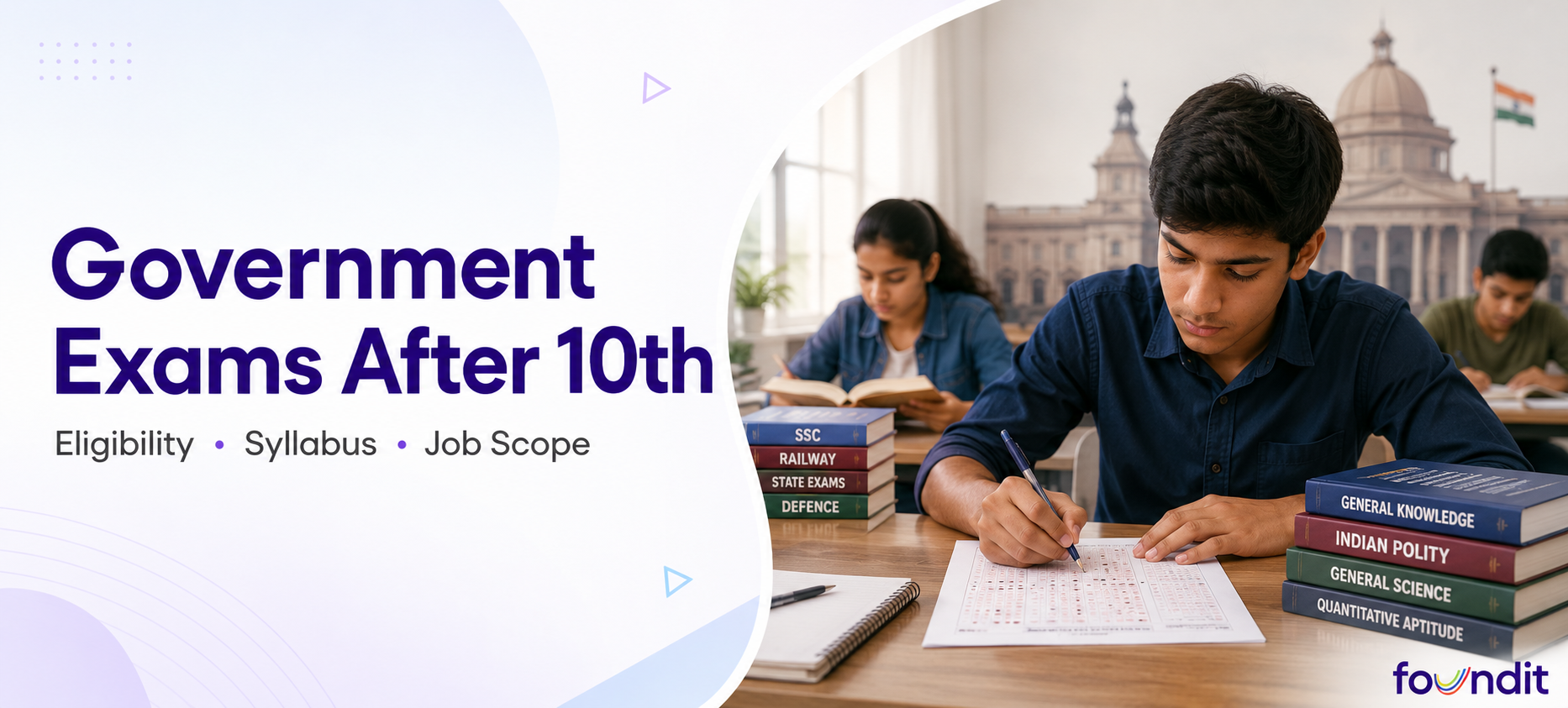
Government competitive exams After 10th are those exams which allow the students to start working in the government sector as early as after class 10th.
According to the MSDE Year End Review 2025, India has over 14,682 ITIs with more than 14 lakh trainees enrolled, reflecting the growing focus on skill development and early career opportunities after Class 10.
Popular options include SSC MTS after 10th, Defence Recruitment and Railway Posts, where the candidates need to fulfil specific eligibility conditions like prescribed RRB group D eligibility criteria.
This article covers everything from Government competitive exams after 10th, eligibility, selection process, salary, career prospects and more in 2026. It also includes vital information to assist candidates for comparing various government exams after 10th
What Are Government Competitive Exams After 10th?
Government competitive exams after 10th are the competitive examination conducted by Central and State Government Organisations on the basis of 10th Passed students to fill entry level government jobs.
After 10th these Government Exams offer an opportunity to get jobs in various departments like Railways, Defence, Police, Post Office etc.
Admission to these examinations is on a merit basis and subject to clear selection procedures. They have specific eligibility conditions, a course outline, and a defined recruitment process that is overseen by accredited government recruitment agencies.
Read Also: Make a career in the Government Sector!
Why Government Jobs After 10th Are Worth Pursuing
Government jobs after 10th can help the candidates to begin a stable career at an early age. These employment opportunities not only provide a steady income, but also promise long-term benefits, career progression, and financial stability.
Job Security
The majority of government positions offer secure services and clear rules governing the services. There are no uncertainties when it comes to the market, and employees receive benefits following government policies.
Early Financial Independence
After completing 10th education, candidates who are eligible for Government competitive exams can start earning early with Government competitive exams After 10th.
Career Growth Opportunities
Entry-level government positions often have defined promotion paths. Over time, employees may advance in their careers through departmental exams, seniority, or other promotions based on merit criteria.
Employee Benefits
The government provides benefits to the employees, including paid leave, medical facilities, allowances, and retirement benefits, according to the service rules. The advantages help to bring about long-term monetary stability.
Better Work-Life Balance
Most departments of government operate on regular hours and offer notified public holidays and leave options. This helps to balance the work responsibilities of employees with their personal responsibilities.
Social Recognition
In India government jobs are considered to be a great option to pursue. Government employment is often seen as a secure and reliable career path with good long-term prospects and credibility.
Read Also: Employee Benefits: A Comprehensive Guide
Complete List of Government Exams After 10th in India 2026
Several Government exams after 10th are conducted every year by central and state recruitment agencies.
The Government competitive exams after 10th are available in railways, defence, paramilitary and state government departments, etc.
| Exam Name | Conducting Body | Category | Minimum Age | Maximum Age* |
| SSC MTS exam after 10th | Staff Selection Commission (SSC) | Central Government | 18 years | 25 years |
| SSC GD Constable | Staff Selection Commission (SSC) | Paramilitary | 18 years | 23 years |
| RRB Group D | Railway Recruitment Board (RRB) | Railways | 18 years | 33 years |
| RRB ALP | Railway Recruitment Board (RRB) | Railways | 18 years | 30 years |
| RPF Constable | Railway Protection Force (RPF) | Railways | 18 years | 28 years |
| Indian Army Agniveer (GD) | Indian Army | Defence | 17.5 years | 21 years |
| Indian Navy MR (Matric Recruit) | Indian Navy | Defence | 17 years | 20 years |
| CISF Constable | Central Industrial Security Force (CISF) | Paramilitary | 18 years | 23 years |
| CRPF Constable | Central Reserve Police Force (CRPF) | Paramilitary | 18 years | 23 years |
| India Post GDS | Department of Posts | Postal Services | 18 years | 40 years |
| State Police Constable | State Police Recruitment Boards | State Government | 18 years | 23–27 years* |
| Forest Guard | State Forest Departments | State Government | 18 years | 25–30 years* |
SSC Exams: Best Central Government Jobs After 10th
Some of the popular Government competitive exams after 10th are conducted by Staff Selection Commission (SSC) for recruitment into some central Government departments.
These exams provide stable jobs, definite promotion and posting in India.
SSC MTS Exam After 10th
SSC MTS exam after 10th is a recruitment exam for Multi-Tasking Staff (MTS) and Havaldar in various central government ministries, departments, and offices.
The candidates should have passed out the Class 10 from a recognised board and should be as per age criteria.
| Parameter | Details |
| Eligibility | Class 10 pass from a recognised board |
| Age Limit | 18–25 years (age relaxation applicable for eligible categories) |
| Selection Process | Computer-Based Examination (CBT) and PET/PST for Havaldar posts |
| Pay Level | Level 1 (Basic Pay: ₹18,000 per month) + applicable allowances |
| Job Location | Across India |
The SSC MTS exam after 10th is based on general intelligence, numerical aptitude, general awareness, and english. It is regarded as one of the easiest exams conducted by the Government after 10th.
SSC GD Constable
The SSC GD Constable posts are available for recruitment for Central Armed Police Forces (CAPFs) such as BSF, CRPF, CISF, ITBP, SSB, Assam Rifles. It is fit for candidates who are interested in Defence and Paramilitary services after class 10th.
| Parameter | Details |
| Eligibility | Class 10 pass from a recognised board |
| Age Limit | 18–23 years (age relaxation applicable for eligible categories) |
| Vacancies | Released every year for posts in BSF, CRPF, CISF, ITBP, SSB, Assam Rifles, SSF, and Narcotics Control Bureau (varies by recruitment cycle) |
| Selection Process | Computer-Based Test (CBT), Physical Efficiency Test (PET), Physical Standard Test (PST), Medical Examination, and Document Verification |
| Pay Level | Level 3 (Basic Pay: ₹21,700 per month) + applicable allowances |
SSC Selection Post (Matriculation Level)
SSC also arranges Selection Post exams for the vacancies at matriculation level in different departments of the central government. Based on the recruitment notification, these posts are either clerical, technical, laboratory, or support staff.
| Parameter | Details |
| Eligibility | Class 10 pass from a recognised board (additional qualifications may be required for certain posts) |
| Age Limit | Generally, 18–25 years or 18–27 years (varies by post; age relaxation applicable for eligible categories) |
| Vacancies | Released as per recruitment notifications for clerical, technical, laboratory, and support staff posts in various Central Government departments |
| Selection Process | Computer-Based Examination (CBT), followed by Document Verification (Skill Test is conducted only for specific posts, if applicable) |
| Pay Level | Varies by post, generally Pay Level 1 to Pay Level 4 under the 7th CPC + applicable allowances |
Railway Jobs After 10th: RRB Group D Eligibility, ALP & More
Indian Railways is the biggest employer of Indian citizens and frequently hires students with a 10th-grade pass.
Indian Railways is one of the largest employers in India and has a regular recruitment through the Railway Recruitment Boards (RRB) for students with 10th grade pass.
The Government exams after 10th are for various technical, operational and security positions in various railway zones.
RRB Group D
RRB Group D is one of the most popular Government competitive exams after 10th for candidates seeking railway employment. The recruitment includes posts such as track maintainer, assistant pointsman, helper, and assistant in various technical departments.
| Parameter | Details |
| Eligibility | Class 10 pass or ITI from a recognised institution |
| Age Limit | 18–33 years (age relaxation applicable for eligible categories) |
| Selection Process | Computer-Based Test (CBT), Physical Efficiency Test (PET), Document Verification, and Medical Examination |
| Pay Level | Level 1 (Basic Pay: ₹18,000 per month) + applicable allowances |
| Vacancies | Announced as per recruitment notification |
Candidates should carefully review the latest RRB Group D eligibility criteria before applying, as educational qualifications, medical standards, and age limits are specified in the official notification.
The CBT generally covers Mathematics, General Intelligence and Reasoning, General Science, and General Awareness.
RRB Assistant Loco Pilot (ALP)
The Assistant Loco Pilot (ALP) is a technical railway post that requires candidates to have passed Class 10 along with an ITI certificate or an equivalent qualification in the relevant trade.
| Parameter | Details |
| Eligibility | Class 10 pass along with an ITI certificate or an equivalent qualification in the relevant trade from a recognised institution |
| Age Limit | 18–30 years (age relaxation applicable for eligible categories) |
| Selection Process | Computer-Based Test (CBT 1), Computer-Based Test (CBT 2), Computer-Based Aptitude Test (CBAT) for shortlisted candidates, Document Verification, and Medical Examination |
| Pay Level | Level 2 (Basic Pay: ₹19,900 per month) + applicable allowances |
| Vacancies | Announced as per recruitment notification |
It offers good career progression and higher pay compared to many entry-level railway posts.
ALP recruitment involves multiple stages, including Computer-Based Tests, Computer-Based Aptitude Test (for shortlisted candidates), document verification, and a medical examination.
RPF Constable After 10th
The Railway Protection Force (RPF) Constable recruitment is open to candidates who have completed Class 10 from a recognised board. RPF Constables are responsible for the security of railway property, passengers, and railway premises.
| Parameter | Details |
| Eligibility | Class 10 pass from a recognised board |
| Age Limit | 18–28 years (age relaxation applicable for eligible categories) |
| Selection Process | Computer-Based Test (CBT), Physical Efficiency Test (PET), Physical Measurement Test (PMT), Document Verification, and Medical Examination |
| Pay Level | Level 3 (Basic Pay: ₹21,700 per month) + applicable allowances |
| Vacancies | Announced as per recruitment notification |
Defence Recruitment After 10th: Agniveer, Navy & More
The Indian Armed Forces and Central Armed Police Forces offer several Government jobs after 10th for candidates interested in serving the nation.
These Government competitive exams after 10th combine physical fitness, discipline, and career opportunities with structured pay and benefits.
Indian Army Agniveer (General Duty)
The Agnipath Scheme, introduced in 2022, recruits Agniveers into the Indian Army, Navy, and Air Force for a four-year service period.
| Parameter | Details |
| Eligibility | Class 10 pass with at least 45% aggregate marks and 33% in each subject |
| Age Limit | 17½–21 years (as per the latest notification) |
| Selection Process | Online Common Entrance Exam (CEE), Physical Fitness Test (PFT), Physical Measurement Test (PMT), Medical Examination |
| Salary | Starting package of approximately ₹30,000 per month in the first year (with annual increments) |
| Service Tenure | Four years under the Agnipath Scheme |
Candidates should carefully review the official recruitment notification before applying, as eligibility criteria and age limits may change for each recruitment cycle.
Indian Navy Matric Recruit (MR)
The Indian Navy recruits Matric Recruit (MR) candidates for roles such as Chef, Steward, and Hygienist. This entry is intended for candidates who have completed Class 10 from a recognised board.
| Parameter | Details |
| Eligibility | Class 10 pass from a recognised board |
| Age Limit | As specified in the official recruitment notification for each recruitment cycle |
| Vacancies | Released periodically for posts such as Chef, Steward, and Hygienist |
| Selection Process | Shortlisting based on marks (as per notification), Written Examination (if applicable), Physical Fitness Test (PFT), Document Verification, and Medical Examination |
| Pay Level | Agniveer (MR) package under the Agnipath Scheme (monthly salary starts at ₹30,000 in the first year with applicable benefits) |
CISF and CRPF Constable
The Central Industrial Security Force (CISF) and Central Reserve Police Force (CRPF) Constable is generally recruited through SSC GD Constable examination and the recruitment notification of respective organisations if there is any.
Candidates should have passed class 10 exam and fulfilled the physical, medical and age criteria.
| Parameter | Details |
| Eligibility | Class 10 pass from a recognised board |
| Age Limit | Generally 18–23 years (age relaxation applicable for eligible categories) |
| Vacancies | Released through the SSC GD Constable recruitment and, in some cases, through separate notifications issued by CISF or CRPF |
| Selection Process | Computer-Based Test (CBT), Physical Standard Test (PST), Physical Efficiency Test (PET), Medical Examination, and Document Verification |
| Pay Level | Level 3 (Basic Pay: ₹21,700 per month) + applicable government allowances |
Postal & Other Government Exams for Class 10 Candidates
Except for SSC, Railways, Defense, there are a few Government Exams after 10th, which offer opportunities in the field of Postal Services and State Government Departments.
These positions are stable, have a clear career path, and are filled through a central or state-level process.
India Post GDS (Gramin Dak Sevak)
One of the most accessible Government jobs after 10th is India Post GDS as candidates are selected based on their class 10th marks. There is no written test for GDS recruitment, like any competitive exams.
Applicants age 18 to 40 years are eligible to apply, as per the official notification.
Those who are selected are appointed as Branch Postmaster (BPM), Assistant Branch Postmaster (ABPM) or Dak Sevak and are paid on the basis of Time Related Continuity Allowance (TRCA).
State Police Constable
Each state police has its own police recruitment board to recruit State Police Constable. Eligibility, age limit, and physical requirements differ from state to state; many states consider candidates who have passed class 10 as their constable eligibility.
Generally, a selection process involves:
- Written examination
- An assortment of tests designed to assess the physical fitness of candidates.
- Physical Standard Test (PST)
- Medical examination
- Document verification
Forest Guard
Forest Guards are recruited by the State Forest Departments in the state-level recruitment drives. Most candidates are expected to have passed Class 10 from a recognised board and have the required physical fitness.
The recruitment procedure typically involves written test, physical fitness tests, verification of documents, and medical checkup. Admission criteria and seats vary from state to state.
Salary Breakdown: How Much Do Government Jobs After 10th Pay?
After 10th, the salary in government jobs is determined by the designation, Pay level, place of posting, allowances applicable etc.
The majority of central government posts are based on the 7th Central Pay Commission, with India Post and Armed Forces using different pay systems.
| Job Role / Exam | Pay Matrix Level | Entry Basic Pay (Monthly) | Approximate In-Hand Salary (Monthly) |
| SSC MTS | Level 1 | ₹18,000 | ₹24,000 – ₹28,000* |
| RRB Group D | Level 1 | ₹18,000 | ₹22,000 – ₹27,000* |
| India Post GDS | TRCA Structure | ₹10,000 – ₹12,000 | ₹12,000 – ₹15,000* |
| Indian Army Agniveer (GD) | Agnipath Package | ₹21,000 (Year 1 Base) | Approximately ₹30,000 (Gross Package) |
| Indian Navy Agniveer (MR) | Agnipath Package | ₹21,000 (Year 1 Base) | Approximately ₹30,000 (Gross Package) |
| Indian Coast Guard Navik (DB) | Level 3 | ₹21,700 | ₹26,000 – ₹30,000* |
Disclaimer: The salary ranges mentioned above are approximate and may vary based on factors such as location, company, individual skills, educational background, and market demand. These figures are indicative of entry-level roles and should not be considered guaranteed compensation.
Read Also: High Paying Government Jobs in India: Top Roles, Salaries & How to Apply in 2026
How to Choose the Right Government Exam After 10th
A candidate’s selection of the appropriate Government exam after 10th depends on his/her educational qualifications, career objective, physical fitness as well as the kind of job he/she would want to pursue.
Candidates can make an informed decision with the following steps.
Step 1: Evaluate Eligibility and Academic Background
The initial step is to evaluate the education requirements of each exam. Most of the Government competitive exams After 10th require pass certificate of class 10 only.
But there are some posts like RRB ALP in which they are also required to possess an ITI or equivalent technical qualification.
Step 2: Check Physical Eligibility
Any candidate wishing to apply should check the physical standards required for recruitment to the police, defence, and/or paramilitary forces as prescribed before applying.
Physical efficiency and medical test are a part of the selection process in Exams like Agniveer, SSC GD Constable, RPF Constable and State Police Constable.
Step 3: Align the Exam with Career Goals
Examinations should be selected according to an examination’s long-term interests. Candidates interested in technical positions can go for railway job while candidates who wants to go to uniformed services can go for defence or police recruitment.
For those seeking administration, there are some positions such as postal and clerical that might be appropriate.
Step 4: Compare Salary, Vacancies, and Selection Process
Candidates should know the salary structure, number of vacancies, exam pattern, selection process etc. of various Government exams after 10th before applying.
Candidates can take a look at the current official notifications on recruitment to know which examination corresponds to their interest and career goals.
Read Also: Career Planning Process: Complete Step-by-Step Guide
Eligibility Criteria at a Glance: Government Exams After 10th
Before applying for Government jobs after 10th, candidates should carefully check the eligibility criteria mentioned in the official notification.
The table below provides a quick comparison of the educational qualification, age limit, and other important requirements for popular government examinations.
| Exam | Educational Qualification | Age Limit | Physical Test | Additional Requirement |
| SSC MTS exam after 10th | Class 10 pass | 18–25 years | No (except Havaldar post) | None |
| SSC GD Constable | Class 10 pass | 18–23 years | Yes | Physical standards and medical fitness |
| RRB Group D | Class 10 pass or ITI (as notified) | 18–33 years | Yes (PET) | Candidates should check the latest RRB Group D eligibility criteria |
| RRB ALP | Class 10 pass with relevant ITI | 18–30 years | No | Relevant ITI trade required |
| RPF Constable | Class 10 pass | 18–28 years | Yes (PET/PMT) | Height and medical standards apply |
| Indian Army Agniveer (GD) | Class 10 pass (minimum marks as notified) | 17½–21 years | Yes | Physical and medical fitness required |
| Indian Navy Agniveer (MR) | Class 10 pass | As per notification | Yes | Physical fitness and medical examination |
| India Post GDS | Class 10 pass | 18–40 years | No | Basic computer knowledge required |
| State Police Constable | Class 10 pass* | 18–23/27 years* | Yes | Eligibility varies by state |
Tips to Prepare for Government Competitive Exams After 10th
Preparing for Government competitive exams after 10th requires regular practice and a planned approach. Following a structured study routine can improve performance in written examinations as well as physical tests.
Step 1: Understand the Exam Pattern and Syllabus
Check the official notification and the syllabus before preparing for the exam. Candidates who have done 10th and preparing for SSC MTS exam, railway recruitment exam, Defence exam should focus only on topics covered in the exam pattern.
Step 2: Practise Previous Year Question Papers
Practice old papers and mock papers to become aware of the format of the questions. This also may help in determining if there are any areas that need further revision.
Step 3: Create a Daily Study Plan
Make a realistic time schedule and set aside time for mathematics, reasoning, general awareness, english and revision. Routine daily study is more effective than long study sessions that are inconsistent.
Step 4: Prepare for Physical Tests
The candidates who have appeared in the Defence exam after 10th, SSC GD, RPF Constable and railway exam with PET should start physical training early.
Running, endurance training, and strength training can be used to achieve the required physical fitness.
Step 5: Choose the Right Exam
Research about the eligibility criteria, Syllabus, selection process, and career prospects of various Government jobs after 10th before applying.
The best government exam after 10th depends on educational qualifications, physical fitness, career goals, and interests of a candidate.
Read Also: Best Courses After 10th: High-Salary Diploma & Career Options 2026
Conclusion
The Government competitive exams after 10th allow students to start a stable career without waiting to pursue higher education.
Based on qualifications, interests and career aspirations, candidates can opt for various career opportunities like the SSC MTS exam after 10th, RRB Group D eligibility test, and India Post GDS.
After 10th, candidates should analyse the eligibility criteria, selection process, salary, and career growth provided by various government exams before applying for the post.
To increase the odds of grabbing one of the numerous Government jobs after 10th, it is essential to read the most current official notification regarding the same and then prepare accordingly by having a plan in place.
FAQs
Candidates who have passed Class 10 can apply for several Government exams after 10th, including SSC MTS exam after 10th, SSC GD Constable, RRB Group D, RPF Constable, India Post GDS, Agniveer recruitment, and various state police and Forest Guard recruitments, subject to the prescribed eligibility criteria.
The difficulty level varies by recruitment process. India Post GDS is often considered one of the more accessible Government jobs after 10th because selection is generally based on Class 10 merit, while other examinations require candidates to clear written and physical tests.
Selected candidates in the SSC MTS exam after 10th receive a basic pay of ₹18,000 per month under Pay Level 1 of the 7th Pay Commission.
Yes. Class 10 pass candidates can apply for defence exams after 10th, such as the Indian Army Agniveer (General Duty) recruitment, provided they meet the educational qualifications, age limit, physical standards, and medical requirements mentioned in the official notification.
Yes. India Post GDS is a popular career option for Class 10 pass candidates because the selection process is generally merit-based, it offers stable employment and provides opportunities to work in the postal network across the country.
 Beware of Scammers
