







Career Options after 12th Commerce
If you’re wondering what after 12th commerce, you’re not alone. Many students reach this stage unsure about the right direction, especially with so many career options after 12th commerce available today.
Commerce is no longer limited to traditional roles like accounting or banking. It now opens doors to finance, management, law, analytics, entrepreneurship, and even emerging digital careers. The key is choosing the right path based on your strengths, interests, and long-term goals.
This article breaks down the most relevant commerce career options after 12th, including degree courses, professional qualifications, and job-oriented skills. You will also find clarity on what to do after commerce 12th, salary expectations, and how to make a confident decision.
What after 12th commerce?
Students can choose from degree courses like B.Com and BBA, professional courses like CA and CFA, or skill-based careers in digital marketing and analytics. The best option depends on your interest in finance, business, law, or data-driven roles.
Quick Overview: Best Career Options After 12th Commerce
| Category | Top Options |
|---|---|
| Degree Courses | B.Com, BBA, BMS, BA Economics |
| Professional Courses | CA, CS, CMA, CFA |
| Skill-Based Courses | Digital Marketing, Data Analytics, UI/UX |
| Law & Management | Integrated Law (BA LLB, BBA LLB), Hotel Management |
| High Salary Paths | CA, CFA, Investment Banking, Business Analytics |
| Job-Oriented Fields | Accounting, Finance, Marketing, HR, Sales |
What After 12th Commerce? Explained
Right after Class 12, one question comes up again and again: what after 12th commerce?
The answer is not a single path. Commerce offers multiple directions depending on what you enjoy and where you want to go.
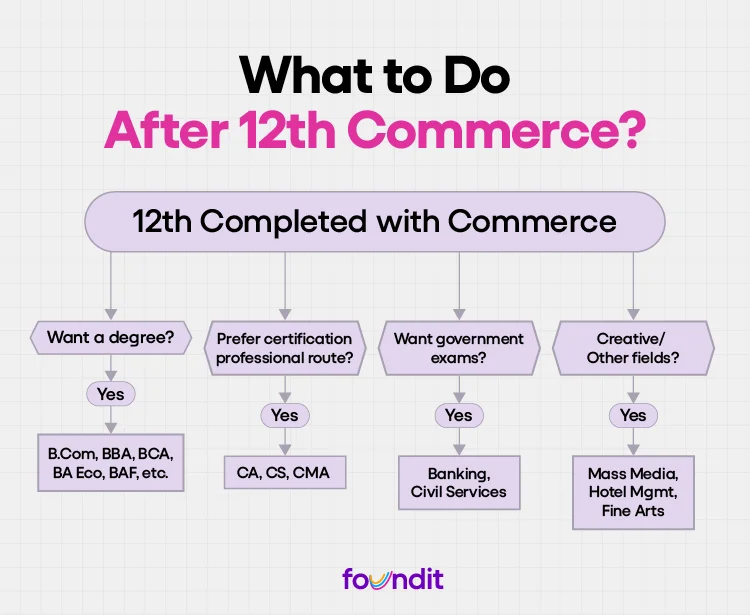
You can choose from degree programmes, professional certifications, or skill-based courses. Each option leads to different career options after 12th commerce, ranging from finance and accounting to management, law, analytics, and business roles.
To make things simple, here are the three main career paths after 12th commerce:
1. Degree-Based Career Path
This is the most common route. You pursue a graduation course and then build your career or continue with higher studies.
- B.Com (General or Honours)
- BBA or BMS
- BA Economics
- Integrated Law (BBA LLB, B.Com LLB)
This path is suitable if you want flexibility and want to explore different commerce career options after 12th before specialising.
2. Professional Career Path
If you are clear about building expertise in finance, accounting, or corporate law, professional courses offer structured and high-growth career opportunities after 12th commerce.
- Chartered Accountant (CA)
- Company Secretary (CS)
- Cost and Management Accountant (CMA)
- Chartered Financial Analyst (CFA)
These paths require discipline and consistency but can lead to some of the most respected careers in commerce after 12th.
3. Skill-Based and Job-Oriented Path
Not every student wants a long academic route. Skill-based courses focus on practical knowledge and quicker entry into commerce stream jobs.
- Digital Marketing
- Business Analytics
- Financial Modelling
- Tally and Accounting Software
This path works well if your goal is to start working early and build experience alongside learning.
Key Takeaway
There is no single answer to what to do after commerce 12th. The right choice depends on your interest, strengths, and long-term goals.
Whether you choose a degree, a professional qualification, or a skill-based course, there are strong career options after 12th commerce across industries today.
Read Also: Top 10 Career Options in Finance in India
After 12th Commerce Courses List
When students search for what after 12th commerce, the biggest challenge is not a lack of options—but too many choices. This section simplifies the decision by presenting a structured after 12th commerce courses list, grouped by career direction.
Instead of looking at random options, it helps to understand which commerce courses after 12th align with your goals—whether you want a corporate job, a professional qualification, or a skill-based role.
Top Courses After 12th Commerce (Quick Comparison)
| Course | Type | Duration | Best For |
|---|---|---|---|
| B.Com (General/Hons) | Degree | 3 years | Accounting, Finance Basics |
| BBA / BMS | Degree | 3 years | Management, Business Roles |
| CA (Chartered Accountant) | Professional | 4–5 years | Audit, Taxation, Finance |
| CS (Company Secretary) | Professional | 3–4 years | Corporate Law, Compliance |
| CMA | Professional | 3–4 years | Costing, Financial Planning |
| BA Economics | Degree | 3 years | Analytics, Research |
| Digital Marketing | Skill-Based | 3–12 months | Marketing, Online Business |
| Business Analytics | Skill-Based | 6–12 months | Data-driven roles |
Courses After 12th Commerce With Maths vs Without Maths
Your subject combination often influences your available career paths after 12th commerce, but it does not limit your success.
| With Maths | Without Maths |
|---|---|
| B.Com (Hons) | B.Com (General) |
| BA Economics | BBA / BMS |
| Actuarial Science | Hotel Management |
| Statistics / Data Courses | Design / Marketing Courses |
| Investment Banking Path | HR / Sales / Operations |
How to Read This Courses List
- If you prefer structured academics → go for degree-based courses
- If you want specialised expertise → choose professional courses
- If you want faster entry into jobs → consider skill-based programmes
This approach helps you filter the right commerce career options after 12th instead of getting overwhelmed by choices.
Top 10 Courses After 12th Commerce
- B.Com
- BBA
- CA
- CMA
- CS
- CFA
- BA Economics
- Actuarial Science
- Business Analytics
- Digital Marketing
Key Takeaway
The best career opportunities after 12th commerce come from choosing a course that matches your strengths, not just trends.
Use this after 12th commerce courses list as a starting point, then explore each option in detail before making your decision.
Read Also: Top Highest Paying Finance Jobs in India
Top Degree Courses After 12th Commerce
Top degree courses after 12th commerce include B.Com, BBA, BMS, BA Economics, and integrated law programmes. These courses form the foundation for multiple career options after 12th commerce in finance, management, analytics, and legal fields.
Choosing the right course is not just about the degree—it is about your long-term career paths after 12th commerce. The sections below explain each option with career outcomes, salary expectations, and suitability.
1. B.Com (Bachelor of Commerce)
B.Com is one of the most preferred commerce courses after 12th. It builds a strong base in accounting, taxation, finance, and business law.
- Duration: 3 years
- Core subjects: Financial Accounting, Taxation, Business Law
- Top roles: Accountant, Auditor, Tax Consultant
- Starting salary: ₹3–6 LPA
- Career growth: CA, MBA, banking and finance roles
Who should choose this: Students who want flexibility and plan to specialise later.
Who should avoid this: Students looking for immediate high-paying roles without further study.
2. BBA (Bachelor of Business Administration)
BBA focuses on management, marketing, and business operations, making it ideal for corporate careers.
- Duration: 3 years
- Core subjects: Marketing, HR, Business Strategy
- Top roles: Business Analyst, Marketing Executive, HR Executive
- Starting salary: ₹4–8 LPA
- Career growth: MBA and leadership roles
Who should choose this: Students interested in business, startups, or management.
Who should avoid this: Students looking for specialised finance roles without further education.
3. BMS (Bachelor of Management Studies)
BMS is similar to BBA but includes a stronger focus on analytics and decision-making.
- Duration: 3 years
- Core subjects: Business Analytics, Operations, Finance
- Top roles: Operations Executive, Strategy Analyst
- Starting salary: ₹4–7 LPA
- Career growth: Consulting, strategy, management roles
Who should choose this: Students who want a mix of business and analytical exposure.
4. BA Economics
BA Economics is one of the strongest academic choices for students interested in data, research, and analytics-driven careers in commerce after 12th.
- Duration: 3 years
- Core subjects: Microeconomics, Macroeconomics, Statistics
- Top roles: Economist, Data Analyst, Research Analyst
- Starting salary: ₹5–10 LPA
- Career growth: High demand in analytics, consulting, and policy roles
Who should choose this: Students comfortable with numbers and analytical thinking.
Who should avoid this: Students not comfortable with Maths or statistics.
5. Integrated Law Courses (BBA LLB / B.Com LLB)
Integrated law programmes combine commerce with legal education and lead to high-growth legal careers.
- Duration: 5 years
- Core subjects: Corporate Law, Business Law, Legal Studies
- Top roles: Corporate Lawyer, Legal Advisor
- Starting salary: ₹5–12 LPA
- Career growth: Strong opportunities in corporate firms and legal consulting
Who should choose this: Students interested in law, compliance, and corporate governance.
Additional Degree Options in Commerce
Along with traditional programmes, there are specialised commerce courses after 12th that offer focused career directions.
- BAF (Bachelor of Accounting & Finance): Focus on accounting and financial management
- BFM (Bachelor of Financial Markets): Covers stock markets and investment analysis
- Banking and Insurance Courses: Prepares for roles in banking and financial services
- BBA in International Business: Ideal for global business roles
- Entrepreneurship Programmes: Suitable for students planning to start a business
These options expand your career options after 12th commerce and help you specialise early.
Career Outcome Comparison (Degree Courses)
| Course | Career Path | Further Study | Growth Potential |
|---|---|---|---|
| B.Com | Accounting, Finance | CA, MBA | Medium → High |
| BBA | Management | MBA | High |
| BMS | Strategy, Operations | MBA | High |
| BA Economics | Analytics, Research | MA, Data Science | Very High |
| Law | Corporate Legal Roles | LLM | Very High |
Key Takeaway
The best option depends on your interests and long-term goals. There is no single “best” choice among commerce career options after 12th.
If you want flexibility → choose B.Com.
If you want management roles → choose BBA/BMS.
If you want analytics → choose Economics.
If you want legal careers → choose Law.
The right decision here directly shapes your future career opportunities after 12th commerce.
Read Also: Top 15 Career Options after BBA
Professional Courses After 12th Commerce
Professional courses after 12th commerce include CA, CS, CMA, and CFA. These courses are designed for specialised careers in finance, accounting, and corporate law, offering some of the most structured career opportunities after 12th commerce.
Unlike degree programmes, professional courses focus on industry-ready knowledge, certifications, and long-term career growth. They are ideal for students who are clear about their goals and ready to commit to a disciplined learning path.
Chartered Accountant (CA)
Chartered Accountancy is one of the most recognised commerce career options after 12th. It focuses on accounting, taxation, auditing, and financial management, and is regulated by ICAI.
- Duration: 4–5 years (depending on attempts)
- Levels: Foundation → Intermediate → Final
- Training: Articleship (practical training under a CA)
- Core areas: Accounting, Taxation, Auditing, Law, Financial Management
Step-by-Step Process to Become a Chartered Accountant
- Register with ICAI: Students may register for the CA Foundation after Class 10. However, they can only appear for the exam after passing Class 12.
- CA Foundation Exam: A 4-month study period is mandatory. Exams are conducted in January, May, and September. Subjects include:
- Accounting
- Business Laws
- Quantitative Aptitude
- Business Economics
Passing Criteria: 40% in each paper and 50% aggregate.
- Register for CA Intermediate: Eligible after clearing Foundation. Students must undergo an 8-month study period before appearing.
- Clear CA Intermediate: Comprises 6 papers divided into Group I and Group II. Passing requires 40% per paper and 50% in each group.
- Begin Articleship: After clearing both Intermediate groups. The practical training lasts 2 years and includes a monthly stipend.
- Complete AICITSS: During the final 6 months of Articleship, students undergo training in IT tools and communication skills.
- Finish Self-Paced Online Modules (SPOM): Four modules (A, B, C, D) must be completed online. Students need a minimum of 50% in each.
- Register for CA Final: Eligible after completing Articleship, SPOM, and AICITSS. The Final has 6 papers split across two groups. Pass with 40% in each paper and 50% in each group.
- ICAI Membership: After successfully clearing the CA Final, students may apply for ICAI membership and officially become Chartered Accountants.
| Stream | Eligibility for registering with ICAI |
| Commerce | Passing of 12th exam with minimum 50% aggregate marks |
| Non-Commerce (with mathematics) | Passing of 12th exam with minimum 60% aggregate marks |
| Non-Commerce (without Mathematics) | Passing of 12th exam with minimum 55% aggregate marks |
This structured journey allows class 12th commerce students to gain technical and practical experience, preparing them for careers in top accounting firms, multinational companies, financial institutions, and government bodies.
Summary of CA Course Structure – Foundation to Final
| Stage | Eligibility | Key Components | Highlights |
|---|---|---|---|
| Foundation | After Class 12 (Register post Class 10) | Accounting, Business Laws, Quantitative Aptitude, Economics | 3 exams/year Min. 4-month study Pass: 40%/subject & 50% aggregate |
| Intermediate | Post Foundation | Group I: 3 Papers Group II: 3 Papers | 8-month study Pass: 40%/paper & 50% per group |
| Articleship | After clearing both Intermediate groups | 2-year practical training | Mandatory before CA Final Includes stipend |
| AICITSS | During last 6 months of Articleship | IT training & Soft skills | Must be completed before CA Final |
| SPOM | Post Intermediate | Modules A, B, C, D (online) | Self-paced 50% passing score required per module |
| Final | After SPOM, AICITSS & Articleship | Group I: 3 Papers Group II: 3 Papers | Held 3 times/year Pass: 40%/paper & 50% per group |
- Top roles: Auditor, Tax Consultant, Financial Advisor
- Starting salary: ₹6–12 LPA
- Growth potential: ₹20+ LPA with experience
Who should choose this: Students who are disciplined, consistent, and interested in finance and accounting.
Who should avoid this: Students looking for quick results or low-pressure study paths.
Cost and Management Accountant (CMA)
CMA focuses on cost accounting, financial planning, and business strategy. It is a strong option for students interested in internal financial management and corporate decision-making.
- Duration: 3–4 years
- Levels: Foundation → Intermediate → Final
- Focus areas: Costing, Budgeting, Financial Analysis, Performance Management
- Regulated by: Institute of Cost Accountants
CMA Course Structure Explained:
This certification is given by the Institute of Cost Accountants of India. This is the same as ICWAI. This exam is also one of the most challenging professional exams in India.
This professional course is now becoming more and more popular among Commerce students to aim for a career in accounting and Finance. This is pursued in three levels.
• CMA Foundation
• CMA Intermediate
• CMA Final
| Foundation | Intermediate paper 1 | Intermediate paper 2 | Final Paper 1 | Final Paper 2 |
| Fundamentals of Economics and Management | Financial Accounting
| Operations Management & Strategic Management | Corporate Laws & Comaliance | Corporate Financial Reporting |
| Fundamentals of Accounting | Laws & Ethics | Cost & Management Accounting and Financial Management | Strategic Financial Management | Indirect Tax Laws & Practice |
| Fundamentals of Laws and Ethics
| Direct Taxation | Indirect Taxation (Including Customs Act) | Strategic Cost Management – Decision Making | Cost & Management Audit |
| Fundamentals of Business Mathematics & Statistics | Cost Accounting | Company Accounts & Audit | Direct Tax Laws and International Taxation
| Strategic Performance Management and Business Valuation |
- Top roles: Cost Accountant, Financial Analyst, Budget Analyst
- Starting salary: ₹6–10 LPA
- Growth potential: ₹15–20 LPA
Who should choose this: Students interested in cost control, budgeting, and corporate finance strategy.
Company Secretary (CS)
CS is a professional course focused on corporate law, governance, and compliance. It is suitable for students interested in legal and regulatory roles in companies.
- Duration: 3–4 years
- Levels: CSEET → Executive → Professional
- Top roles: Company Secretary, Compliance Officer
- Starting salary: ₹5–10 LPA
- Growth potential: ₹15–25 LPA
Who should choose this: Students interested in corporate law and governance.
Chartered Financial Analyst (CFA)
CFA is a globally recognised qualification focused on investment management, financial analysis, and global finance careers.
- Duration: 2.5–4 years
- Levels: Level 1 → Level 2 → Level 3
- Top roles: Investment Banker, Portfolio Manager, Equity Analyst
- Starting salary: ₹8–15 LPA
- Growth potential: ₹25+ LPA
Who should choose this: Students interested in global finance and investment roles.
Comparison of Professional Courses
| Course | Best For | Difficulty Level | Career Direction | Salary Range |
|---|---|---|---|---|
| CA | Accounting, Taxation | Very High | Audit, Finance | ₹6–20+ LPA |
| CMA | Costing, Finance Strategy | High | Corporate Finance | ₹6–20 LPA |
| CS | Corporate Law | High | Compliance, Governance | ₹5–25 LPA |
| CFA | Investment, Finance | High | Investment Banking | ₹8–25+ LPA |
Key Takeaway
Professional courses are among the most rewarding career paths after 12th commerce, but they require time, consistency, and strong commitment.
If you are clear about your goals, these courses can lead to some of the highest-paying and most respected careers in commerce after 12th.
Read Also: Top 10 Highest Paid Jobs in India in Commerce Field
High Salary Commerce Courses After 12th
High salary commerce courses after 12th include CA, CFA, BA Economics, and specialised finance and analytics programmes. These options offer strong career opportunities after 12th commerce with higher earning potential over time.
High salary does not come from the course alone. It depends on skill level, consistency, and career progression. The courses below are known for leading to well-paying commerce stream jobs when pursued seriously.
Top High Salary Courses (Quick List)
- Chartered Accountant (CA)
- Chartered Financial Analyst (CFA)
- BA Economics (with analytics focus)
- Actuarial Science
- Business Analytics / Data Analytics
- Investment Banking Pathways
High Salary Courses Comparison
| Course | Career Role | Starting Salary | Growth Potential |
|---|---|---|---|
| CA | Auditor, Finance Manager | ₹6–12 LPA | ₹20+ LPA |
| CFA | Investment Banker, Portfolio Manager | ₹8–15 LPA | ₹25+ LPA |
| BA Economics | Data Analyst, Economist | ₹5–10 LPA | ₹15–20 LPA |
| Actuarial Science | Risk Analyst, Actuary | ₹8–20 LPA | ₹30+ LPA |
| Business Analytics | Data Analyst, Consultant | ₹6–12 LPA | ₹20+ LPA |
| Investment Banking | Investment Analyst | ₹10–20 LPA | ₹40+ LPA |
What Makes These Courses High Paying
- They require specialised skills (finance, analytics, risk management)
- They are in demand across industries
- They offer strong long-term growth, not just starting salary
These factors create strong career paths after 12th commerce with long-term earning potential.
Important Reality Check
Not every student will earn a high salary immediately. Most high-paying careers in commerce after 12th require:
- Consistent effort over several years
- Additional certifications or specialisation
- Practical experience and internships
This is why choosing the right path early matters when deciding what to do after commerce 12th.
Key Takeaway
If your goal is a high-paying career, focus on building strong skills along with choosing the right course.
The best career options after 12th commerce are those that match your strengths and offer long-term growth, not just quick results.
Read Also:
Best Commerce Stream Jobs and Salary Scope
Commerce stream jobs include roles in accounting, finance, management, marketing, analytics, and corporate law. These roles offer strong career opportunities after 12th commerce across industries.
The job you get depends on the course you choose and the skills you build. The table below maps the most common career paths after 12th commerce to real job roles and salary ranges.
Course to Job to Salary Mapping
| Course | Job Role | Starting Salary | Growth Potential |
|---|---|---|---|
| B.Com | Accountant, Tax Consultant | ₹3–6 LPA | ₹8–15 LPA |
| BBA / BMS | Marketing Executive, HR Executive | ₹4–8 LPA | ₹10–20 LPA |
| CA | Auditor, Finance Manager | ₹6–12 LPA | ₹20+ LPA |
| CS | Company Secretary, Compliance Officer | ₹5–10 LPA | ₹15–25 LPA |
| CFA | Investment Analyst | ₹8–15 LPA | ₹25+ LPA |
| BA Economics | Data Analyst, Research Analyst | ₹5–10 LPA | ₹15–20 LPA |
| Digital Marketing | SEO Executive, Marketing Specialist | ₹3–6 LPA | ₹10–18 LPA |
| Business Analytics | Data Analyst, Consultant | ₹6–12 LPA | ₹20+ LPA |
Top Career Areas in Commerce
- Finance and Accounting: Includes roles like accountant, auditor, and financial analyst
- Management and Business: Includes HR, operations, and marketing roles
- Analytics and Data: Includes data analyst and research roles
- Legal and Compliance: Includes company secretary and corporate law roles
These areas define the most stable and growing careers in commerce after 12th.
How Salary Growth Works
Salary in commerce stream jobs depends on three main factors:
- Level of specialisation (CA, CFA, MBA, etc.)
- Work experience and skill development
- Industry demand (finance and analytics roles grow faster)
Students who focus on skill-building and internships early usually see faster salary growth.
Key Takeaway
The best career options after 12th commerce are those that connect your course with real job roles and growth opportunities.
Instead of choosing a course blindly, focus on where it leads in terms of jobs and salary.
Read Also: Best B.Com Courses for a Successful Career in 2026
Skill-Based Courses and Emerging Careers
Skill-based courses after 12th commerce focus on practical learning and faster entry into jobs. These options open up modern career opportunities after 12th commerce in digital, analytics, and business-driven roles.
Unlike traditional degrees, these courses emphasise real-world skills. They are ideal if you want to start working early or build expertise alongside your degree.
Top Skill-Based Courses for Commerce Students
| Course | Duration | Career Role | Starting Salary |
|---|---|---|---|
| Digital Marketing | 3–6 months | SEO Specialist, Marketing Executive | ₹3–6 LPA |
| Business Analytics | 6–12 months | Data Analyst, Consultant | ₹6–12 LPA |
| Financial Modelling | 3–6 months | Financial Analyst | ₹5–10 LPA |
| Tally / Accounting Software | 2–4 months | Account Executive | ₹2–5 LPA |
| UI/UX Design | 6–12 months | Designer, Product Role | ₹4–10 LPA |
| E-commerce Management | 3–6 months | Marketplace Manager | ₹4–8 LPA |
Emerging Career Areas in Commerce
- Digital Marketing: Covers SEO, paid ads, content, and online business growth
- Data and Analytics: Includes business analytics and data-driven decision-making
- FinTech: Combines finance with technology, including digital payments and financial platforms
- E-commerce: Focuses on online business operations and marketplaces
These areas are shaping the future of commerce career options after 12th.
Who Should Choose Skill-Based Courses
- Students who want early job opportunities
- Students who prefer practical learning over theory
- Students who want to earn while studying
These courses are especially useful if you are still exploring what to do after commerce 12th and want to test different fields.
How to Use Skill-Based Courses Smartly
Skill-based learning works best when combined with a degree or professional course.
- Combine B.Com with accounting software or analytics
- Combine BBA with digital marketing or business tools
- Combine Economics with data analytics
This combination creates stronger career paths after 12th commerce and improves job readiness.
Key Takeaway
Skill-based courses are not replacements for degrees, but they are powerful add-ons.
They help you build practical skills, improve employability, and access modern careers in commerce after 12th that are growing rapidly.
Read Also: Best Career Options and Courses after B.Com
How to Choose the Right Career Path After 12th Commerce
Choosing the right path after Class 12 is not about picking the most popular option. It is about selecting a direction that fits your strengths, interests, and long-term goals. If you are unsure what after 12th commerce, this section will help you decide step by step.
Start with Your Interests
Your interest plays a major role in shaping your career paths after 12th commerce. Ask yourself what kind of work you enjoy.
- If you like numbers → consider finance, accounting, or analytics
- If you like business → consider management or entrepreneurship
- If you like law → consider legal and compliance roles
- If you like creativity → explore marketing or digital fields
Understand Career Outcomes Before Choosing
Every course leads to different career opportunities after 12th commerce. Instead of choosing based on trends, focus on outcomes.
- B.Com → accounting, finance, taxation
- BBA/BMS → management, marketing, HR
- CA/CMA → finance and accounting specialisation
- CFA/Economics → analytics and investment roles
This approach helps you connect your choice directly with real commerce stream jobs.
Evaluate Effort vs Reward
Some of the best career options after 12th commerce require long-term effort.
- CA and CFA → high effort, high reward
- Degree courses → moderate effort, flexible outcomes
- Skill-based courses → faster entry, gradual growth
Choose a path that matches your ability to stay consistent.
Avoid Common Mistakes
- Choosing a course just because others are doing it
- Ignoring your strengths and interests
- Focusing only on short-term salary
- Not understanding the career path after the course
Avoiding these mistakes helps you build stronger careers in commerce after 12th.
Simple Decision Framework
If you are still confused what to do after commerce 12th, use this simple guide:
- Want flexibility → choose B.Com
- Want management roles → choose BBA/BMS
- Want high-paying finance roles → choose CA/CFA
- Want analytics → choose Economics or Analytics courses
- Want early job → choose skill-based courses
Key Takeaway
The best choice is the one that aligns with your strengths and long-term vision.
There are many courses after 12th commerce, but success depends on choosing the right course and staying consistent.
FAQs on Career Options After 12th Commerce
🔽 What are the best career options after 12th commerce?
The best career options after 12th commerce include B.Com, BBA, CA, CS, CFA, and Economics. The right choice depends on your interest in finance, management, analytics, or law.
🔽 What to do after commerce 12th for a high salary?
If your goal is a high salary, consider CA, CFA, Actuarial Science, or Business Analytics. These career paths after 12th commerce offer strong long-term earning potential with experience.
🔽 Which course is best after 12th commerce without maths?
Students without Maths can choose B.Com, BBA, BMS, or skill-based courses like digital marketing. These options still provide strong career opportunities after 12th commerce.
🔽 What are the top commerce stream jobs?
Popular commerce stream jobs include accountant, financial analyst, marketing executive, HR manager, and investment analyst. Salaries vary based on skills and experience.
🔽 Is commerce a good career option after 12th?
Yes, commerce offers diverse careers in commerce after 12th across finance, business, analytics, and law, with strong growth and salary potential.
Job By Role:
 Beware of Scammers
