







Business courses after 12th are a popular choice for students who want to build careers in business management, finance, marketing, entrepreneurship, and corporate leadership. These programmes provide knowledge of business administration, organisational management, and strategic decision-making.
With increasing demand for skilled professionals in banking, financial services, consulting, retail, e-commerce, and multinational companies, business management courses offer strong career growth and employment opportunities.
Students from Commerce, Science, and Arts streams can choose from various undergraduate business courses, diploma programmes, and professional management courses after 12th.
This guide covers the best business courses after 12th, eligibility requirements, entrance exams, course options, salary prospects, career opportunities, and future scope in the business and management sector.
Why Choose Business Courses After 12th?
India’s job market is expanding, but it’s also becoming selective. Companies don’t just need degrees anymore. They need people who understand how businesses function in real situations. That’s exactly where business education fits in.
Another thing worth noticing is flexibility. With a business degree, you’re not stuck in one field. You could start marketing, shift to operations later, and even move into consulting. A few careers after 12th offer this kind of flexibility.
There’s also a practical angle many students miss initially. Most business courses now include internships, case studies, and real projects. So instead of just theory, you actually see how decisions play out in companies.
From a broader career planning guide perspective, business education creates a strong base. It supports long-term job opportunities in India, whether in private companies, startups, or even government roles.
Types Of Business Courses After 12th
Not all courses serve the same purpose. Thus, before choosing, it helps us to understand different types of business courses.
Undergraduate Degree Courses
These are the most common and structured options. They typically run for three years and are widely accepted across industries.
BBA is the most popular choice. It gives you a mix of management subjects and prepares you for corporate roles or an MBA later.
B.Com focuses more on finance and accounting. If you’re thinking about CA, taxation, or banking, this is often the preferred route.
BMS sits somewhere in between, with a stronger focus on management theory and communication skills.
Specialised BBA programmes are also growing. You’ll find options in Finance, Marketing, HR, and even Business Analytics. These allow early focus, which can help in competitive job markets.
Integrated Courses
The IPM (Integrated Programme in Management) combines a BBA and MBA into a single five-year course.
The competition is tough, and the entrance exams demand strong preparation. But if you get in, you essentially fast-track your career.
Diploma And Certificate Courses
These are shorter programmes, usually six months to a year.
Courses like Digital Marketing or Business Analytics can add practical skills quickly. But in practice, they work best as add-ons rather than replacements for a degree.
Read Also: Best Courses after Class 12th Commerce: Courses List, Jobs, Salary Potential
Top Business Courses After 12th In India
BBA (Bachelor of Business Administration)
BBA is typically the preferred course among those pursuing business studies post-12th.
The curriculum covers a range of management subjects over three years. It begins with fundamental topics such as business management and communication skills, and gradually introduces specialised areas including marketing, finance, human resource management, and entrepreneurship.
Regarding educational qualifications, most institutes require 50% marks in class 12. However, some reputed institutes have higher requirements.
Career-wise, students usually enter roles like management trainees or marketing executives. Many also go on to pursue an MBA.
When it comes to the salary after business courses, entry-level professionals typically earn between ₹3 lakh and ₹5 lakh per annum, depending on their skills, specialisation, employer, and location. Graduates from reputed institutions may receive higher salary packages.
Read Also: Best Career Options after BBA with High Salary
B.Com (General and Honours)
B.Com is ideal if you’re inclined towards finance or accounting.
The course dives deeper into subjects like taxation, auditing, and financial management. Honours programmes usually offer more depth and specialisation.
Job roles include accountant, auditor, and financial analyst. Many students also prepare for professional courses like CA alongside it.
BMS (Bachelor of Management Studies)
BMS focuses more on management and organisational behaviour. Students develop strong communication and analytical skills, which are useful in corporate roles.
It’s especially valued in metro job markets where companies look for well-rounded graduates.
Integrated Programme in Management (IPM)
IPM combines undergraduate and postgraduate studies into one path.
The selection process includes entrance exams and interviews. It’s competitive, but the outcome is strong. Graduates often land high salary jobs early on.
Specialised Business Courses
Courses in Business Analytics, Finance, or Marketing are gaining traction.
These programmes are designed around industry demand. For example, Business Analytics focuses on data-driven decision-making, which is now relevant across sectors.
Read Also: Top Courses for 12th Commerce Students Without Maths
Business Courses After 12th Eligibility and Qualification
Below are details on the eligibility criteria for various courses in business after 12th:
| Course Level | Popular Courses | Duration | Eligibility | Average Fees |
| Certificate | Business Analysis Fundamentals, Business Foundations, Essential Technologies for Business | 6 months to 1 year | Passed 10+2 in any stream | INR 500 to 15,000 |
| Diploma & PG Diploma | Advance Diploma in Business Studies, Diploma in Business Administration, Diploma in Business Management | 1 to 2 years | Passed 10+2 in any stream | INR 15,000 to 8,00,000 |
| UG | B.Com, BBS, BBA, BBM | 3 years | Passed 10+2 in any stream | INR 50,000 to 10,00,000 |
| PG | MBA, MCom, MBS | 2 years | Undergraduate degree in Business or relevant stream | INR 5,000 to 25,00,000 |
Disclaimer: Course fees are approximate and may vary by institute, course, and location.
- Qualification required: 10+2 (any equivalent qualification).
- Marks required: Generally, 50% in overall subjects. In some prestigious private institutions, 60% may be required, whereas government institutions may accept candidates with 45-50%.
- Stream required: Most of the time, students of all the three categories — Commerce, Science, and Arts can join courses in business. This is considered to be one of the most flexible areas of business education.
- Age: No particular restrictions on age in most cases.
Entrance Exams for Business Courses After 12th
Getting into a good institution usually means clearing one of these competitive exams in India. Here’s what you need to know:
CUET UG (Common University Entrance Test): Conducted by NTA, CUET UG is now the primary entrance test for admissions to central universities. It tests subjects from Class 12 and includes domain-specific papers. Most central university BBA and B.Com programmes now require CUET scores.
IPMAT (Integrated Programme in Management Aptitude Test): Conducted separately by IIM Indore and IIM Rohtak, this exam is specifically for IPM admissions. It tests Quantitative Ability and Verbal Ability. The IIM Indore version is generally considered more difficult.
SET (Symbiosis Entrance Test): Required for admission to Symbiosis International University’s undergraduate business programmes, including BBA. It includes General English, Quantitative Aptitude, General Awareness, and Analytical and Logical Reasoning.
NPAT (National Programme on Admissions Test): Conducted by NMIMS University for its undergraduate programmes, including BBA and B.Com. It tests English language, Quantitative and Numerical Ability, and Reasoning and General Intelligence.
UGAT (Under Graduate Aptitude Test): Conducted by AIMA for admission to BBA, BHM, BCA, and integrated MBA programmes at various institutions. It tests general aptitude and relevant subject knowledge.
Read Also: List Entrance Exams After 12th Across Streams
Business Courses after 12th Steps
The format of the business course applications after the 12th process remains largely the same in all institutions. Here’s how the entire process goes:
Step 1 – Check eligibility: See that you fulfill the percentage and stream requirements for your choice of courses.
Step 2 – College shortlisting: Do your research based on your score, college locations, tuition fees, and placements. Consider at least five-seven colleges to narrow down your choices.
Step 3 – Entrance exam registration: You can apply and appear for CUET, IPMAT, SET, NPAT, and other tests depending upon the institute and course of your choice. The application process generally starts from January to March for July admissions.
Step 4 – Take the exam: After appearing for the test, you will get your scorecard.
Step 5 – GD/PI rounds: Most top colleges have rounds for Group discussion and Personal interview after the entrance test.
Step 6 – Seat confirmation: After getting the offer letter from the institution, verify your documents and pay the fees to confirm your admission.
Syllabus And Subjects Covered
The major subjects within most business degree courses are similar, although their depth and scope may differ. In year one, students usually enrol in Principles of Management, Business Communication, Financial Accounting, Micro and Macro Economics, and Business Mathematics and Statistics.
Year two courses usually include Marketing Management, Human Resource Management, Financial Management, Business Law, and Organisational Behaviour.
Year three courses include Strategic Management, Entrepreneurship, International Business, Supply Chain Management, and Research Methodology.
The practical component is vital in most business degrees. Internships, which are normally undertaken during the second or third year of the course, allow students to gain hands-on experience by working in real organisations and applying their knowledge of business principles.
Skills Required for Business Courses
Academic ability alone is insufficient to succeed in a business education and career. The following abilities must be mastered to achieve success:
- Effective Communication: The ability to convey ideas, negotiate with customers, write reports, present ideas, and manage teams is essential for business people, as they have to communicate a lot during the course of their working hours.
- Analytical Skills: Analysing the balance sheet, understanding market trends, evaluating proposals, and drawing conclusions based on gathered information are all critical abilities for most business jobs.
- Leadership: Business jobs usually demand leadership qualities like decision-making under pressure, inspiring employees, taking responsibility, leading projects, and managing teams.
- Basic Financial Awareness: Knowledge of basic accounting, budgeting, and financial planning can help business graduates excel, no matter what job they choose in the corporate world.
- Proficiency with Digital Tools: Modern-day businesses cannot function without digital tools. It is necessary to possess basic knowledge of digital technologies like CRM software, digital marketing tools, databases, and analytics programs, even for non-technical positions.
Read Also: Why Business Communication Matters: 10 Key Reasons for Success in the Workplace
Career Scope and Job Opportunities
The scope of career options for business graduates is quite extensive. Graduates of BBA, B.Com, and BMS programmes can find roles in sectors such as banking and financial services, management consulting, e-commerce, retail, fast-moving consumer goods (FMCG), real estate, healthcare, logistics, and information technology (IT) services.
- Business Analyst – A professional who analyses business data, identifies challenges, and recommends solutions to improve processes, efficiency, and overall business performance.
- Marketing Manager/Executive – Plans and implements marketing campaigns, handles corporate communications, and analyses consumer behaviour.
- HR Executive/Manager – Recruits employees, oversees labour relations, evaluates performance, and conducts training.
- Financial Analyst – Studies financial information to help with decision making, budgeting, and financial forecasting. Found mostly in banks and consulting firms.
- Operations Executive – Oversees smooth running of organisational processes and logistics operations. Very rapidly growing field in e-commerce.
Salary Structure After Business Courses
One of the most practical questions students ask is what they can realistically earn. Here’s a look at the salary after business courses landscape:
| Experience Level | Role Examples | Expected Salary Range (Per Annum) |
| Entry-level (0–2 years) | Management Trainee, Marketing Executive, HR Associate | ₹3 LPA – ₹6 LPA |
| Mid-level (3–6 years) | Business Analyst, Marketing Manager, Finance Executive | ₹6 LPA – ₹12 LPA |
| Senior-level (7+ years) | Senior Manager, Head of Department, Consultant | ₹12 LPA – ₹25 LPA+ |
| Top institutions (IIM IPM, NMIMS) | All entry-level | ₹18 LPA – ₹30 LPA |
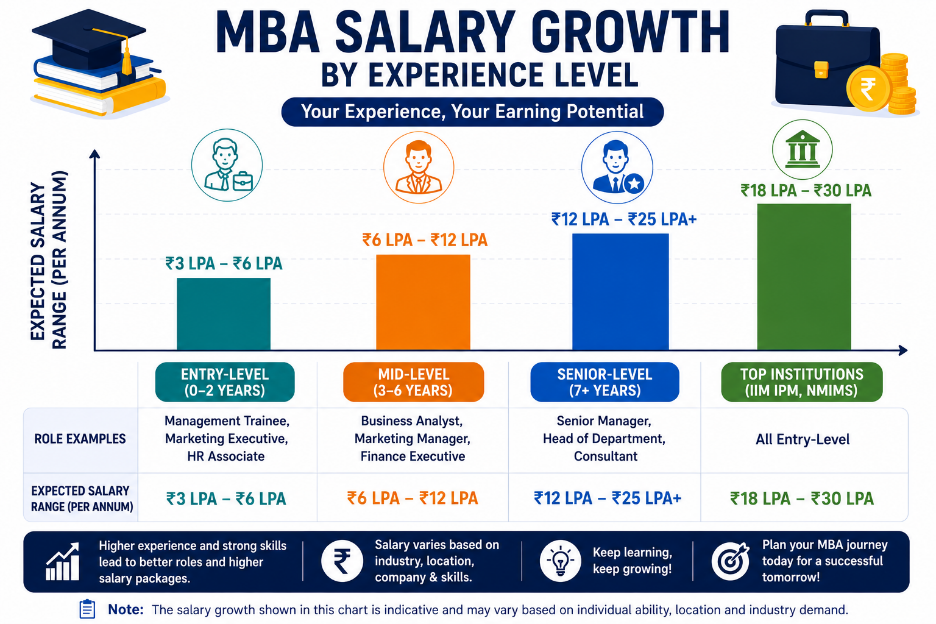
Worth noting: salary growth in business careers is strongly tied to upskilling. Those who combine their undergraduate degree with an MBA, a professional certification, or specialised skills consistently see faster progression and higher pay.
Disclaimer: The salary ranges mentioned above are approximate and may vary based on factors such as location, company, individual skills, educational background, and market demand. These figures are indicative of entry-level roles and should not be considered guaranteed compensation.
Government Job Opportunities After Business Courses
It doesn’t mean that business graduates cannot join the government sector. Government job preparation has been an option chosen by many students.
- Banking Sector: Amongst the most popular competitive examinations in the country, one can find the following options – IBPS PO, IBPS Clerk, and SBI PO. Graduates in business having the skills in finance and logic are perfect for such positions.
- SSC (Staff Selection Commission): SSC CGL offers access to various government job roles, including Assistant, Inspector, Auditor, and other administrative and supervisory positions in different government departments and ministries.
- UPSC (Civil Services): Many business graduates give their applications for civil services. Optional subjects such as Economics and Commerce are suitable for people who have graduated from the business department.
- RBI Grade B: This is the position in the Reserve Bank of India that is highly appropriate for the applicants who have majored in finance/economics.
Read Also: Make a career in the Government Sector
Business Courses After 12th Preparation Tips
Effective preparation is essential for success in business entrance exams. Here are the factors that matter most:
- Start Early: Since most entrances, including IPMAT and SET, have defined syllabi, begin your preparations well in advance – at least six months before the examinations. Preferably even from Class 11 for any competitive course.
- Prepare for aptitude: This is because quantitative, logical, and verbal aptitudes make up a major part of any business entrance examination. Regular practice pays off rather than trying to learn everything at once.
- Improve general awareness: General knowledge forms a part of various entrances, such as SET and UGAT. You can develop that by reading the newspaper daily – or even better, using trusted news apps on your phone.
- Enhance communication skills: The fact that all good institutions conduct GD/PI rounds only suggests the importance of developing good oratory skills. Join a debating society, engage in mock discussions, or speak out your thoughts regularly.
Best Career Options After Business Courses
Some of the career opportunities that one could pursue following completion of a business degree may vary depending on personal interests; however, the following have proven to be highly valuable:
- Traditional business careers within the realms of marketing, finance, human resources, and business operations continue to be the most common route to follow, with clear growth opportunities in bigger organisations.
- Starting your own business can also be a valid choice since many business schools encourage and even facilitate entrepreneurial thinking.
- Management consulting continues to be an extremely prestigious career path pursued by business graduates. Management consultancies such as Deloitte, McKinsey & Company, and BCG recruit exclusively from leading universities, and the work itself is highly intellectual and lucrative.
- Finance-related positions, including investment banking, equity research, and corporate finance, have proved highly lucrative and sought-after, with good earning potential in the long run.
Read Also: Best Courses after Class 12th Commerce
Common Mistakes Students Make
Understanding current industry trends can help students make informed course and career decisions.
- Trend-chasing: The mere fact that a specific course or college is trendy does not imply that it is best for you. Social media and peer influence have a way of making courses much more glamorous than they should be. Make sure you check for yourself.
- Ignoring interests: Business management education covers many topics, but there is an obvious difference between learning about finance and marketing all day long. If you have an interest, take it instead of going for the most “common” choice.
- Failing to verify eligibility properly: Some students end up applying to colleges without making sure that they fulfill the required criteria of percentage or stream. An easily avoidable mistake – do your homework.
- Neglecting placement information: While fees and ranks can be important considerations, your career prospects will depend on how many placements the college has made. Always ask for the placement report.
Read Also: 6 Career Mistakes Job-seekers Should Avoid
Conclusion
Business studies after the 12th grade offer a practical pathway to careers in management, finance, marketing, entrepreneurship, and other growing sectors. With businesses expanding across industries, these programmes provide the knowledge and skills needed to succeed in a competitive professional environment.
The essential thing here is not merely the selection of the course but whether it suits your interests or not. By taking the time to know what you want, it is easier to create a successful career for yourself.
In the end, there will always be some importance of business education within any industry. With proper planning, consistent hard work, and adaptability, students who meet the education requirements can build a strong and successful career with long-term growth opportunities
FAQs
Courses like BBA, B.Com, BMS, and IPM are highly preferred.
One needs to have 50% marks in 12th with any stream qualification. The minimum percentage may vary depending on the college.
CUET, IPMAT, SET, NPAT, and UGAT are some of the exams recognised by many institutes offering business courses.
Entry-level jobs offer salaries of ₹3–6 LPA.
Yes, students having Science, Commerce, or Arts stream can join any business course.
Marketing, finance, HR, consulting, and entrepreneurship are some fields where one can build a career.
 Beware of Scammers
