



India is strengthening its vocational education system to meet changing industry needs. According to The Economic Times, the Ministry of Skill Development and Entrepreneurship has partnered with Microsoft to bring AI education to 200,000 students across more than 1,000 ITIs and NSTIs.
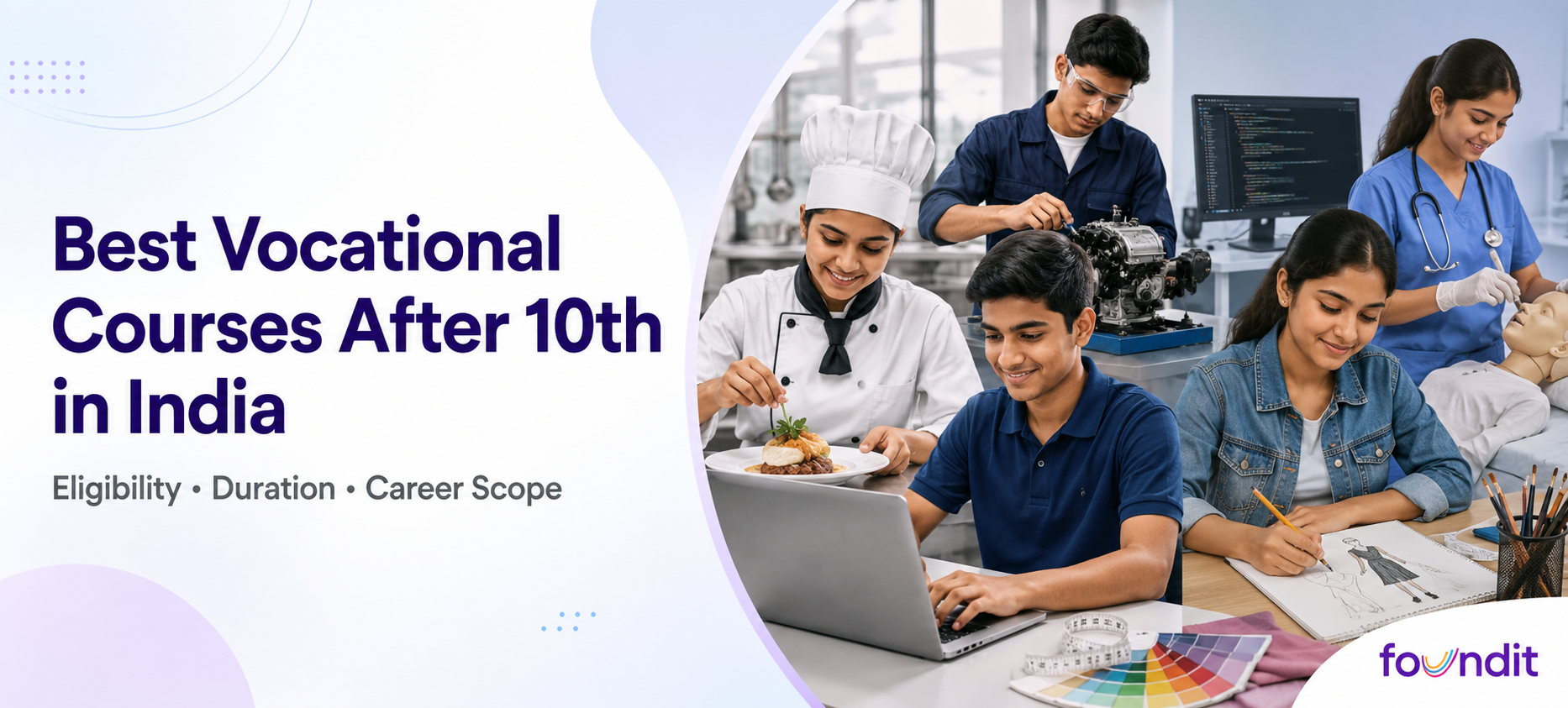
The initiative highlights the growing demand for practical, technology-focused skills. Today, vocational courses after 10th prepare students for careers across both traditional trades and emerging industries.
This guide explains the available courses, eligibility, fees, career opportunities, government schemes, and other key details to help you choose the right path after Class 10.
What Are Vocational Courses? (Definition, Types & How They Differ from Regular Courses)
The vocational training programs are special training programs in which students get job-oriented skills in a particular trade or profession. These are different from traditional education programmes, which only concentrate on theoretical education.
Vocational training programs involve practical learning skills using workshops, labs, simulations, and industrial exposure. This program enables students to get ready for their professional career right after completion of the course while giving them chances of higher education through diploma and degree courses.
Due to the increasing demand of skilled professionals in different industries, vocational courses have emerged as one of the best choices for job-oriented courses after 10th.
Read Also: Best Courses After 10th: High-Salary Diploma & Career Options 2026
Top Vocational Courses After 10th in India – Sector-wise List with Fees & Duration
Students can opt for vocational courses in various industries according to their interests and job prospects. The following sectors continue to offer some of the most popular skill development courses after 10th.
IT & Computer Courses
The IT sector continues to generate demand for skilled professionals with practical knowledge of software, hardware, networking, and office applications. Many of these programmes are suitable for students interested in technology careers.
| Course Name | Duration | Approx. Fees | Certification |
| Diploma in Computer Applications (DCA) | 6–12 months | ₹5,000 – 30,000 | University/State Board |
| Web Designing & Development | 3–6 months | ₹1,000 – INR 28.7 lakh | NSDC/Private |
| Computer Hardware & Networking | 6–12 months | ₹10,000 – 25,000 | NSDC/CompTIA |
| Data Entry Operator Certificate | 3–6 months | ₹5,000 | State Board/NIELIT |
| Tally & Accounting Software | 3–6 months | ₹2,138-8,100 | Tally Authorised |
Healthcare Vocational Courses
The healthcare industry is still amongst the fastest growing employment sectors in India. Programs in this field provide candidates with experience of working as health workers in hospitals, laboratories, clinics, and diagnostic centers.
| Course Name | Duration | Approx. Fees | Certification |
| Medical Lab Technician (MLT) | 1–2 years | ₹10,000–₹60,000 | NSDC/Paramedical Board |
| ANM (Auxiliary Nurse Midwifery) | 2 years | ₹1,770 – ₹50,000 | State Nursing Council |
| Pharmacy Assistant | 6–12 months | ₹15,200 | NSDC |
| Dental Assistant | 6–12 months | ₹15,000 | State Board |
| General Duty Assistant (GDA) | 3–6 months | ₹30,000 | NSDC |
Beauty & Wellness Courses
Beauty and Wellness is another field that has been rapidly growing because of high consumer demand. Students get an opportunity to start their own venture.
| Course Name | Duration | Approx. Fees | Certification |
| Certificate in Beauty Culture | 3–6 months | ₹30,000–₹80,000 | NSDC/State Board |
| Hair Styling & Cosmetology | 6–12 months | ₹25,000-₹6,90,000 | VLCC/NSDC |
| Nail Technician | 3 months | ₹4,250 | Private/NSDC |
| Skin Care & Aesthetics | 6 months | ₹40,000 | NSDC |
| Spa Therapy | 6–12 months | ₹40,000–₹50,000 | NSDC/Private |
Hospitality & Tourism Courses
Hospitality courses help in developing students’ abilities in customer service, food production, housekeeping, and travel management. Students can pursue their careers in areas like hotels, restaurants, airlines, resorts, and tourism.
| Course Name | Duration | Approx. Fees | Certification |
| Food & Beverage Service | 6–12 months | ₹30000 – ₹ 256500 | NSDC/IHMCT |
| Housekeeping Operations | 6 months | ₹1.5 Lakh – ₹10 Lakh | NSDC |
| Travel & Tourism Assistant | 6–12 months | ₹10,000- ₹11Lakhs | NSDC/IATA |
| Bakery & Confectionery | 6–12 months | ₹449 – ₹2999 | State Board/NSDC |
| Front Office Operations | 6 months | ₹3,200 | NSDC/Hotel Institute |
Agriculture & Rural Development Courses
Agriculture-based vocational programmes remain valuable for students from rural and semi-urban regions. Several government-supported schemes also offer free or subsidised training in this sector.
| Course Name | Duration | Approx. Fees | Certification |
| Certificate in Agricultural Sciences | 6–12 months | ₹79,296 | State Agriculture University |
| Organic Farming | 3–6 months | ₹75,000 | NSDC |
| Dairy Technology | 6–12 months | ₹50,000–₹3,00,000 | State Board |
| Horticulture Assistant | 6 months | ₹5,000-3,00,000 | NSDC |
| Rural Development & Panchayati Raj | 3–6 months | ₹2,00,000 | Government |
Disclaimer: The fees mentioned are approximate and are subject to change. Actual fees may vary based on the applicable requirements, policies, and charges at the time of processing.
Read Also: Top Career Options after Class 10th in 2026
Eligibility & Admission Process: Who Can Apply and How
Vocational courses are designed to make skill-based education accessible to students from different academic backgrounds.
While admission requirements vary depending on the course, institution, and state, most programmes have straightforward eligibility criteria that allow students to begin developing practical skills soon after completing Class 10.
Eligibility Criteria
Most institutes follow similar admission requirements for vocational courses after 10th.
- Educational Qualification: Class 10 pass from a recognised board.
- Minimum Marks: Most certificate programmes do not have a minimum marks requirement, while some diploma courses after 10th may require 45–50% aggregate marks.
- Age Limit: Most programmes accept candidates aged 14–25 years. Government ITI programmes generally require candidates to be at least 14 years old.
- Subject Requirements: Most courses are open to students from all backgrounds. However, technical and healthcare programmes may prefer students with a science background.
- Special Provisions: Several state governments offer reservations and concessions for eligible categories, including students with disabilities.
- Mathematics Requirement: Many beauty, hospitality, retail, and creative courses do not require mathematics as a compulsory subject.
Eligibility requirements vary across institutions and states. Students should always verify the latest admission criteria with the respective institute before applying.
Step-by-Step Admission Process
Admission procedures differ across government and private institutions, but the overall process generally follows these steps.
Step 1: Select Your Course and Institute
Begin by shortlisting two or three courses based on your interests and career goals. Compare government and private institutes, and check whether they are recognised by NSDC, NCVT, State Boards, or universities.
Step 2: Check Eligibility and Collect Required Documents
Review the admission criteria carefully and keep important documents ready, including your Class 10 marksheet, transfer certificate, identity proof, passport-sized photographs, and any category certificates, if applicable.
Step 3: Fill the Application Form
Generally, government institutes accept application forms through state admission portal, while private institutes provide application options both online and offline. The admission process starts mostly in the month of May to August.
Step 4: Submit Documents and Pay the Admission Charges
Submit the necessary documents and pay the admission charges. Government ITIs and training institutes have minimal charges as compared to private institutes.
Step 5: Attend the Interview or Counselling (If any)
Some specialised healthcare and vocational courses have interview or counselling process. Admissions in government ITIs are done through counseling based on merit.
Step 6: Confirm Admission and Begin Training
Once your seat is allotted, complete the admission formalities within the specified timeline. Most institutes commence academic sessions between July and August.
Read Also: Best Diploma Courses After 10th in 2026
Fees, Duration & Scholarships: What Vocational Courses Really Cost
The cost of vocational courses after 10th varies depending on the programme, institute, and mode of study. Government institutions generally offer more affordable options, while private institutes may charge higher fees based on infrastructure, facilities, and certifications offered.
Government fees vary across states. Some states, including Rajasthan, Gujarat, and Tamil Nadu, offer selected ITI trades at subsidised or minimal cost.
Course Duration
Course duration depends on the qualification level and the skills being taught.
| Duration | Typical Course Types | Best Suited For |
| 3–6 months | Basic certificates and short-skill programmes | Quick workforce entry |
| 6–12 months | Advanced certificates and one-year diplomas | Skilled employment and further education |
| 1–2 years | Diploma programmes and ITI trades | Technical careers and supervisory roles |
Government-Funded Scholarships and Free Training
Students looking for affordable skill development courses after 10th can benefit from various government initiatives.
The Pradhan Mantri Kaushal Vikas Yojana (PMKVY) is India’s flagship vocational training programme, implemented by the Ministry of Skill Development and Entrepreneurship (MSDE) through the National Skill Development Corporation (NSDC). Eligible candidates can receive recognised training in multiple sectors through approved training centres.
PMKVY training is available through:
- NSDC-affiliated training partners across India
- Pradhan Mantri Kaushal Kendras (PMKKs)
- The Skill India Digital portal
It is important for students to ensure that they are aware of the availability, eligibility criteria, and application procedures from the official government website before choosing the course.
Fees charged for the courses may vary from one institution to another; therefore, it is important to check out the updated fees directly from the institution concerned.
Read Also: Educational Guidance and Counselling for Students
How to Choose the Right Vocational Course for Your Career Goals
Selection of a vocational course is not only about selecting a popular course. The choice depends on many factors such as interest and a future career.
Identify Your Interest Area
Start off by identifying your strengths and preferences. For instance, students with practical inclinations would be better suited to technical courses like electrical, automotive or plumbing courses.
Those with inclinations towards people would favor healthcare, hospitality, or beauty and wellness courses. Course selection in line with one’s interest could make one more interested in the job and hence more satisfied.
Look into the Employment Demand for your Area
Job prospects vary between cities and regions. Before joining a program, it is important to look at job openings in the industry, talk to people who have jobs in the area you choose, and refer NSDC Sector Skill Council reports.
Verify NSDC Certification and Institute Recognition
Always ensure that the institute offers recognised certifications. Check whether it is affiliated with NSDC, NCVT, a recognised State Board, or a university.
Reviewing placement records and industry partnerships can also help you assess the quality of training provided.
Compare Course Fees with Career Opportunities
Compare the overall course cost with potential career outcomes. Consider the average entry-level salary in your preferred field, opportunities for career progression, and the availability of government-funded alternatives before making your final decision.
Read Also: 8 Steps to finding a career that you are passionate about
Career Scope & Salary After Vocational Courses: What You Can Realistically Earn
Taking up vocational courses after 10th can provide avenues in different industries including IT, healthcare, hospitality, manufacturing, beauty and wellness, agriculture, and retail.
Career paths will be dictated by the particular course taken, practical skills gained, industry demands, and location. With more experience, qualifications, and up-skilling, an individual is able to advance into supervisory positions or even venture into business ventures.
Vocational Courses After 10th Salary by Sector
The table below provides indicative monthly salary ranges across different sectors. Actual salaries vary depending on the employer, city, experience, and individual skills.
| Sector | Salary |
| IT & Computer | ₹9.1L/yr-₹10.1L/yr |
| Healthcare (Paramedical) | 2.5L/yr-₹2.8L/yr |
| Beauty & Wellness | ₹3.5L/yr-₹4.4L/yr |
| Hospitality & Tourism | ₹2.4L/yr-₹3.5L/yr |
| Agriculture & Agri-tech | ₹2.9L/yr-₹3.2L/yr |
| Electrical & Electronics (ITI) | ₹2.5L/yr-₹3.3L/yr |
| Automotive (ITI) | ₹2.3L/yr-₹3.4L/yr |
| Fashion & Apparel | ₹5.8L/yr-₹6.4L/yr |
Disclaimer: The salary ranges mentioned are approximate and may vary based on factors such as location, company, individual skills, educational background, and market demand. These figures are indicative of entry-level roles and should not be considered guaranteed compensation.
Read Also: Off-the-Job Training: Meaning, Methods, and Benefits
Government Schemes That Support Vocational Education in India
The Government of India has initiated various programs for the encouragement of skill development and employability amongst students.
Vocational education is facilitated through these programs through various means such as subsidised or even free vocational training programs.
PMKVY – Free Government Vocational Training
The Pradhan Mantri Kaushal Vikas Yojana (PMKVY) is implemented by the Ministry of Skill Development and Entrepreneurship (MSDE) through the National Skill Development Corporation (NSDC).
Key features include:
- Free training for eligible candidates
- Industry-recognised certifications through NSDC-affiliated Sector Skill Councils
- Placement support through authorised training partners
- Training across multiple sectors, including IT, healthcare, retail, hospitality, construction, logistics, agriculture, and beauty & wellness
Eligible candidates can enrol through the Skill India Digital portal or their nearest Pradhan Mantri Kaushal Kendra (PMKK).
NSDC Certification and Industry Partners
The NSDC certification is accepted across various sectors owing to the fact that training programs offered are aligned with the National Occupational Standards (NOS). The NSDC has collaboration with many training institutions and Sector Skill Councils.
Students should verify whether their chosen institute appears in the official NSDC training partner directory before enrolling.
Skill India Mission
The Skill India Mission brings together multiple government initiatives that promote vocational education, apprenticeship, and workforce development across India.
The mission integrates programmes such as:
- Pradhan Mantri Kaushal Vikas Yojana (PMKVY)
- National Apprenticeship Promotion Scheme (NAPS)
- Standard Training Assessment and Reward (STAR)
These initiatives continue to expand access to skill development opportunities across various sectors and regions.
Read Also: Make a career in the Government Sector!
Top Colleges & Institutes for Vocational Courses After 10th in India
Students should choose institutes that offer recognised certifications, experienced faculty, practical training, and industry exposure.
Government-approved institutions generally provide affordable education, while private institutes may offer specialised infrastructure and placement support.
Government Institutes
- Industrial Training Institutes (ITIs)
- Pradhan Mantri Kaushal Kendras (PMKKs)
- State Boards of Technical Education
- IGNOU Vocational Programmes
- Kendriya Vidyalaya and Navodaya Vidyalaya vocational streams (where available)
Private Institutes
- Aptech Computer Education
- NIIT
- VLCC Institute
- Institute of Hotel Management (IHM) affiliated centres
- Lovely Professional University
- Amity University
- Dr Bhim Rao Ambedkar College (Delhi University)
Checklist Before Choosing an Institute
Before enrolling, verify the following:
- Is the institute recognised by NSDC, NCVT, a State Board, or a university?
- Does it provide recognised certification?
- Does it have a verifiable placement record?
- Is practical training included in the curriculum?
- Does the institute maintain industry partnerships?
Read Also: Zone-wise ranking of top B-Schools across the country
Vocational Courses After 10th for Science, Commerce & Arts Students
Students from every academic background can pursue vocational education. The most suitable course depends on career interests rather than stream alone.
Science Stream
| Course | Duration | Key Career Roles |
| Medical Lab Technician (MLT) | 1–2 years | Lab Technician, Sample Collector, Hospital Support |
| Diploma in Pharmacy (D.Pharm) | 2 years | Pharmacy Assistant, Medicine Store |
| Diploma in Nursing (GNM/ANM) | 2–3 years | Nurse, Midwife, Community Health Worker |
| Diploma in Electronics Engineering | 1–2 years | Electronics Technician, Repair Specialist |
| Agricultural Science Certificate | 6–12 months | Agriculture Assistant, Soil Technician |
| Computer Hardware & Networking | 6–12 months | Hardware Technician, Network Support |
Commerce Stream
| Course | Duration | Key Career Roles |
| Tally & Accounting Certificate | 3–6 months | Accounts Assistant, Data Entry Operator |
| Retail Management Diploma | 6–12 months | Store Executive, Sales Coordinator |
| Banking & Financial Services | 6–12 months | Banking Support, Insurance Executive |
| Digital Marketing Certificate | 3–6 months | Social Media Executive, Content Assistant |
| Logistics & Supply Chain | 6–12 months | Warehouse Coordinator, Dispatch Executive |
Arts Stream
| Course | Duration | Key Career Roles |
| Fashion Designing Certificate | 6–12 months | Design Assistant, Boutique Professional |
| Beauty Culture & Cosmetology | 6–12 months | Beautician, Makeup Artist |
| Graphic Design | 6–12 months | Junior Graphic Designer |
| Travel & Tourism Certificate | 6 months | Travel Consultant, Ticketing Executive |
| Early Childhood Care & Education | 6–12 months | Childcare Assistant |
| Performing Arts | 1–2 years | Performer, Instructor, Content Creator |
Conclusion: Is a Vocational Course the Right Path for You?
Vocational courses after 10th provide a practical pathway for students who want to develop industry-relevant skills and begin building their careers early.
Before enrolling, compare course content, institute recognition, placement support, and career opportunities. It is equally important to verify certifications, understand the fee structure, and explore whether government-funded alternatives are available for your chosen field.
Government initiatives such as the Skill India Mission and PMKVY have made vocational education more accessible through recognised training and certification.
FAQs
There is no single best vocational course after 10th. The right choice depends on your interests, skills, and career goals. IT, healthcare, hospitality, and technical trades remain some popular options.
The vocational courses after 10th salary varies by industry, employer, experience, and location. Entry-level salaries generally range from ₹7,000 to ₹18,000 per month and may increase with experience.
Most vocational courses require candidates to have passed Class 10 from a recognised board. Some diploma and healthcare programmes may also require minimum qualifying marks or specific subject requirements.
Yes. Eligible students can enrol in free vocational training under PMKVY through authorised training centres. These programmes offer recognised NSDC certification across multiple industry sectors.
ITI courses after 10th focus on technical trades, while vocational courses cover technical, healthcare, hospitality, retail, and service sectors. The better option depends on your career interests and goals.
 Beware of Scammers
