




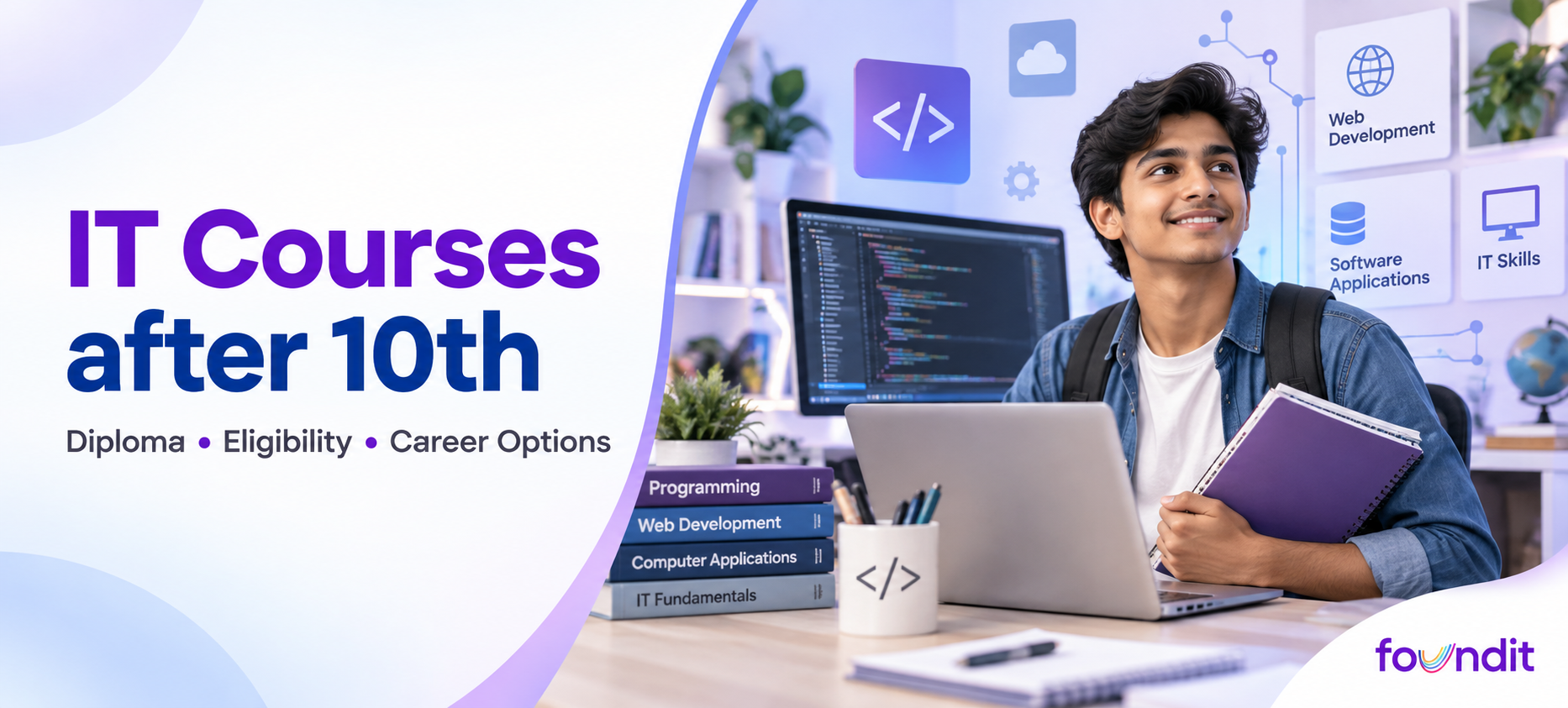
IT courses following 10th class can help lay a good foundation for a career in the field of technology. Students have the opportunity to learn about available courses including basic computer courses, programming, web development, networking, and other technology related courses.
In FY26, the tech sector will generate direct employment of approximately 6 million people, and the sector’s size will be pegged at $315 billion, according to the NASSCOM 2026 Strategic Review.
Students select a course according to their interest and academic plans and preferred career pathways. Short-term certificate courses may be useful to acquire certain skills, and diploma courses can provide more formal technical training.
This article provides information on the various IT courses after 10th, eligibility, course duration, career options, and what can be done after completing IT courses.
What are IT courses after 10th?
IT courses after 10th is the short term or Diploma courses after 10th that enable students to develop some basic technical and computer skills after 10th. They can include programming, networking, web development, hardware, and cyber security.
There are options for students to take this course in various formats depending on their career interests:
- Certificate courses: Typically, shorter than a degree (usually 3-12 months) and concentrate on particular computer or technical skills.
- ITI courses: These courses can offer hands-on training in fields like information technology, computer hardware, and technical trades.
- Diploma courses: 1 to 3 years in length and generally offer more general technical training. Students aiming to pursue a career in IT can pursue a diploma in information technology.
The right course will be determined by your interests, study plans, and career goals.
Read Also: Best Courses After 10th: High-Salary Diploma & Career Options 2026
Why Choose a Tech Career Path Right After 10th?
Students can take up technology courses after Class 10 in order to learn hands-on skills in a timely manner. It can also be a straight route to further education or to a first job in technical fields.
The IT and technology industry in India has been growing steadily. The direct employment in IT/Tech industry has grown from 4.14 million in 2019 to 5.8 million in the recent years, according to the Press Information Bureau of Government of India.
Technology infrastructure and opportunities are expanding beyond major cities. Software Technology Parks of India (STPI) has established centres in several Tier-II and Tier-III cities to support IT and technology businesses, promote entrepreneurship, and encourage the growth of the technology sector in these regions.
Technology infrastructure and opportunities leave several options to explore after class 10 for students. They encompass programming, technical support, network, web development, and cybersecurity. Computer courses after 10th may be useful in developing skills for these areas.
Students may also earn certifications and/or advance their education following completion of the first course. When considering the highest paying computer courses, it is important to select courses that are in demand and not just because of the salary.
Read Also: Top 10 Highest Paying Tech Skills to Learn in 2026
Complete List of Computer Courses After 10th
Students have several computer courses after 10th to choose from. The right option depends on the course duration, skills covered, and your plans for further education.
| Course name | Eligibility | Duration |
| Certificate in Computer Applications | 10th Pass | 6 to 12 months |
| Diploma in Computer Science | 10th Pass | 1 to 2 years |
| Certificate in Web Designing | 10th Pass | 6 months |
| Diploma in Software Development | 10th Pass | 1 year |
| Diploma in Information Technology | 10th Pass | 1 to 3 years |
| Diploma in Cybersecurity | 10th Pass | 1 year |
| Certificate in Data Entry and Office Automation | 10th Pass | 6 months |
| Diploma in Graphic Designing | 10th Pass | 1 year |
| Diploma in Digital Marketing | 10th Pass | 6 months to 1 year |
| Certificate in Programming Languages | 10th Pass | 6 months |
| Diploma in Computer Hardware and Networking | 10th Pass | 1 year |
| ITI information technology courses | 10th Pass | Varies by trade |
The fees for IT courses after 10th vary based on the course, institute and duration. Short-term certificate courses may cost less than longer diploma programmes.
Students looking for job-oriented options can compare courses based on the skills they teach. Those interested in technology careers can also consider a diploma in information technology or a diploma in cybersecurity after 10th.
There is no single course that is suitable for everyone. If you are comparing the best computer courses for high salary, consider the career scope, required skills and opportunities for further education along with the expected salary.
Read Also: Basic Computer Skills For 2026: Definition And Examples
Best Diploma in IT after 10th: Courses, Fees & Colleges
After class 10, students can pursue diploma courses in information technology to develop their practical and technical abilities to enter the IT industry at a basic level. These programmes consist of classroom-based courses, hands-on training, and may also be complementary to further training.
Diploma in computer science and engineering
A Diploma in Computer Science and Engineering is a three-year course provided by a polytechnic institute. It includes the following courses: Programming, Databases, Computer Networks, Operating Systems, and Software Development.
Students also have hands-on experience in the laboratory and projects. There is a variation in the fee charged depending on the institute, state, and type of students, so students should check the latest fee structure before applying.
Diploma in information technology
A Diploma in IT usually focuses on software, applications, and internet technologies. Students may learn programming, web development, databases, software engineering, and basic IT security.
This is a suitable option for students who want to build a foundation in technology after Class 10. It can also provide a pathway to higher technical education.
Diploma in computer applications
A Diploma in Computer Applications (DCA) is generally shorter than a polytechnic diploma. It may cover applications such as MS Office, accounting software, internet tools, and basic computer operations.
The course can suit students who want to develop basic digital skills within a shorter period. However, its duration, curriculum, and recognition can vary across institutes.
Top government institutes for IT diploma
Government polytechnics are available across different states and offer diploma programmes in computer science, IT, and related fields. Fees and admission rules differ by the institute.
| Institute | Location | Programme | Approx. Fees |
| Government Polytechnic, Mumbai | Maharashtra | Diploma in Computer Science | ₹15,000–₹30,000 |
| Delhi Government Polytechnic | Delhi | Diploma in Information Technology | ₹10,000–₹25,000 |
| Chandigarh Polytechnic | Chandigarh | Diploma in Computer Science and Engineering | ₹15,000–₹30,000 |
| Government Polytechnic, Chennai | Tamil Nadu | Diploma in Information Technology | ₹10,000–₹25,000 |
| Government Polytechnic, Pune | Maharashtra | Diploma in Computer Science | ₹15,000–₹30,000 |
| Government Polytechnic, Bengaluru | Karnataka | Diploma in Computer Science and Engineering | ₹10,000–₹30,000 |
| Government Polytechnic, Hyderabad | Telangana | Diploma in Information Technology | ₹10,000–₹25,000 |
Disclaimer: The fee figures mentioned are indicative. Actual fees may vary. Please verify the latest fee details with the respective institution.
Students can compare these options based on course duration, subjects, fees, admission requirements, and career plans.
Read Also: Diploma Courses After 10th: Best Career Options, Streams & Salary Guide 2026
ITI Computer Courses After 10th: Government-recognised Options
ITI information technology courses provide practical training for students who want to enter technical fields after Class 10. These vocational programmes are offered through ITIs and can lead to recognised trade certificates.
The Directorate General of Training (DGT) oversees the national vocational training system. Students can choose computer-related trades based on their interests, such as software, office applications, hardware, or technical support.
ITI information technology
The ITI Information Technology trade generally focuses on computer operations, programming basics, data management, networking, and troubleshooting. Students also gain practical experience through computer lab training.
The course duration and admission requirements can vary by trade and institute. Students should check the latest details on the official state ITI admission portal before applying.
Computer operator and programming assistant (COPA)
COPA is a popular computer-related ITI trade for students who want to develop practical digital skills. The course covers computer operations, office applications, data processing, internet use, and basic programming.
The trade generally has a one-year duration. It can help students prepare for entry-level roles such as computer operator, data entry operator and office assistant.
IT and electronics system maintenance
IT and Electronics System Maintenance focuses more on computer hardware and technical maintenance. Students learn about computer components, peripherals, basic networking, and equipment troubleshooting.
This option can suit students who prefer practical hardware work over programming. Career options may include hardware technician, IT support assistants, and maintenance technicians.
ITI eligibility and admission process
Eligibility requirements depend on the trade and state. Many ITI computer trades require students to have passed Class 10, while some trades may have additional subject or percentage requirements.
The admission process usually involves these steps:
- Visit the official ITI admission portal of your state.
- Register using your Class 10 details and required documents.
- Select your preferred trade and ITI.
- Check the merit list or admission result.
- Complete document verification.
- Pay the required fees and begin training.
Government ITIs generally has lower fees than private institutes. Students should check the latest fee structure, eligibility criteria, and admission dates before submitting an application.
Read Also: Best ITI Courses After 10th: Fee, Duration, Salary 2026
High-Salary IT Skills: Cybersecurity, Web Development And AI After 10th
Students interested in the best computer courses for high salary can explore skills such as cybersecurity, web development and artificial intelligence. However, salary depends on skills, experience, job roles, and qualifications.
Cybersecurity and ethical hacking – H3
Cybersecurity focuses on protecting computers, networks, and digital information from online threats. Students can start with a diploma in cybersecurity after 10th and later add specialised certifications.
Key skills include network security, ethical hacking, system protection, and basic programming. With further education and experience, students can move into roles such as security analysts or cybersecurity technicians.
Full-stack web development
Web development is another technology skill that students can start learning after Class 10. Basic courses usually cover HTML, CSS, and JavaScript, while advanced training may include React, Python, databases, and APIs.
Students can begin with a short-term course and build practical projects to improve their skills. Further study and experience can help them progress towards roles such as web developers or full-stack developers.
Artificial intelligence and machine learning
Artificial intelligence and machine learning involve using data and computer systems to perform tasks that usually require human intelligence. Beginners can start with basic programming, mathematics, and data concepts.
Students should treat AI as a longer-term career path because advanced roles usually require stronger technical and mathematical knowledge. Building a foundation after Class 10 can help with future diploma or degree-level studies.
Comparison of high-demand IT skills
| IT skill | What students learn | Suitable starting option | Career direction |
| Cybersecurity | Network security, ethical hacking, system protection | Diploma or certificate | Security analyst, cybersecurity technician |
| Web development | HTML, CSS, JavaScript, programming, databases | Short-term course or diploma | Web developer, full-stack developer |
| Artificial intelligence | Programming, data, mathematics and AI concepts | Beginner certificate followed by higher studies | AI operations, data and AI-related roles |
There is no single IT skill that guarantees a high salary. Students should choose a field based on their interests, learning ability, and plans for higher education.
Among computer courses after 10th, cybersecurity and web development can provide an early introduction to technology. AI can also be explored as a foundation for more advanced studies later.
Read Also: Diploma in AI After 10th: Your Complete Guide to Courses, Careers & Scope in 2026
Short-term IT certifications for 10th pass students
Short-term IT certifications can help 10th pass students develop practical skills without committing to a three-year programme. These courses typically take around 2–6 months and can support entry-level jobs, internships or freelance work.
| Certification/Course | Duration | Key skills covered | Career options |
| Certificate in Web Development | 3–6 months | HTML, CSS, JavaScript, basic web development | Junior web developer, web designer |
| Certificate in Python Programming | 3–6 months | Python basics, programming logic, problem-solving | Junior Python developer, coding trainee |
| Certificate in Cybersecurity | 3–6 months | Network security, cyber threats, security basics | Cybersecurity trainee, IT support |
| Certificate in Computer Applications | 3–6 months | MS Office, internet, basic computer skills | Computer operator, office assistant |
| Certificate in Tally and Accounting | 2–6 months | Tally, GST, basic accounting | Accounts assistant, billing executive |
| Certificate in Data Analytics | 3–6 months | Excel, data handling, basic visualisation | Data entry executive, analytics trainee |
1. Certificate in Web Development
This course introduces HTML, CSS and basic JavaScript to help students build websites. It can provide a foundation for entry-level careers in web development and design.
2. Certificate in Python Programming
Students learn Python fundamentals, programming logic and basic problem-solving skills. The course provides a foundation for further studies in software development and automation.
3. Certificate in Cybersecurity
This certification covers network security, common cybersecurity threats and basic security practices. It is suitable for students interested in pursuing a career in cybersecurity.
4. Certificate in Computer Applications
Students learn basic computer skills, MS Office, internet usage and other essential digital skills. The course is useful for computer operator and office-based roles.
5. Certificate in Tally and Accounting
This course introduces Tally, basic accounting concepts and GST-related fundamentals. It can help students prepare for entry-level billing and accounts assistant roles.
6. Certificate in Data Analytics
Students learn Excel, basic data handling and data visualisation techniques. The course provides an introductory pathway for those interested in data-related careers.
Read Also: AI Courses for Beginners in 2026: A Complete Guide
Diploma Vs ITI Vs Degree: Which IT Path Is Right For You?
After Class 10, students interested in technical and IT careers can choose between an ITI, diploma or degree programme. Each path differs in duration, eligibility, course level, fees, and career opportunities.
ITI programmes focus more on practical trade skills and can help students enter the workforce sooner. A diploma provides broader technical knowledge with practical training, while a degree offers deeper theoretical knowledge along with opportunities for advanced study.
| Basis | ITI | Diploma | Degree |
| Duration | 1–2 years | 3 years | 4 years |
| Course level | Vocational/Technical | Technical/Professional | Undergraduate |
| Eligibility | 10th pass | 10th/12th pass | Class 12 (PCM) + JEE |
| Focus area | Hands-on trade skills | Technical knowledge + practical training | Theory + research + design |
| Course fees (Govt. institute) | ₹2,000–₹10,000/year | ₹8,000–₹25,000/year | ₹50,000–₹1,50,000/year |
| Job opportunities | Technician/Technologist | Technician/Engineer | Engineer and other graduate-level roles |
| Higher study option | Diploma (Lateral, Year 2) | B.Tech (Lateral, Year 2) | M.Tech / MBA / UPSC |
Disclaimer: The salary figures mentioned are indicative. Actual salaries may vary depending on the role, employer, location, and experience.
ITI: a practical route after Class 10
ITI is a vocational training option that focuses on practical skills in a specific trade. Students can choose trades related to areas such as electrical work, mechanical work, and welding.
With a shorter duration of around 1–2 years, ITI can help students develop job-oriented skills and enter technician-level roles sooner.
For students who want to start working after Class 10 without spending several years on higher education, ITI can be a suitable technical pathway. Government ITIs also have relatively lower course fees, with the approximate fee shown in the comparison above ranging from ₹2,000 to ₹10,000 per year.
Diploma: a balance of technical knowledge and practical skills
A diploma is a three year course of study in the technical or professional field which offers theoretical and practical instruction. Students who finish Class 10 may go for a number of diploma courses such as computer science, electronics, and other engineering courses.
A diploma may result in entry level or technician positions in engineering, depending on the specialty. It can also give an alternative route to B.Tech: Lateral entry, enabling eligible students to enter into the 2nd year of the degree programme.
Degree: a longer path with broader career options
A degree course normally requires class 12 with appropriate subjects. A four-year B. is a popular undergraduate degree in engineering.
Upon successful completion of all necessary entrance/examination and admission requirements, Tech or BE programme after admission.
A degree course has more extensive theoretical study, as compared to ITI and diploma course, and includes practical, design and research-oriented learning. Can provide progression to graduate engineering positions and higher education MTech or MBA.
Which IT path should you choose?
The choice should be based on your learning objectives, learning style, and also your speed in the learning process. In case you’re looking for practical training and have a desire to complete the course after Class 10 and get straight to work, ITI might be a better option.
If you are interested in technical education with hands on experience and lateral entry into B.A diploma will be taken into account for Tech.
For those who will go on to the undergraduate level in engineering and seek greater options for further education, a degree might be a better choice.
There are no straight and easy paths in IT that work for all students. Compare the course duration, eligibility, fees, learning approach and career options before making your decision.
Eligibility for IT Courses After 10th: What You Need to Know
Many IT courses after 10th are open to students from different academic backgrounds. Most entry-level programmes require students to have passed Class 10 from a recognised board. However, eligibility criteria can vary depending on the course, institute, and state.
Eligibility by course type
Different IT programmes have different admission requirements. Here is a general overview:
- ITI trades (COPA, ITESM): Class 10 pass from a recognised board is generally required. Some institutes or state-level admissions may specify minimum marks or subject requirements.
- Polytechnic diploma (DCSE, DIT): Class 10 pass is generally the minimum qualification. Certain diploma programmes may require Mathematics and Science at Class 10 level, depending on the state and institute.
- DCA and short diploma programmes: Many private institutes accept Class 10 pass students. Minimum marks and subject requirements may vary by institute.
- Online certificates: Many beginner-level online IT courses have no formal educational eligibility criteria. Basic computer knowledge and familiarity with English can be helpful for following the course.
- Diploma in cybersecurity: Eligibility varies by institute. Several entry-level programmes accept Class 10 pass students, while some may prefer or require Mathematics or other specific subjects.
Admission process step-by-step
The admission process depends on whether you choose an ITI, government polytechnic, private institute, or online programme. The general process is:
- Choose the course and institute: Decide whether you want to pursue an ITI trade, polytechnic diploma, private diploma or online certification.
- Check eligibility: Review the institute’s official eligibility criteria, including minimum marks, required subjects and age limits, if applicable.
- Check admission dates: Government institutes generally follow state or institute-specific admission schedules. Check out the official admission portal for the latest dates.
- Complete the application: Application to be submitted either through the official portal or directly to the institute for the respective programme.
- Submit documents: Common documents include Class 10 marksheet, school leaving certificate, identity proof and category certificate (if applicable).
- Finalise the selection procedure: Admission could be merit, counselling, an entrance test or direct admission based on the programme.
- Confirm the admission: Make payment of the required fees and formalities for confirmation of admission.
Can students do IT without science?
Yes. Students do not always need a Science background to start an IT course after Class 10. Many entry-level programmes accept students from different academic backgrounds, provided they meet the stated eligibility criteria.
Courses such as DCA, COPA and several beginner-level digital skills programmes can be accessible to students without a Science background. However, some technical diploma programmes may require Mathematics or specific subjects at Class 10 level.
Therefore, students should check the eligibility criteria of the specific course and institute before applying. This helps avoid choosing a programme for which a particular subject or minimum percentage is mandatory.
Read Also: Science Courses After 10th
Career Scope & IT Jobs You Can Get After 10th
After an IT course completion, a scope of career can be extended to technical support, software development, networking, systems administration and cyber security.
The students can be given entry level jobs on completing ITI trade, Diploma or any kind of IT related certification and can gain skills from the experience and further training.
But it is dependent on the employer concerning the job eligibility, the course qualification and the required skills for the job. Additional certifications or experience may also be required for some technical jobs.
Entry-level IT job roles
The following roles can be considered by students who complete relevant IT courses, ITI trades or diplomas after Class 10:
| Job role | Typical qualification | Estimated starting salary | Key skills needed |
| IT Support Specialist | IT support certification / IT diploma | ₹2–4 LPA | Hardware and software troubleshooting, operating systems, communication |
| Help Desk Technician | IT support certification / IT diploma | ₹2–3.5 LPA | Troubleshooting, ticketing tools, customer service |
| Junior Software Developer | Software development diploma / coding certification | ₹3–5 LPA | Programming, Git, basic software development |
| Network Technician | Networking or IT diploma | ₹2.5–4.5 LPA | TCP/IP, routers, switches, network troubleshooting |
| Systems Administrator Assistant | IT diploma / systems administration training | ₹2.5–4 LPA | Operating systems, server basics, backups, troubleshooting |
| Entry-Level Cybersecurity Analyst | Cybersecurity diploma / certification | ₹3–5 LPA | Network security, security tools, threat monitoring |
Salary ranges by role
Entry-level IT salaries in India can vary significantly by role, employer and location. Based on the salary ranges listed above, starting salaries for these roles generally fall between ₹2 LPA and ₹5 LPA.
IT support and help desk roles can offer starting salaries of around ₹2–4 LPA. Network technician and systems administration roles can offer approximately ₹2.5–4.5 LPA. Junior software development and entry-level cybersecurity roles can offer around ₹3–5 LPA at the starting level.
As professionals gain experience and develop specialised skills, their earning potential can increase. For example, the provided salary data places experienced junior software developers and cybersecurity analysts in the ₹6–8 LPA range, while experienced IT support and network professionals can earn around ₹5–7 LPA.
Disclaimer: The salary figures mentioned are indicative. Actual salaries may vary depending on the role, employer, location, and experience.
How to get an IT job after diploma or ITI
Getting an entry-level IT job requires more than completing a course. Students can improve their chances by combining their qualifications with practical skills and work experience.
- Complete an internship or apprenticeship: Practical exposure can help students understand workplace tools and processes.
- Build a basic portfolio: Students interested in software development can create small projects and maintain them on GitHub. Cybersecurity learners can practise through suitable labs and security exercises.
- Develop job-specific skills: Focus on the tools and technical skills commonly required for the chosen role. For example, networking students can practise router configuration and troubleshooting.
- Apply for entry-level positions: Look for jobs that clearly state eligibility for ITI, diploma or certification holders. Check the qualification requirements before applying.
- Continue learning: Additional certifications and practical experience can help students move towards more specialised IT roles.
Career growth after an IT course
An IT course after 10th can serve as a starting point rather than the final qualification. Students can gain experience, pursue advanced certifications, or continue their formal education.
For example, someone starting in IT support can develop expertise in systems or networking. A student interested in programming can progress from junior development roles to more specialised software development positions.
Similarly, cybersecurity learners can build knowledge of security tools, networks, and threat monitoring before moving into more advanced roles.
The career path ultimately depends on the course selected, practical skills, additional qualifications and experience gained after Class 10.
Read Also: 8 fastest growing tech skills you should watch out for
Top Institutes for IT Courses After 10th in India
When thinking of career in IT after class 10, it is crucial to select the appropriate institute. The institute can affect the training quality, practical exposure and certification, and placement.
Students have the option to attend government ITIs, government polytechnics, private training institutes, or online learning institutions.
Please do check if the course is recognised and the necessary requirements of the course are in accordance with your Class 10 Grade.
Government institutes: Polytechnics and ITIs
Students who want to pursue technical education after Class 10 are common to ITIs and polytechnics run by the government. They provide courses in computer applications, software, networking, and electronics.
| Institute | State/UT | Relevant courses or areas |
| Government Polytechnic, Mumbai | Maharashtra | Computer Science, IT and related technical programmes |
| Government ITIs in Delhi | Delhi | COPA and other IT-related trades |
| Government Polytechnic, Chennai | Tamil Nadu | Computer-related diploma programmes |
| Government Polytechnic, Bengaluru | Karnataka | Computer Science, IT and electronics-related programmes |
| Government Polytechnic, Chandigarh | Chandigarh | Computer-related diploma programmes |
| Government ITIs in Gujarat | Gujarat | COPA and other computer-related trades |
| Government Polytechnics in West Bengal | West Bengal | Computer Science and IT-related diploma programmes |
| Government ITIs in Rajasthan | Rajasthan | COPA and other IT-related trades |
The exact courses available can differ between institutes and admission cycles. Students should check the respective state’s technical education or skill development department before applying.
Private institutes and online platforms
Private training institutes and online platforms can provide additional options for students who want flexible learning or specialised IT skills.
- NIIT: Provides training programmes across areas such as software, data and digital technologies. Course availability and eligibility vary by programme.
- Aptech Computer Education: Offers computer education and training in areas including software, hardware and networking.
- Jetking: Focuses on networking, hardware, cloud and related technical skills through career-oriented training programmes.
- Arena Animation: Provides training in areas such as web design, multimedia, animation and UI/UX.
- Coursera, Udemy and NPTEL: Offer online courses covering programming, computer science, cybersecurity, networking and other IT subjects. Eligibility depends on the individual course.
How to choose an institute
Students should evaluate not only the name of the institute but also other factors when making a comparison. Review the course content, hands-on experience, certification, faculty experience, placement or internship support.
For government institutions please check the eligibility dates and conditions from the official website of the government institution.
When applying for private or online programmes, find out about the institute’s accreditation/certification and the qualification you will receive upon completion of the programme.
Read Also: How to choose YOUR engineering college
Conclusion
Selecting the right IT course after 10th can guide students to develop relevant skills and start their career in the IT field. Research the course content, recognition and career opportunities prior to enrolling.
Students will get an opportunity to explore computer courses after 10th, ITI trades or IT diploma based on their interest. Students looking for vocational courses can also begin it in a practical way from ITI information technology course.
Refer to the eligibility and admission criteria of the respective institute / official state portal before applying. This will enable you to choose a course which will match your capabilities and the longterm career plans.
Read Also: Career Planning Process: Complete Step-by-Step Guide
FAQs
IT courses after 10th include ITI computer-related trades, polytechnic diplomas, DCA programmes and short-term certifications. The right option depends on your interests, eligibility, and career goals.
Courses in areas such as software development, cybersecurity, networking, and web development can lead to good career opportunities. Salary depends on skills, experience, job roles and employers rather than the course alone.
Yes, you can apply for entry-level IT jobs after completing a relevant diploma. Roles may include IT support technician, network technician, junior developers and technical support executive, depending on your skills and qualifications
Absolutely, there are lots of IT courses after 10th that students with no science background are eligible for. Some Technical Diploma courses may have access requirements for Mathematics or particular subjects, please refer to access requirements before applying.
A diploma in information technology or related course offered by a polytechnic institution after completion of Class 10 usually requires 3 years. Specific length may vary for course, institute and state.
No, in general, BCA requires completion of Class 12 or equivalent. The students who wish to opt for BCA can take Class 11 and 12 first and then join BCA programme.
The fees for IT Course varies according to the programme, institute and Government or Private. ITI and polytechnic institutes may have lesser fees but private institutes may charge more. Please refer to the current fee structure directly to the institute.
Neither option is universally better. Diploma training can give practical technical training after Class 10 and further studies in Class 11 and 12 can maintain the possibility of higher education, even the opportunity to study for a degree. Select according to your career goals and desired learning style.
 Beware of Scammers
