






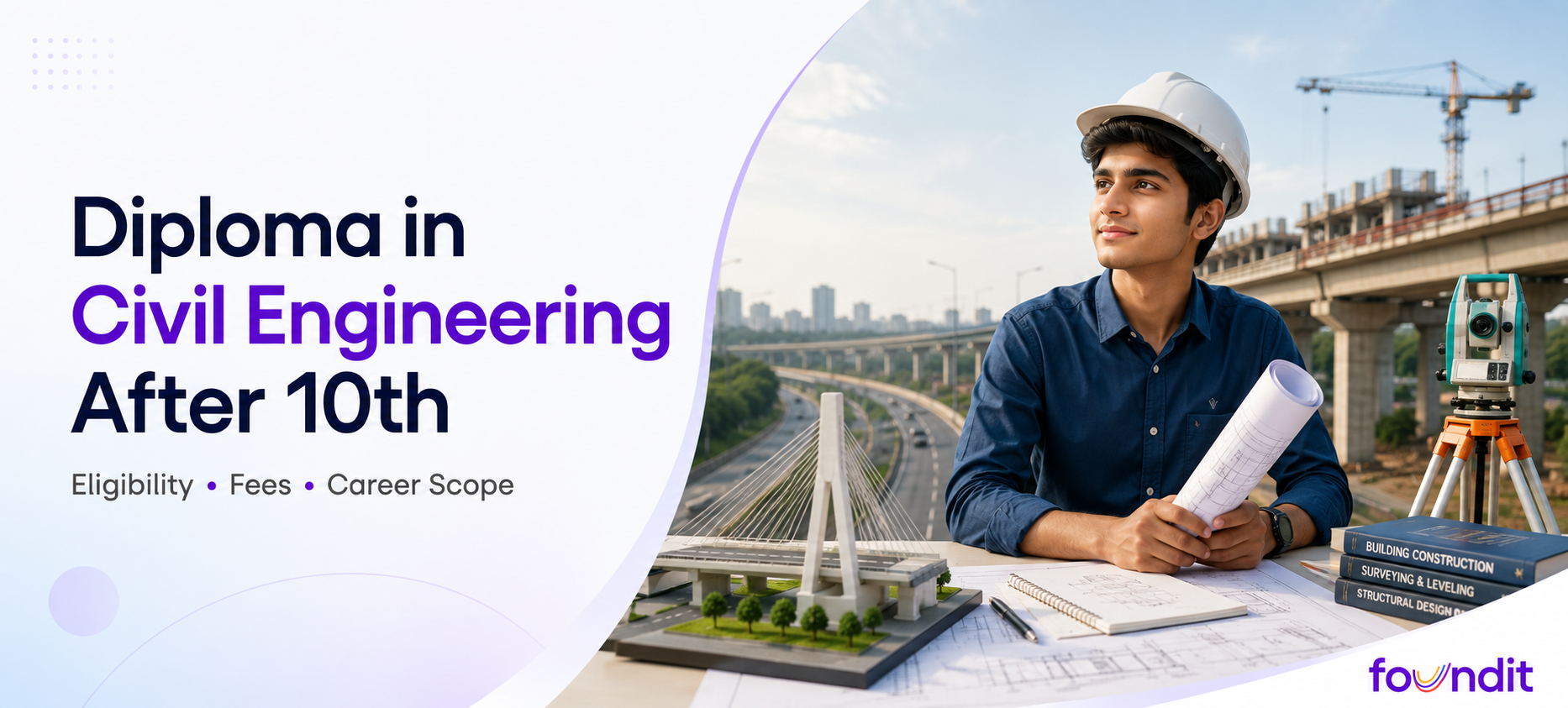
India’s infrastructure sector continues to expand, creating demand for skilled civil engineering professionals across construction, transportation, and public infrastructure. Reflecting this trend, civil engineering recorded stronger preference during IIT admissions for 2026, according to a report by The Times of India.
For students planning a technical career after Class 10, a Diploma in Civil Engineering offers an opportunity to develop practical engineering skills and enter the workforce earlier. The programme also provides a pathway to higher education through lateral entry into B.Tech courses.
This article explains the Diploma in Civil Engineering after 10th, including eligibility, course structure, admission process, fees, top colleges, career opportunities, salary, and future study options.
What is a Civil Engineering Diploma Course After 10th?
A Civil Engineering diploma course after 10th is a three-year polytechnic programme that equips students with practical knowledge of construction, surveying, structural design, and infrastructure development. The course combines classroom learning with laboratory sessions, fieldwork, and industrial training.
The programme is conducted in AICTE approved polytechnic colleges in both government and private sectors of India.
This program not only helps in making the career in construction companies, consultancy agencies and government sectors but also provides lateral entry in B.Tech courses from the second year onwards.
Course Overview
| Feature | Details |
| Programme Type | Polytechnic Diploma |
| Duration | 3 Years (6 Semesters) |
| Approving Body | AICTE |
| Eligibility | Class 10 pass with Science and Mathematics |
| Admission Process | Merit-based or state-level entrance examination |
| Lateral Entry | Available for eligible Class 12/ITI candidates |
| Higher Education Option | Direct admission to the second year of B.Tech through lateral entry |
The curriculum focuses on technical concepts, construction practices, engineering drawing, surveying, and project execution. Practical training remains an important component throughout the programme.
Read Also: Civil Engineer Job Description
Eligibility Criteria for Diploma in Civil Engineering
Diploma in civil engineering eligibility criteria usually requires passing Class 10 from a recognised board. The institutions also require that the applicants have studied science and mathematics in their secondary level education.
Although the basic eligibility remains similar across India, admission criteria, minimum marks, and age requirements may vary by state admission authorities and individual institutions.
General Eligibility
| Criteria | Requirement |
| Educational Qualification | Class 10 (SSC/Matriculation) from a recognised board |
| Mandatory Subjects | Science and Mathematics |
| Minimum Aggregate Marks | Usually 35%–50% (varies by state and institution) |
| Age Requirement | Generally, 14 years or above (state-specific norms apply) |
| Admission Mode | Merit-based or state polytechnic entrance examination |
Most government polytechnic colleges follow eligibility according to their respective State Directorate of Technical Education. Candidates should refer to the official admission notification before applying.
Reserved Category Relaxation
Candidates belonging to SC, ST, OBC, EWS, and other reserved categories may receive relaxation in minimum qualifying marks as per state government reservation policies. The extent of relaxation differs across admission authorities.
Read Also: Diploma in Engineering After 10th
How Long is the Course? Duration, Semesters & Lateral Entry Options
The Diploma in Civil Engineering after 10th is typically done in three years and is spread out over six semesters. The course includes theoretical studies as well as lab sessions and site visits.
Candidates initially begin with the basics of engineering and advance into advanced civil engineering topics during their third-year courses. The syllabus may differ slightly for each state-level technical education board.
Three-Year Course Programmes
Those who enrol after class 10th start off with the first semester. During the course, they learn about the principles of engineering, building technology, surveying, structures engineering, and project management.
The majority of polytechnics approved by AICTE also offer industrial training/projects in the last semester.
Lateral Entry Option
Candidates who have successfully passed Class 12 in Science with Mathematics and/or ITI in a related field may qualify for lateral entry admissions. Qualified candidates can join the second-year level of the diploma course depending upon the admission policies of each state.
Lateral entry helps decrease the course period to two years. Lateral entry admissions are conducted by the concerned State Directorate of Technical Education. The eligibility norms and admission procedures vary from state to state.
After completing the diploma program, one can opt for lateral entry into the second year of the B.Tech Civil Engineering program in the respective institutes according to AICTE regulations.
Diploma in Civil Engineering Syllabus: Subjects You’ll Study
A comprehensive syllabus is followed in the Diploma in Civil Engineering after 10th, which comprises engineering subjects as well as construction subjects. Various subjects are introduced gradually within six semesters.
While the syllabus remains largely the same in all AICTE approved colleges and institutions, there may be slight changes in the syllabus prescribed by state technical education boards.
Year 1 Subjects
| Semester | Key Subjects |
| Semester 1 | Engineering Mathematics, Engineering Physics, Engineering Chemistry, Engineering Drawing, Communication Skills |
| Semester 2 | Building Materials and Construction, Surveying and Levelling, Computer Applications, Environmental Science |
The first year builds a foundation in mathematics, science, engineering drawing, and basic construction practices. Students also learn surveying techniques and communication skills required in technical workplaces.
Year 2 Subjects
| Semester | Key Subjects |
| Semester 3 | Structural Analysis, Concrete Technology, Soil Mechanics, Fluid Mechanics, Building Drawing |
| Semester 4 | Transportation Engineering, Estimating and Costing, Advanced Surveying, Water Supply and Sanitation |
The second year introduces core civil engineering subjects used in construction planning, structural design, transportation systems, and infrastructure projects.
Year 3 Subjects
| Semester | Key Subjects |
| Semester 5 | Design of RCC Structures, Project Management, Contract Management, Irrigation Engineering |
| Semester 6 | Industrial Training/Project Work, Advanced Construction Techniques, Professional Practices |
This year will be centered on practical learning through projects and industrial training. Practical knowledge of construction management and professional engineering practices is gained during this year.
The detailed syllabus might vary a bit according to the affiliating technical education board, hence students need to check the official curriculum according to their respective institute or state authorities.
Civil Engineering Diploma Fees: Government vs. Private Colleges
The fee for Civil Engineering Diploma course after 10th varies from one institute to another. Government polytechnic institutes tend to have comparatively less fees than private institutes depending upon the infrastructure facilities provided at such institutions.
It is necessary for the students to take into account examination fees, hostel fees, and other educational fees prior to choosing an institute.
| Institution Type | Approximate Fees |
| Government Polytechnic Colleges | ₹10,000–₹25,000 per year |
| Private Polytechnic Colleges | ₹50,000–₹5,00,000 (total course fee) |
Government polytechnic colleges remain an affordable option for students pursuing technical education. Fee concessions and scholarships may also be available for eligible candidates.
Private institutes may offer additional facilities such as industry collaborations, placement support, and modern laboratories. Students should compare fees, accreditation, and placement records before taking admission.
Scholarships Available
Eligible students can apply for financial assistance through various government scholarship schemes.
- National Scholarship Portal (NSP) for eligible technical education students.
- AICTE Pragati Scholarship for female students enrolled in AICTE-approved institutions.
- State Government Polytechnic Scholarships offered by respective technical education departments.
- Post-Matric Scholarships for eligible SC, ST, OBC, and other reserved category students.
Disclaimer: Fee figures are indicative and may differ across institutions and states. Candidates should always verify the latest fee structure and scholarship eligibility before applying.
Read Also: Diploma Courses After 10th
Admission Process: How to Get into a Civil Engineering Diploma Program
Admission to a Civil Engineering diploma course after 10th is conducted through merit-based counselling or state-level entrance examinations. The process differs across states, so candidates should refer to the respective admission authority’s notification.
Most admissions begin soon after the declaration of Class 10 results. Applicants must submit their documents within the prescribed schedule to participate in counselling.
Merit-Based Admission
Many states allot seats based on Class 10 marks. The admission process generally involves the following steps.
Step 1: Check Eligibility
Confirm that you have passed Class 10 from a recognised board with Science and Mathematics. Also verify the minimum marks required by the concerned state or institution.
Step 2: Complete Online Registration
Visit the official State Directorate of Technical Education or Polytechnic admission portal. Fill in the application form and upload the required documents.
Step 3: Submit Required Documents
Candidates are generally required to submit:
- Class 10 mark sheet and passing certificate
- School leaving or transfer certificate
- Passport-size photographs
- Category certificate (if applicable)
- Identity proof and domicile certificate (where applicable)
Step 4: Merit List and Counselling
The admission authority prepares a merit list based on the prescribed eligibility criteria. Shortlisted candidates participate in online or offline counselling to select their preferred college.
Step 5: Seat Allotment and Fee Payment
Once a seat is allotted, candidates must complete document verification and pay the admission fee within the stipulated deadline to confirm admission.
Entrance Examination-Based Admission
Some states conduct entrance examinations for diploma admissions instead of purely merit-based selection.
Common state-level entrance examinations include:
- Delhi CET – Delhi Common Entrance Test
- JEXPO – Joint Entrance Examination for Polytechnics (West Bengal)
- AP POLYCET – Andhra Pradesh Polytechnic Common Entrance Test
- TS POLYCET – Telangana State Polytechnic Common Entrance Test
- DTE Maharashtra – Directorate of Technical Education, Maharashtra
These examinations generally assess Class 10-level Mathematics, Science, and English. The syllabus and counselling process are announced by the respective state admission authorities.
Candidates should always verify the latest admission schedule, eligibility conditions, and counselling guidelines through the official state technical education portal before applying.
Read Also: Top Entrance Exam for Engineering
Top Colleges for Civil Engineering Diploma in India
Choosing the right institution plays an important role in building technical knowledge and practical skills. Before applying, students should compare AICTE approval, faculty, laboratories, placement support, and industry exposure.
Government polytechnic colleges generally offer affordable education, while private institutions may provide additional infrastructure and placement assistance. Admission criteria and fee structures vary across colleges.
Civil Engineering Diploma Top Colleges in India
| College | State |
| Government Polytechnic Mumbai | Maharashtra |
| Government Polytechnic, Ahmedabad | Gujarat |
| Government Polytechnic College, Chennai | Tamil Nadu |
| Government Polytechnic, Pune | Maharashtra |
| Rajkiya Polytechnic, Lucknow | Uttar Pradesh |
| Bhubaneswar Engineering School | Odisha |
| DTTE Government Polytechnic Institutes | Delhi |
Government polytechnic institutes remain a preferred choice because of their recognised curriculum, experienced faculty, and subsidised tuition fees.
Top Private Polytechnic Colleges
| College | State |
| MAEER’s MIT Polytechnic | Maharashtra |
| Sandip Polytechnic | Maharashtra |
| SRM Polytechnic College | Tamil Nadu |
| Chandigarh Polytechnic College | Chandigarh |
| LGC Polytechnic College | Punjab |
| Amity School of Engineering & Technology (Diploma) | Delhi NCR |
Private institutions often provide modern laboratories, industry partnerships, and campus placement support. Students should verify approvals, facilities, and placement records before making a final decision.
Career Options and Salary After Civil Engineering Diploma
A Diploma in Civil Engineering after 10th prepares students for technical roles across construction, infrastructure, consulting, and government organisations. Job opportunities are available in both the public and private sectors, depending on qualifications, skills, and recruitment criteria.
Fresh diploma holders generally begin with entry-level technical positions. Salaries increase with experience, certification, and higher qualifications.
Job Roles and Salary
| Job Role | Industry | Approximate Salary |
| Junior Civil Engineer | Construction & Infrastructure | ₹3.2L/yr-₹3.5L/yr |
| Site Supervisor | Building Construction | ₹3.3L/yr-₹3.6L/yr |
| Draughtsman (Civil) | Design & Consultancy | ₹4.3L/yr-₹5.3L/yr |
| Junior Engineer (JE) | Government Departments | ₹50,000-₹62,000 |
| Quantity Surveyor | Construction & Real Estate | ₹6.5L/yr-₹7.1L/yr |
| AutoCAD Operator | Architecture & Design | ₹3.3L/yr-₹3.6L/yr |
| Construction Supervisor | Infrastructure Projects | ₹3.3L/yr-₹4.9L/yr |
| Survey Assistant | Surveying & Mapping | ₹2.9L/yr-₹4.2L/yr |
Disclaimer: The salary ranges mentioned above are approximate and may vary based on factors such as location, company, individual skills, educational background, and market demand. These figures are indicative of entry-level roles and should not be considered guaranteed compensation.
Government Sector Jobs After Diploma
Many diploma holders prepare for Junior Engineer recruitment conducted by central and state government organisations. These roles offer structured career progression and government pay scales.
Common government recruiters include:
- Public Works Department (PWD)
- Central Public Works Department (CPWD)
- National Highways Authority of India (NHAI)
- Indian Railways (RRB Junior Engineer)
- Municipal Corporations
- State Irrigation Departments
- State Electricity Boards
Recruitment is generally conducted through examinations organised by the Staff Selection Commission (SSC), Railway Recruitment Boards (RRBs), or respective State Public Service Commissions.
Top Companies Hiring Diploma Holders
Private sector demand remains strong due to continued infrastructure development across India. Diploma holders are recruited for construction, project execution, surveying, and site management roles.
Some leading recruiters include:
- Larsen & Toubro (L&T)
- Tata Projects Limited
- Shapoorji Pallonji Group
- Afcons Infrastructure
- Hindustan Construction Company (HCC)
- DLF Limited
- NBCC (India) Limited
- IRB Infrastructure Developers
Civil Engineering Diploma vs. B.Tech: Which Path is Right for You?
Though both qualifications can earn you a career in civil engineering, the two are different in terms of duration, cost, and career options. It all depends on what kind of an education one wants and the financial capability and career path they want to pursue.
Diploma focuses on technical knowledge and allows one to enter employment earlier than B.Tech does.
| Parameter | Diploma in Civil Engineering | B.Tech Civil Engineering |
| Eligibility | Class 10 pass | Class 12 (PCM) + entrance examination |
| Duration | 3 years | 4 years |
| Approximate Total Fees | ₹19,000 | ₹8,00,000 |
| Learning Focus | Practical and skill-based | Theoretical and application-based |
| Entry-Level Roles | Technician, Site Supervisor, Junior Engineer | Graduate Engineer, Design Engineer, Project Engineer |
| Higher Education | Lateral Entry B.Tech | M.Tech, MBA, Higher Studies |
| Government Opportunities | Junior Engineer recruitment | Assistant Engineer and Junior Engineer recruitment |
| Time to Enter Workforce | Earlier | Longer academic route |
Who Should Choose a Diploma?
A diploma may be suitable for those students who intend to start their careers right after Class 10. Additionally, those students who want practical education and aim for lateral entry to B.Tech can go for a diploma.
Who Should Choose B.Tech?
A B.Tech programme is a good choice for students who aspire to pursue advanced engineering roles or research careers. Further, students who look forward to becoming involved in designing and managing projects can opt for B.Tech.
Most students do a Polytechnic diploma civil engineering course, get hands-on experience and later join B.Tech in second year via lateral entry path.
Scope and Future After Civil Engineering Diploma: Higher Studies & Growth
A Diploma in Civil Engineering after 10th provides opportunities for employment as well as higher education. With continued infrastructure development India, skilled diploma holders remain in demand across construction, transportation, housing, and public infrastructure projects.
Students can also enhance their career prospects by pursuing higher qualifications and industry-recognised certifications. These pathways support career progression and broaden employment opportunities over time.
Lateral Entry to B.Tech Civil Engineering
Diploma holders can apply for Lateral entry B.Tech programmes offered by AICTE-approved institutions. Eligible candidates are generally admitted directly into the second year of the degree programme, subject to university and state admission regulations.
This route enables students to complete a bachelor’s degree in a shorter duration while building on the practical knowledge gained during their diploma studies. Admission criteria may differ across institutions.
Professional Certifications to Enhance Employability
Along with formal education, technical certifications can strengthen practical skills and improve career prospects.
- AutoCAD for engineering drafting and design
- Revit (Building Information Modelling – BIM)
- Primavera P6 for project planning and scheduling
- STAAD.Pro for structural analysis and design
- Microsoft Project for construction project management
- LEED or IGBC certification for green building practices
Selecting certifications relevant to your career goals can improve technical competence and support professional growth within the construction industry.
Conclusion
A Diploma in Civil Engineering after 10th offers a practical pathway into the engineering and construction sector. The programme combines technical learning with industry exposure, preparing students for careers in both private organisations and government departments.
Students can also continue their education through lateral entry B.Tech programmes and professional certifications. These options help expand technical knowledge and support long-term career development.
Before applying, compare AICTE-approved institutions, admission requirements, fee structures, and placement opportunities. Making an informed decision can help you choose a programme that aligns with your educational and career objectives.
Read Also: Best Courses After 10th: High-Salary Diploma & Career Options 2026
FAQs
Candidates must have passed Class 10 from a recognised board with Science and Mathematics as compulsory subjects. Minimum qualifying marks vary by state and institution.
The standard programme lasts three years and is divided into six semesters.
Graduates can work as Junior Civil Engineers, Site Supervisors, Quantity Surveyors, Draughtsmen, AutoCAD Operators, Survey Assistants, and Construction Supervisors in public and private organisations.
Entry-level salaries generally range from ₹15,000 to ₹35,000 per month in private organisations. Government Junior Engineer positions follow notified pay scales prescribed by the recruiting authority.
Yes. Eligible diploma holders can seek direct admission to the second year of a B.Tech Civil Engineering programme through the lateral entry admission process.
Yes. Diploma holders can apply for Junior Engineer and technical posts in organisations such as PWD, CPWD, NHAI, Railways, municipal corporations, and state government departments through the prescribed recruitment process.
The programme is suitable for students seeking practical technical education and an early start to their careers. It also provides opportunities for higher education and career advancement through lateral entry B.Tech and professional certifications.
 Beware of Scammers
