





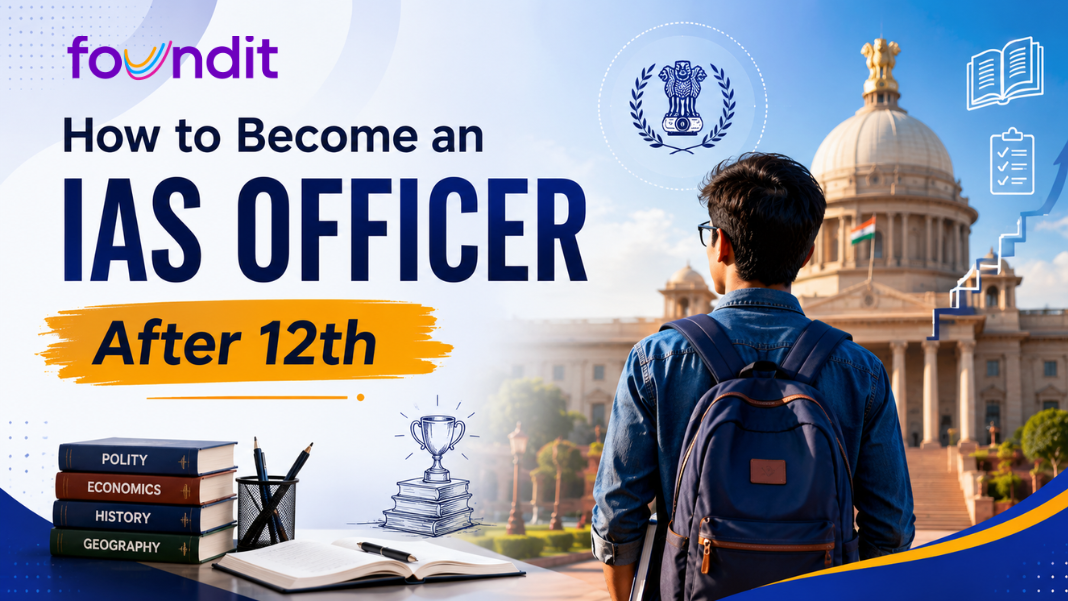
Many students start exploring how to become an IAS officer after 12th because the Indian Administrative Service (IAS) is one of the most prestigious career options in India. IAS officers are responsible for managing government programmes and ensuring the effective delivery of public services at various levels of administration.
However, there is no direct entry into the IAS after Class 12. Candidates must complete a bachelor’s degree and then clear the UPSC (Union Public Service Commission) through a defined selection process and career roadmap.
This article explains the complete career path to becoming an IAS officer after 12th, including eligibility criteria, graduation options, UPSC exam stages, preparation tips, common mistakes to avoid, salary, skills required, and career growth opportunities.
What is IAS?
IAS stands for Indian Administrative Service. It is one of the top services recruited through the UPSC Civil Services Examination, which is among the toughest competitive exams India.
IAS officers are responsible for:
- Managing district administration
- Implementing government policies
- Handling public issues and governance
The IAS role involves much more than administrative office work. IAS officers handle a wide range of responsibilities, including maintaining law and order, implementing government policies, managing public services, and responding to situations such as natural disasters and emergencies.
Because of this, the skills required for the IAS role are:
- Patience
- Clarity in decision-making
- Strong understanding of society and governance
UPSC Civil Services Exam Overview
IAS selection happens through the UPSC Civil Services Examination. It is the main recruitment exam for top government services, including IAS, IPS (Indian Police Service), and IFS (Indian Foreign Service).
The examination is conducted once every year through a structured selection process. Notification is usually released in February; Prelims are held in May or June, and mains follow later in the same year.
The IAS selection process includes:
Exam Stages
- Prelims: The Preliminary Examination consists of two objective-type papers that assess General Studies (GS) and aptitude. The score of General Studies Paper 1 is considered for selection to the Main Examination, while the aptitude paper is qualifying in nature, and candidates must secure the prescribed minimum marks.
- Mains: Nine descriptive papers covering general studies, essays, optional subjects, and language papers. This stage tests writing ability and depth of understanding.
- Interview: A personality test conducted by the UPSC board. It evaluates confidence, communication, and decision-making under pressure.
Merit List
- Final ranking is based on mains marks and interview scores.
- Prelims marks are not counted in the final merit list.
- Service allocation depends on rank, category, and preference order submitted by the candidate.
Read Also: Make a career in the Government Sector
UPSC IAS Syllabus and Exam Papers
The UPSC Civil Services Examination consists of three stages: Prelims, Mains, and Interview. Understanding the syllabus and paper structure is essential for effective preparation.
UPSC Prelims Syllabus
The Preliminary Examination includes two objective-type papers:
| Paper 1: General Studies | Paper 2: Civil Services Aptitude Test (CSAT) |
| Governance and Polity in India | Problem Solving & Decision Making |
| Current Events of National and International Importance | Comprehension |
| General Science | Data Interpretation (Class 10 Level) |
| History of India and Indian National Movement | Communication & Interpersonal Skills |
| Environmental Ecology, Biodiversity, and Climate Change | Basic Numeracy (Class 10 Level) |
| Indian and World Geography | Analytical Ability & Logical Thinking |
| Social and Economic Development | General Mental Ability |
UPSC Mains Syllabus
Candidates who qualify for the Prelims appear for the Mains examination, which consists of descriptive papers.
| Papers | Subjects |
| Paper A (Qualifying) | Any Indian Language |
| Paper B (Qualifying) | English |
| Paper 1 | Essay |
| General Studies 1 | Indian Heritage, Culture, History & Geography |
| General Studies 2 | Constitution, Governance, Polity, Social Justice & International Relations |
| General Studies 3 | Technology, Economic Development, Security, Environment & Disaster Management |
| General Studies 4 | Ethics, Integrity & Aptitude |
| Optional Subject Paper 1 | Candidate’s Chosen Subject |
| Optional Subject Paper 2 | Candidate’s Chosen Subject |
After clearing the Mains examination, candidates are called for the Personality Test (Interview), which assesses their knowledge, decision-making ability, communication skills, and suitability for administrative roles.
Can You Become IAS After 12th
No, you cannot become an IAS officer directly after 12th. A bachelor’s degree from a recognised university is mandatory for UPSC exam eligibility.
When students search for “IAS after 12th grade,” they are usually referring to when they should begin their preparation. While the UPSC application process starts only after graduation, the IAS preparation journey can begin immediately after Class 12.
Starting early gives students more time to build a strong understanding of subjects such as history, geography, polity, economics, and current affairs. It also helps develop essential skills like analytical thinking, answer writing, and time management, which are important for UPSC preparation.
Students can create the career roadmap and begin with NCERT (National Council of Educational Research and Training) books and current affairs reading. These habits gradually improve understanding and subject clarity.
IAS Eligibility Criteria
IAS eligibility rules are simple but must be followed strictly. Without meeting them, you cannot apply for the UPSC exam.
| Eligibility Factor | Requirement |
| Citizenship | Indian citizen as per UPSC rules |
| Educational Qualification | Bachelor’s degree from a recognised university |
| Number of Attempts | 6 General/EWS, 9 OBC, unlimited SC/ST |
Age Limit
To apply for the UPSC Civil Services Examination, candidates must meet the prescribed age criteria. The minimum age for all categories is 21 years, while the upper age limit varies based on the candidate’s category.
| Category | Minimum Age | Maximum Age |
| General | 21 Years | 32 Years |
| OBC | 21 Years | 35 Years |
| SC/ST | 21 Years | 37 Years |
The candidate’s age is calculated based on the date specified in the official UPSC notification. Age relaxations are provided by UPSC according to government rules for reserved categories.
IAS Preparation Strategy After 12th
Preparation should begin with building strong basic concepts early. This stage focuses on understanding, not memorising advanced content.
Start with NCERT books from Class 6 to 12 first. Focus on history, geography, polity, economics, and science basics.
These books explain concepts in a simple and structured way. They create the base for advanced UPSC preparation later.
Many students skip the basics and face confusion during advanced study. A solid foundation always improves long-term preparation efficiency.
Subject-wise Preparation Plan
- History: NCERT Class 6 to 12, followed by Spectrum Modern History and Ancient India by R.S. Sharma.
- Geography: NCERT Class 6 to 12, followed by Certificate Physical Geography by G.C. Leong.
- Polity: NCERT Class 9 to 12, followed by Indian Polity by M. Laxmikanth.
- Economics: NCERT Class 9 to 12, followed by Indian Economy by Ramesh Singh.
- Current Affairs: Daily newspaper reading with note-making, along with monthly magazines like Yojana and Kurukshetra.
Daily Study Routine
- Spend one to two hours daily on preparation during Class 12 or early college.
- Divide time between reading, note-making, and short-answer writing.
- Reserve time each week for newspaper reading and current affairs revision.
Recommended Books and Sources
- NCERT textbooks from Class 6 to 12 across subjects.
- The Hindu or Indian Express for daily current affairs.
- Standard reference books for each GS paper after NCERT completion.
Revision and Practice
- Regular revision prevents forgetting and strengthens retention.
- Attempting mock tests regularly builds exam familiarity and speed.
- Analysing mistakes from mocks helps identify weak areas early.
Best Graduation Courses After 12th
There is no fixed degree required for becoming an IAS officer. Students from any stream can apply after completing graduation from a recognised university.
Some of the popular graduation courses chosen by UPSC aspirants include:
- BA in Political Science
- BA in History
- BA in Sociology
- BA in Public Administration
- BA in Economics
- BCom (Bachelor of Commerce)
- BSc (Bachelor of Science)
- BBA (Bachelor of Business Administration)
- BTech (Bachelor of Technology)
Many candidates choose BA courses such as Political Science, History, and Sociology due to syllabus overlap benefits. Subjects like polity, history, society, and governance align well with UPSC General Studies preparation.
However, students from Science and Commerce also succeed. Background does not limit success in UPSC exams, as candidates from all academic streams clear the examination every year.
The best course depends on individual interest, academic comfort, and backup career options. A degree that allows consistent study time helps balance preparation and college performance.
Choosing a course with UPSC syllabus overlap can reduce the overall study burden. At the same time, students should select a subject they enjoy studying, as long-term interest often helps maintain consistency throughout the preparation journey.
Read Also: Best Career Options & Courses After 12th for All Streams
IAS Preparation Roadmap by Stage
Preparation becomes easier when divided into clear stages logically. This approach prevents confusion, improves long-term consistency, and builds a career path.
After 12th
- Decide graduation course based on interest and UPSC syllabus overlap.
- Build daily reading and note-making habits from the start.
- Strengthen NCERT foundation across history, geography, polity, and economics.
During Graduation
- Cover UPSC General Studies syllabus basics alongside college subjects.
- Start current affairs seriously through newspapers and monthly magazines.
- Practise answer writing regularly and attempt sectional mock tests.
- Research and select the optional subject carefully before final year.
Final Year and After Graduation
- Fill the UPSC application form when notified and verify eligibility details carefully.
- Focus on intensive prelims preparation covering GS Paper 1 and CSAT thoroughly.
- After clearing prelims, shift immediately to mains strategy and answer writing practice.
Read Also: Top 30 IAS Interview Questions with Answers
How Long Does It Take to Become an IAS Officer
Becoming an IAS officer takes several years after 12th completion. Graduation itself requires three to four years depending on the course.
Preparation often runs alongside graduation rather than after it. This overlap reduces the total time taken before the first attempt.
Some candidates clear the exam in their first serious attempt. Others take multiple attempts to improve strategy and understanding.
Total time may vary significantly depending on individual consistency, preparation strategy, number of attempts, and performance in each stage of the examination. It is better to focus on preparation quality rather than rushing through stages because consistency plays a key role in long-term career growth.
Common Mistakes to Avoid
Many students think IAS can be attempted directly after 12th. This misunderstanding creates confusion and wastes effort in initial stages.
Key Mistakes to Avoid
- Thinking IAS is possible immediately after 12th without completing graduation.
- Ignoring graduation preparation, which affects confidence and discipline during preparation.
- Delaying preparation until graduation is fully completed.
- Not following current affairs consistently throughout the preparation period.
- Choosing optional subjects casually without proper research or interest assessment.
Careful planning and early awareness always improve overall preparation efficiency. Avoiding these mistakes improves efficiency in government job preparation.
Read Also: 5 Tips to Get a Government Job in India in 2026
Career After Clearing UPSC
After selection, IAS officers undergo training at LBSNAA (Lal Bahadur Shastri National Academy of Administration) in Mussoorie. Training prepares them for administrative responsibilities across different postings.
Work includes district administration, policy implementation, and inter-departmental coordination. Officers handle real-world problems that directly affect public systems and communities daily.
Career growth follows a structured progression from sub-divisional roles to senior positions. Officers can become District Collectors, Secretaries, and hold central government postings over time.
These roles offer both responsibility and the ability to create meaningful impact on governance.
IAS remains a strong long-term career choice due to its stability, social respect, and scope of influence. Few careers offer the same combination of public service and administrative authority at a national level.
IAS Officer Salary
The salary of an IAS officer is determined under the 7th Pay Commission and increases with promotions and years of service.
| Post/Level | Monthly Salary (Basic Pay) |
| Junior Scale (1–4 Years) | ₹56,100 |
| Senior Time Scale | ₹67,700 |
| Junior Administrative Grade | ₹78,800 |
| Selection Grade | ₹1,18,500 |
| Super Time Scale | ₹1,44,200 |
| Cabinet Secretary | ₹2,50,000 |
Disclaimer: The salary ranges mentioned above are indicative and may vary depending on factors such as grade, pay level, location of posting, applicable allowances, and periodic revisions as per government pay commissions and regulations. These figures are provided for general guidance only and do not represent guaranteed or fixed remuneration.
In addition to the basic salary, IAS officers receive several benefits and allowances, including:
- Dearness Allowance (DA)
- House Rent Allowance (HRA)
- Travel Allowance (TA)
- Official Residence
- Security and Support Staff
- Medical Benefits
- Study Leave and Official Travel Opportunities
Conclusion
Becoming an IAS officer after the 12th is a gradual journey. It requires patience, planning, and consistent preparation over time. The correct path involves completing graduation and preparing for UPSC.
Students who start early usually feel less pressure during preparation. That foundation improves performance across all exam stages.
Understanding the process clearly helps avoid confusion and mistakes. It also makes preparation more structured and effective. If you are in Class 12, start building your basics now.
FAQs
No, you cannot become an IAS officer directly after 12th. A bachelor's degree is required, but preparation can begin early.
IAS is often considered tougher due to its broad syllabus. It also has a lower success rate and unpredictable exam pattern.
A rank around 1000 usually gives Group B services. It may not secure IAS but still offers a stable government role.
Age must be between 21 and 32 years old. Age of 21 is considered the lower age limit, while age of 32 is generally considered the upper age limit
IAS usually requires a top rank within the first 100. The exact cutoff changes every year based on vacancies.
 Beware of Scammers
