




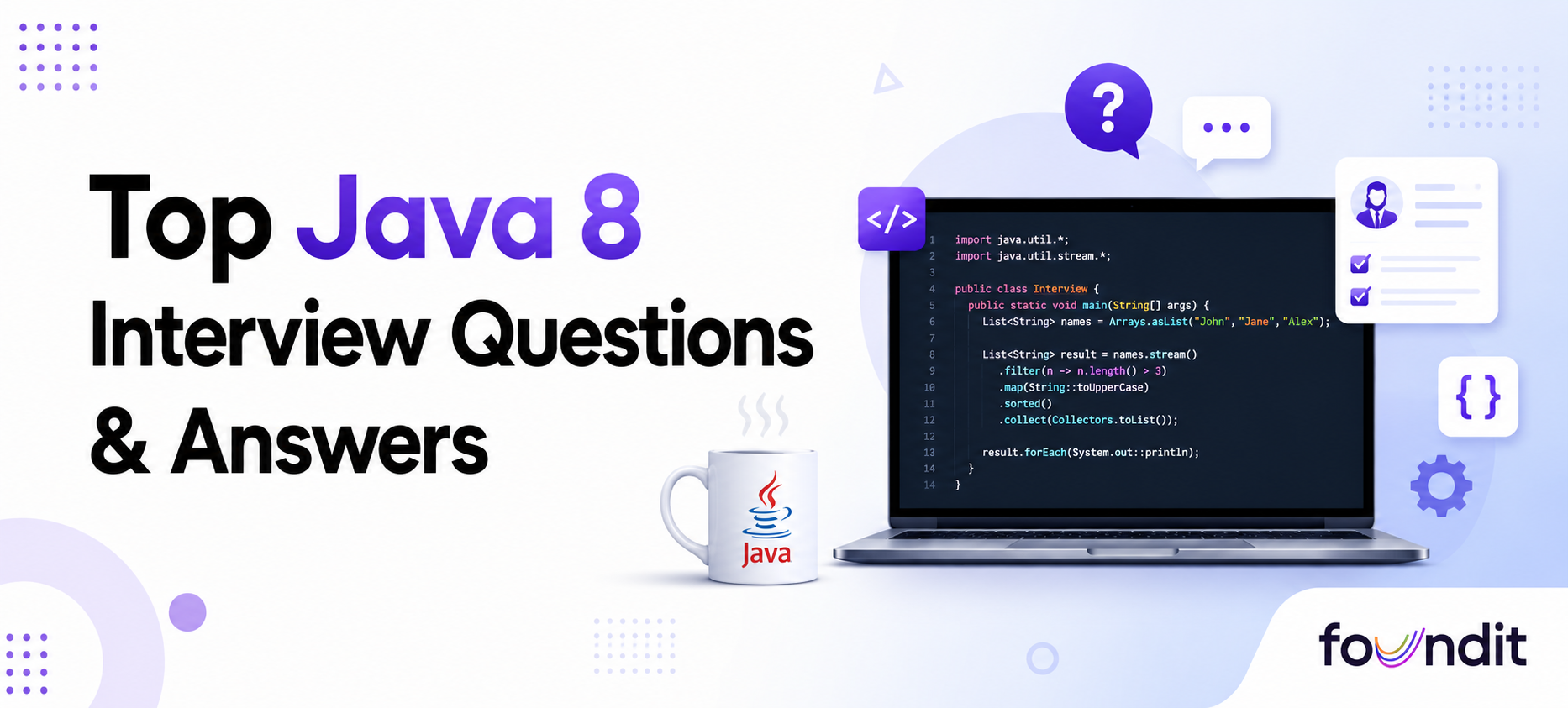
Java 8 was released back in March 2014, but if you look at job boards across India today, it still appears in countless Java developer job postings. Even after more than a decade, it’s considered a core skill that employers expect every Java developer to know.
Clearing interview rounds isn’t about reciting textbook definitions; interviewers want to see how you use Java 8 features to solve real production problems, clean up legacy code, and write cleaner, more efficient applications.
If you’ve got a Java interview coming up, Java 8 isn’t something you can afford to skip. It’s often the baseline interviewers use to assess whether you understand modern Java development and can write maintainable, production-ready code.
This guide covers the Java 8 interview questions with clear explanations, practical code examples, and comparison tables. Whether you’re a fresher building your fundamentals or an experienced developer revising advanced concepts, you’ll find interview-focused answers to help you prepare with confidence.
What is Java 8 and Why Does it Still Matter for Interviews?
Java 8 radically modified the language syntax with features like lambda expressions, the Stream API, functional interfaces, and the Optional class. In Azul’s 2025 State of Java Survey, 23% of respondents still used Java 8. This shows that Java 8 still remains widely used in enterprise environments.
When an interviewer asks you about java 8 features interview questions, they aren’t just checking if you know the syntax. They are evaluating whether you understand memory management changes (like PermGen vs Metaspace), concurrency performance bottlenecks, and the fundamental shift from imperative loop processing to declarative streaming.
Key Java 8 Features at a Glance
Instead of trying to memorise a massive list of updates, focus on the core features that actually show up in coding rounds. These are the high-priority topics you need to master.
| Feature | What It Actually Does | Interview Weight |
| Lambda Expressions | Cuts out anonymous inner class boilerplate code | Crucial |
| Stream API | Lets you filter and transform data without loops | Crucial |
| Functional Interfaces | The single method targets that power lambdas | High |
| Optional Class | A cleaner, safer way to prevent app crashes from nulls | High |
| Default Methods | Lets you add features to interfaces without breaking old code | Medium |
| Method References | A neat shorthand using the :: operator | Medium |
| Date-Time API | Fixed the broken, thread-unsafe legacy Date classes | Medium |
| MetaSpace | Shifted class metadata out of the heap into native memory | Medium |
Read Also: How to Become a Java Developer?
Core Java 8 Concepts Freshers Must Know
Most java 8 interview questions for freshers focus on a few core topics before moving to advanced concepts. These include lambda expressions, functional interfaces, the Stream API, Optional, default methods, and method references.
If you are new to Java 8, begin with these fundamentals. Each answer below is concise enough to explain during an interview and includes a code example along with a short note on why interviewers ask the question.
Q1. What is a Lambda Expression in Java 8?
A lambda expression is a concise block of code that accepts parameters and returns a value without requiring a separate method declaration. It allows developers to pass behaviour into a method, making the code shorter and easier to read.
Before Java 8, developers relied on anonymous inner classes to achieve the same result. Lambda expressions removed much of that boilerplate and introduced a cleaner programming style.
Syntax
(parameters) -> expression
Example
// Before Java 8
Runnable r1 = new Runnable()
};
// Java 8 Lambda
Runnable r2 = () -> System.out.println(“Running”);
Why interviewers ask this:
Among all lambda expression interview questions Java developers face, this is usually the first. Interviewers want to know whether you understand both the syntax and how lambda expressions simplify code using functional interfaces.
Q2. What is a Functional Interface in Java 8?
A functional interface is an interface that contains exactly one abstract method, making it suitable for lambda expressions. It forms the foundation of Java functional programming introduced in Java 8.
Common examples include:
- Runnable
- Callable
- Comparator
- Interfaces in the java.util.function package
The @FunctionalInterface annotation allows the compiler to verify that the interface follows the Single Abstract Method (SAM) rule.
Key Points
- Must contain exactly one abstract method.
- Can contain multiple default methods.
- Can contain multiple static methods.
- Using @FunctionalInterface is optional but recommended.
Why interviewers ask this:
This is one of the most common java 8 functional interface interview questions. Interviewers expect candidates to understand how functional interfaces support lambda expressions rather than treating them as separate concepts.
Q3. What is the Stream API in Java 8?
The Stream API Java provides a functional way to process collections without modifying the original data source. Instead of storing data, a stream carries elements through a sequence of operations.
Common stream operations include:
- filter()
- map()
- sorted()
- collect()
Intermediate operations execute only when a terminal operation runs, a concept known as lazy evaluation.
Example
List<String> names = Arrays.asList(“Anil”, “Bhavya”, “Chetan”);
List<String> result = names.stream()
.filter(n -> n.startsWith(“A”))
.collect(Collectors.toList());
// Output: [Anil]
Streams make collection processing more concise, readable, and expressive than traditional loops.
Why interviewers ask this:
Java 8 stream interview questions appear frequently because streams are widely used in enterprise applications. Recruiters want to know whether you can process collections efficiently instead of relying only on loops.
Q4. What is the Optional Class in Java 8?
The optional class java is a wrapper object designed to wrap values that might be null. Instead of risking a random NullPointerException because a database query or API call returned nothing, you return an Optional. This forces the next developer to explicitly check if data exists before using it.
Example
Optional<String> name = Optional.ofNullable(getName());
String result = name.orElse(“Unknown”);
Useful methods include:
- isPresent()
- ifPresent()
- orElse()
- orElseGet()
- orElseThrow()
Although Optional improves null handling, it is generally recommended for return types rather than fields or method parameters.
Why interviewers ask this:
These java 8 optional class interview questions assess whether you understand safer approaches to null handling instead of simply avoiding exceptions.
Q5. What is a Default Method in a Java 8 Interface?
A default method is a method inside an interface that includes an implementation using the default keyword. Before Java 8, interfaces could contain only abstract methods.
Default methods allow developers to introduce new functionality without breaking existing implementations. This makes it easier to evolve APIs while maintaining backward compatibility.
Example
interface Vehicle
}
Why interviewers ask this:
This is one of the most common java 8 default methods interview questions. Interviewers want to know whether you understand why default methods were introduced, not just how to write them.
Q6. What is a Method Reference in Java 8?
A method reference is a shorthand way of referring to an existing method using the :: operator instead of writing an equivalent lambda expression. It improves readability when a lambda expression simply calls an existing method.
There are four common types of method references Java 8 developers should know.
1. Reference to a Static Method
Function<String, Integer> f = Integer::parseInt;
2. Reference to an Instance Method of a Particular Object
Supplier<String> s = myObject::toString;
3. Reference to an Instance Method of an Arbitrary Object
Function<String, Integer> len = String::length;
4. Reference to a Constructor
Supplier<ArrayList<String>> list = ArrayList::new;
Method references make code cleaner when an existing method already performs the required operation. They are commonly used with streams and functional interfaces.
Why interviewers ask this:
These java 8 method reference interview questions test whether you recognise situations where method references improve readability over lambda expressions.
Q7. What is the Date-Time API in Java 8?
Java 8 introduced the Java Date Time API through the java.time package, providing immutable and thread-safe classes for handling dates and times. It replaced many limitations of the older Date and Calendar classes.
Some of the most commonly used classes include:
- LocalDate
- LocalTime
- LocalDateTime
- Duration
- Period
These classes simplify date calculations and make code easier to understand and maintain. Their immutable design also helps prevent accidental modifications in concurrent applications.
Why interviewers ask this:
These java 8 date time API interview questions help interviewers assess whether you understand modern date handling instead of relying on legacy APIs.
Q8. What is MetaSpace in Java 8 and How Does It Differ from PermGen?
MetaSpace Java 8 is the memory area introduced to store class metadata, replacing the PermGen space used in earlier Java versions. Unlike PermGen, MetaSpace uses native memory and can grow automatically unless a limit is configured.
The table below highlights the key differences.
| Aspect | PermGen (Java 7 and Earlier) | MetaSpace (Java 8+) |
| Location | JVM Heap | Native Memory |
| Size Limit | Fixed by Default | Grows Automatically |
| Common Error | OutOfMemoryError: PermGen | Rare with Default Settings |
| JVM Flag | -XX:MaxPermSize | -XX:MaxMetaspaceSize |
Moving class metadata to native memory reduced many memory-related issues seen in older JVM versions. Developers can still configure an upper limit when required using JVM parameters.
Why interviewers ask this:
This java 8 metaspace vs permgen interview question helps distinguish candidates who understand JVM memory management from those familiar only with Java syntax. It also gives interviewers insight into your understanding of Java’s runtime environment.
Read Also: Java Interview Questions and Answers For Freshers & experienced
Advanced Java 8 Interview Questions for Experienced Developers
These questions focus on concurrency, functional programming, and design decisions that experienced Java developers encounter in production environments.
Once you’ve mastered the fundamentals, interviewers usually move beyond syntax. They want to understand how you evaluate different approaches and solve real-world problems using Java 8 features.
Q9. What is CompletableFuture in Java 8?
CompletableFuture represents the result of an asynchronous computation and allows developers to chain multiple tasks without blocking the current thread.
It improves on the older Future interface, which could not be chained or completed manually. Using CompletableFuture, you can execute tasks in the background and process results as they become available.
CompletableFuture.supplyAsync(() -> fetchData())
.thenApply(data -> process(data))
.thenAccept(result -> System.out.println(result));
Methods such as thenApply(), thenCompose(), and thenCombine() help build non-blocking workflows, making them useful for applications that call multiple services simultaneously.
Why interviewers ask this:
Java 8 CompletableFuture interview questions help interviewers assess your understanding of asynchronous programming and non-blocking application design.
Q10. What is the Difference Between Intermediate and Terminal Operations in Streams?
Intermediate operations return another stream and execute lazily, whereas terminal operations produce the final result and trigger stream execution.
Operations such as filter(), map(), and sorted() build the processing pipeline. Terminal operations like collect(), count(), reduce(), and forEach() execute the pipeline.
| Type | Examples | Returns | Execution |
| Intermediate | filter(), map(), sorted() | Stream | Lazy |
| Terminal | collect(), count(), reduce() | Value or Collection | Executes Pipeline |
Why interviewers ask this:
This question checks whether you understand how Stream API execution actually works.
Q11. What is the Difference Between map() and flatMap() in Java 8?
The map() method converts each element into one new value, whereas flatMap() converts each element into a stream and then combines all resulting streams into one.
Use map() when each input produces one output. Use flatMap() when each input produces multiple values, such as flattening a list of lists.
// map
list.stream()
.map(String::length);
// flatMap
listOfLists.stream()
.flatMap(List::stream);
Why interviewers ask this:
Questions on map vs flatMap Java 8 help interviewers determine whether you can process nested collections efficiently.
Q12. What is the Difference Between findFirst() and findAny() in Java 8?
findFirst() returns the first element according to encounter order, while findAny() returns any matching element and performs better with parallel streams.
In sequential streams, both methods often produce the same result. The difference becomes noticeable when processing data in parallel.
| Method | Order Guarantee | Best Use Case |
| findFirst() | Returns the first element | Sequential streams |
| findAny() | No ordering guarantee | Parallel streams |
Why interviewers ask this:
This findFirst vs findAny Java 8 question evaluates whether you understand parallel stream behaviour and performance considerations.
Q13. How Does Java 8 Handle Multiple Inheritance with Default Methods?
When two interfaces provide the same default method, Java requires the implementing class to resolve the conflict explicitly.
Developers can specify which implementation to invoke using InterfaceName.super.methodName().
interface A
}
interface B
}
class C implements A, B
}
Why interviewers ask this:
This question tests your understanding of default methods and how Java resolves the diamond problem.
Q14. How are Collections Different from Streams in Java 8?
A collection stores data in memory, while a stream represents a sequence of operations performed on that data.
Collections can be traversed multiple times and modified directly. Streams process data lazily, cannot be modified, and can only be consumed once.
| Aspect | Collections | Streams |
| Storage | Stores elements | No storage |
| Traversal | Multiple times | Once |
| Evaluation | Eager | Lazy |
| Modification | Supported | Not Supported |
Why interviewers ask this:
This question helps interviewers evaluate whether you understand the conceptual difference between storing data and processing data.
Q15. What is the Nashorn JavaScript Engine in Java 8?
Nashorn is the JavaScript engine introduced in Java 8 that allows JavaScript code to run inside the JVM.
It replaced the older Rhino engine and could execute scripts using the javax.script package. Although useful in Java 8, Nashorn was deprecated in later Java releases.
Why interviewers ask this:
Interviewers occasionally ask about Nashorn to assess broader knowledge of Java 8 features beyond streams and lambda expressions.
Q16–Q20. Additional Advanced Questions
These short questions cover topics that frequently appear in interviews for experienced Java developers.
Q16. What are Collectors in Java 8?
Collectors are utility methods provided by the Collectors class and used with the collect() terminal operation. Common examples include toList(), joining(), and groupingBy().
Q17. How does Predicate chaining work?
The Predicate interface provides the and(), or(), and negate() methods, allowing multiple conditions to be combined into a single readable expression.
Q18. What do Consumer, Supplier, and Function do?
Consumer accepts a value without returning one, Supplier returns a value without taking input, and Function accepts one value and returns another.
Q19. What does Stream.parallel() do?
parallel() processes a stream across multiple threads. It generally improves performance only for large datasets and stateless operations.
Q20. What is the difference between Comparable and Comparator?
Comparable defines the natural ordering of objects using compareTo(), whereas Comparator defines custom sorting rules outside the class using compare().
Read Also: Java Interview Questions and Answers for 2 to 3 years Experienced: Top 50
Hands-On: Java 8 Stream API Coding Questions
Many Java interviews include live coding exercises to evaluate your understanding of the Stream API. These problems test whether you can apply concepts such as filtering, mapping, grouping, and aggregation to solve practical programming tasks.
Problem 1: Filter Employees by Salary and Collect Names
Problem: Given a list of employees, return the names of employees earning more than ₹50,000.
List<String> highEarners = employees.stream()
.filter(e -> e.getSalary() > 50000)
.map(Employee::getName)
.collect(Collectors.toList());
Explanation:
The filter() operation selects employees who meet the salary condition. The map() operation extracts their names, and collect() stores the results in a list.
Problem 2: Find the Sum of All Even Numbers
Problem: From a list of integers, calculate the sum of all even numbers.
int sum = numbers.stream()
.filter(n -> n % 2 == 0)
.mapToInt(Integer::intValue)
.sum();
Explanation:
The filter() method keeps only even numbers. mapToInt() converts the stream into an IntStream, allowing the built-in sum() method to calculate the total efficiently.
Problem 3: Group Students by Grade Using Collectors.groupingBy
Problem: Group a list of students based on their grade.
Map<String, List<Student>> byGrade = students.stream()
.collect(Collectors.groupingBy(Student::getGrade));
Explanation:
Collectors.groupingBy() creates a map where each key represents a grade, and the corresponding value contains all students belonging to that grade. It is one of the most commonly used collectors in Java 8 interviews.
Read Also: Most Asked Java Interview Questions & Answers for 5 – 6 Years Experienced
Java 8 Practice MCQs to Test Your Knowledge
These multiple-choice questions help reinforce the concepts covered above and closely resemble questions asked during written assessments. They also provide a quick way to revise before technical interviews or online screening tests.
MCQ 1. Which feature was introduced in Java 8 to support functional programming?
A. Generics
B. Lambda Expressions
C. Reflection
D. Serialisation
Answer: B. Lambda Expressions
MCQ 2. Which interface is a functional interface?
A. Runnable
B. List
C. Map
D. Set
Answer: A. Runnable
MCQ 3. Which Stream API method is a terminal operation?
A. filter()
B. map()
C. sorted()
D. collect()
Answer: D. collect()
MCQ 4. Which class was introduced to reduce NullPointerException?
A. Objects
B. Optional
C. Collections
D. Stream
Answer: B. Optional
MCQ 5. Which package contains the new Date-Time API?
A. java.util
B. java.sql
C. java.time
D. java.calendar
Answer: C. java.time
MCQ 6. Which operator is used for method references?
A. ->
B. =>
C. ::
D. <>
Answer: C. ::
MCQ 7. Which Stream API method transforms each element into another value?
A. filter()
B. peek()
C. map()
D. collect()
Answer: C. map()
MCQ 8. Which functional interface accepts one input and returns no value?
A. Supplier
B. Function
C. Predicate
D. Consumer
Answer: D. Consumer
MCQ 9. Which feature replaced PermGen in Java 8?
A. HeapSpace
B. MetaSpace
C. NativeHeap
D. ClassLoaderPool
Answer: B. MetaSpace
MCQ 10. Which Stream API method is commonly used for grouping objects?
A. mapping()
B. joining()
C. groupingBy()
D. partition()
Answer: C. groupingBy()
Read Also: Best 22 Java Technical Architect Interview Questions and Answers
How Did You Score?
Use your score as a quick indicator of your Java 8 preparation level. If you score lower than expected, revisit the topics where you made mistakes before moving to advanced interview questions.
| Score | Performance |
| 9–10 | Excellent understanding of Java 8 concepts. You are well prepared for most technical interview rounds. |
| 7–8 | Good grasp of the fundamentals. Review advanced Stream API, collectors, and concurrency concepts before your interview. |
| 5–6 | Fair understanding. Revisit lambda expressions, functional interfaces, Optional, and the Stream API. |
| Below 5 | Strengthen your Java 8 fundamentals before moving to advanced interview questions for experienced developers. |
Read Also: Tips to Make a Successful Career in Java
Conclusion
Java 8 continues to be one of the most important versions for technical interviews because its core features remain widely used in enterprise applications. Concepts such as lambda expressions, the Stream API, functional interfaces, Optional, and the Date-Time API continue to form the foundation of modern Java development.
Preparing for java 8 interview questions requires more than memorising definitions or syntax. Focus on understanding why each feature exists, practise writing clean code, and solve coding problems using streams and functional programming concepts.
Regular practice with interview questions, coding exercises, and mock interviews can improve both your technical knowledge and communication skills. Explaining your approach clearly often leaves a stronger impression than simply arriving at the correct answer.
FAQs
Preparing around 40–50 well-selected questions is usually sufficient for most technical interviews. Alongside theoretical concepts, practise coding problems involving collections, streams, functional interfaces, and common interview scenarios.
Yes. Java 8 stream interview questions are among the most common practical questions asked during technical interviews. Recruiters often ask candidates to filter, sort, group, transform, or aggregate collections using streams instead of traditional loops.
Not necessarily. Most java 8 interview questions for freshers focus on lambda expressions, streams, Optional, and functional interfaces. Java 8 CompletableFuture interview questions are more common in interviews for experienced developers.
Start by understanding the core concepts before moving to coding practice. Write programs using lambda expressions, streams, Optional, method references, and collectors, then explain your solutions in your own words.
No. Java 8 provides a strong foundation, but Spring Boot interviews also cover Spring Core, dependency injection, REST APIs, microservices, database integration, and application architecture.
Practise coding regularly, solve interview-style problems, and participate in mock interviews whenever possible. Focus on explaining your thought process clearly, writing clean code, and justifying your approach instead of relying on memorised answers.
 Beware of Scammers
