




A digital marketing course after 12th is a skill-based program that helps students step into roles related to online marketing, content, and advertising. The course is less about academic theory and more about learning how things work in a real business setup.
Some students choose a digital marketing career as it allows them to enter the workforce at an earlier stage compared to traditional long-term degree programmes. The field appeals to learners who prefer practical, skill-based learning combined with real-world exposure.
This article walks through the complete preparation process for a digital marketing course after 12th, from eligibility and course types to fees, skills, salary, and career scope.
What is Digital Marketing
Digital marketing refers to promoting products or services through platforms such as search engines, social media, websites, email, and mobile apps. It focuses on reaching consumers where they spend most of their time online.
It includes a lot of different tasks, like creating content, advertising, search engine optimisation (SEO), analytics, and engaging with customers. In simple terms, it combines creativity and data-driven strategies to achieve business goals.
It is important to note that digital marketing is not limited to large businesses. Small businesses, startups, and even individuals use digital marketing to increase brand visibility and drive sales.
Read Also: 7 Avenues to a Successful Digital Marketing Career
Types of Digital Marketing Courses
The following are the types of digital marketing courses:
Certificate Courses
For students looking to start their journey into digital marketing, certificate courses are a good place to start. They are brief and targeted, and easy to get started with, particularly if you are just investigating this area.
Often, these courses are used to gain familiarity before proceeding to more advanced courses. The aim is to expose the students to the tools and ideas rather than execution.
- Duration: 2 to 6 months
- Fees: ₹14,000 to ₹35,000
- Coverage: SEO, social media, and basic advertising
- Practical exposure: Basic assignments or small projects
- Suitability: Beginners looking for quick entry
Digital marketing certificate courses help you get started, but they usually need to be followed by deeper learning.
Diploma Courses
Diploma courses for digital marketing are more formal and explore concepts in more detail. These courses aim to demonstrate the practice of digital marketing.
Often, these courses have practical projects or simulations, which take learning to the next level.
- Duration: 6 to 12 months
- Fees: ₹25,000 to ₹70,000
- Coverage: Basic to advanced digital marketing topics
- Practical exposure: Live projects and case-based learning
- Suitability: Students aiming for job readiness
Diploma courses provide a stronger foundation for entry-level roles.
Online Courses
The major selling point of online digital marketing courses is their flexibility. You can acquire knowledge at your own pace and time.
However, it can be difficult without a strong sense of discipline. At times, students learn but have difficulty applying knowledge due to lack of practical skills.
- Duration: Flexible (self-paced)
- Fees: Free to ₹20,000
- Coverage: Conceptual understanding of key topics
- Practical exposure: Limited or self-driven
- Suitability: Learners who prefer independent study
Online courses are useful for learning concepts, but they work better when combined with hands-on practice.
Degree Programs
Undergraduate degrees are more formal and mix digital marketing with other business courses. These are usually preferred by students with a longer-term learning preference.
The knowledge gained is broader, but often the learning is spread across different topics. This may delay the practical application of skills somewhat.
- Duration: Around 3 years
- Fees: Up to ₹4.5 lakh
- Coverage: Marketing along with business fundamentals
- Practical exposure: Depends on the college and curriculum
- Suitability: Students planning long-term corporate careers
Degree programs build a strong base, but practical skills often need to be developed alongside.
Why Choose Digital Marketing After 12th
The main reason why people choose digital marketing after Class 12th is because they want to get working as soon as possible and gain experience. Digital marketing allows students to work on real projects and develop relevant digital marketing skills without spending years studying before entering the workforce.
The industry has best career options and is in a constant state of evolution with new technologies, tools, and platforms.
Often, companies don’t look for degrees here but rather for the ability to run campaigns and achieve the desired results.
High Demand in the Market
There has been a growing need for digital marketers, and it is not a temporary phenomenon. It’s tied into the way companies operate, as most businesses heavily rely on the digital space to acquire and retain customers.
Often, employers don’t just want general marketers. They want someone who can manage certain aspects such as SEO, PPC (Pay-Per-Click), or content. This is what is happening in practice, which is creating the growth in hiring.
- 46,000+ job openings in India across platforms
- Demand across startups, agencies, and established firms
- Roles available in multiple industries
- Increasing need for specialised skills
Demand exists strongly, but employers prefer candidates with practical, job-ready skills.
Early Career Entry
One of the practical advantages of digital marketing is how quickly you can get started. Courses are designed to be short and focused, which means you are not spending years before entering the job roles.
Many students begin internships early, and that exposure, even if basic, helps them understand how real campaigns work. This helps students gain early exposure to real-world marketing environments.
- Course duration of 2 to 6 months
- Internship opportunities within 3 to 4 months
- Early exposure to real work environments
- Faster transition from learning to earning
Early entry helps build experience, which matters more than just certifications.
Freelancing and Remote Work
Digital marketing naturally supports flexible work setups. Since most of the work happens online, location becomes less of a constraint, which is something many students find appealing.
Freelancing also creates additional opportunities. Professionals don’t rely on a single job but take up multiple projects, especially in areas like social media or content marketing.
- Remote work opportunities across roles
- Freelancing with domestic and global clients
- Project-based work flexibility
- Option to build multiple income streams
Flexibility exists, but it requires discipline and consistent skill development.
Expanding Digital Economy
The growth of India’s digital economy is a major reason behind the rising demand in this field. As more users come online, businesses are naturally shifting their focus towards digital platforms.
Worth noting, this is not just about numbers, it directly affects how companies allocate budgets and hire talent. More digital spending means more opportunities.
- Expected 900 million internet users by 2026
- Growth in online businesses and startups
- Increased investment in digital advertising
- Expansion of e-commerce and services
The market is expanding, but competition is also increasing alongside it.
Read Also: Digital Marketing as a Long-Term Career Option
Skills You Will Learn in a Digital Marketing Course
There has been a significant change in the skills required in digital marketing. It is not just about creating content or advertising but also about how you integrate platforms, data, and AI.
Often, what they are looking for is not only the knowledge of tools but how you can bring strategy and execution together. In 2026, it is all about performance, automation, and efficient use of AI in the workflow.
Social Media Marketing Skills
Social media marketing skills today goes beyond basic posting. You are expected to understand how platforms work, how audiences behave, and how content drives engagement and conversions.
Many times, real skill comes from managing campaigns and building communities rather than just growing follower numbers. It is about turning attention into consistent interaction and eventually into business outcomes.
- Coverage: Audience segmentation, content strategy, platform algorithms
- Platforms: Instagram, LinkedIn, YouTube
- Practical exposure: Campaign management and engagement strategies
- Advanced focus: Social commerce and creator economy
- Suitability: Roles in social media management and branding
Strong social media skills are measured by engagement quality, not just reach.
Read Also: Social Media Marketing
Content Marketing Skills with AI Integration
Content marketing has evolved into a more technical and structured process. It now combines storytelling with AI tools to produce content faster while maintaining consistency.
The challenge is not creating content but ensuring it reaches the right audience and remains relevant across platforms. This is where AI integration plays a key role.
- Coverage: Content planning, scripting, and storytelling
- Tools: Heygen, Invideo, AI writing assistants
- Practical exposure: Content calendars and video production
- Advanced focus: LLM content seeding and AI visibility
- Suitability: Content strategy and brand communication roles
Content works when it is both discoverable and aligned with user intent.
Read Also: How to Become a Content Marketer
SEO Including Generative Engine Optimisation
SEO is no longer limited to ranking on search engines. It now includes optimising content for AI-driven platforms that generate answers directly for users.
Worth noting, this shift requires a different approach. You are not just targeting keywords; you are structuring content in a way that AI systems can understand.
- Coverage: On-page SEO, technical SEO, keyword research
- Tools: SEMrush, Ahrefs, SurferSEO
- Practical exposure: Website optimisation and content structuring
- Advanced focus: Generative Engine Optimisation (GEO)
- Suitability: SEO and organic growth roles
Visibility now depends on both search rankings and AI-generated responses.
Paid Advertising and Campaign Management
Paid advertising has become more data-driven and automated. It is not just about running ads, but about managing budgets, tracking performance, and improving results continuously.
Many times, automation tools are used to streamline campaigns and reduce manual work. This allows marketers to focus more on strategy and optimisation.
- Coverage: Ad creation, targeting, and budget management
- Tools: N8N, ManyChat, Mailchimp, HubSpot
- Practical exposure: Campaign execution and performance tracking
- Advanced focus: Automation workflows and AI personalisation
- Suitability: Performance marketing roles
Success in paid ads depends on how efficiently you convert traffic into leads.
Email Marketing and Automation
Email marketing remains one of the most reliable channels, but it has evolved with automation and personalisation. It is no longer just about sending bulk emails.
The effectiveness comes from how well you segment your audience and automate communication based on behaviour. This ensures consistent engagement without manual effort.
- Coverage: List building, campaign management, segmentation
- Tools: Mailchimp, HubSpot, ManyChat
- Practical exposure: Email campaigns and automation setup
- Advanced focus: AI-based personalisation and drip campaigns
- Suitability: CRM and retention-focused roles
Email marketing works best when it feels personalised rather than promotional.
Read Also: Thinking of a Digital Marketing Job? These 6 Options are the Best!
Digital Marketing Course Duration
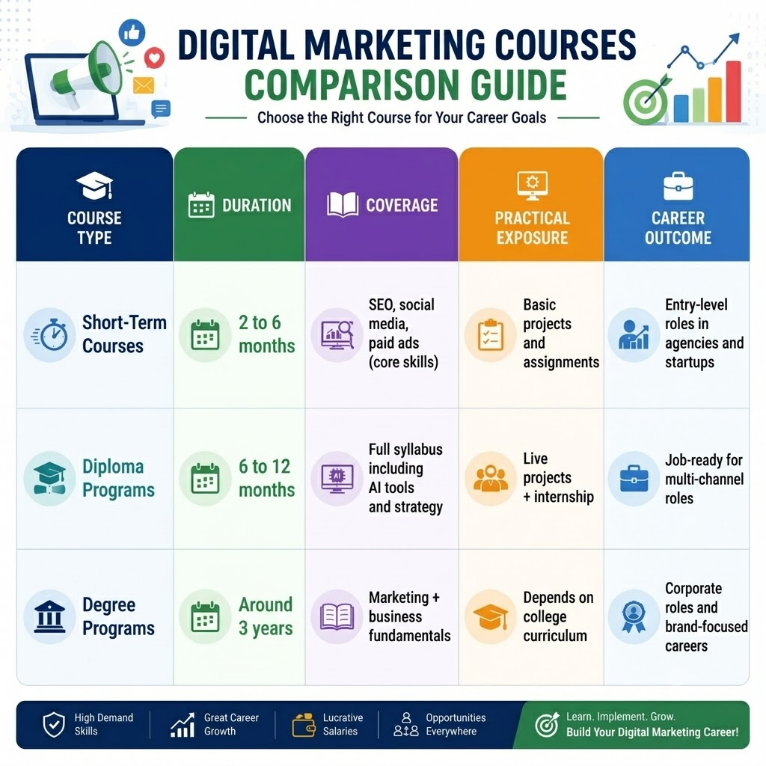
The duration of a digital marketing course usually depends on one key decision, how quickly you want to start working versus how much depth you want before that. There is no single “right” duration, it varies based on your career approach.
Usually, students focus only on finishing fast, but worth noting, the depth of learning directly affects the kind of roles you can access initially. So, the choice is really between speed and preparation.
Course Duration Comparison – H3
| Course Type | Duration | Coverage | Practical Exposure | Career Outcome |
| Short-Term Courses | 2 to 6 months | SEO, social media, paid ads (core skills) | Basic projects and assignments | Entry-level roles in agencies and startups |
| Diploma Programs | 6 to 12 months | Full syllabus including AI tools and strategy | Live projects + internship | Job-ready for multi-channel roles |
| Degree Programs | Around 3 years | Marketing + business fundamentals | Depends on college curriculum | Corporate roles and brand-focused careers |
Short-Term Courses: 2 to 6 Months
Short-term courses are built for speed. They focus only on essential, job-specific skills so that you can start working as early as possible.
These are chosen by students who want to begin earning quickly and are comfortable learning deeper skills on the job.
- Focus on core execution skills
- Faster entry into the job market
- Limited strategic depth
- Suitable for immediate earning goals
- Learning continues after placement
These courses help you enter the industry quickly, but growth depends on how you build skills afterwards.
Degree Programs: 3 Years
Degree programs take a longer, more traditional route. They combine digital marketing with broader business education requirements, which shapes a more holistic understanding.
That said, the focus is not on immediate execution skills but on long-term career development and corporate roles.
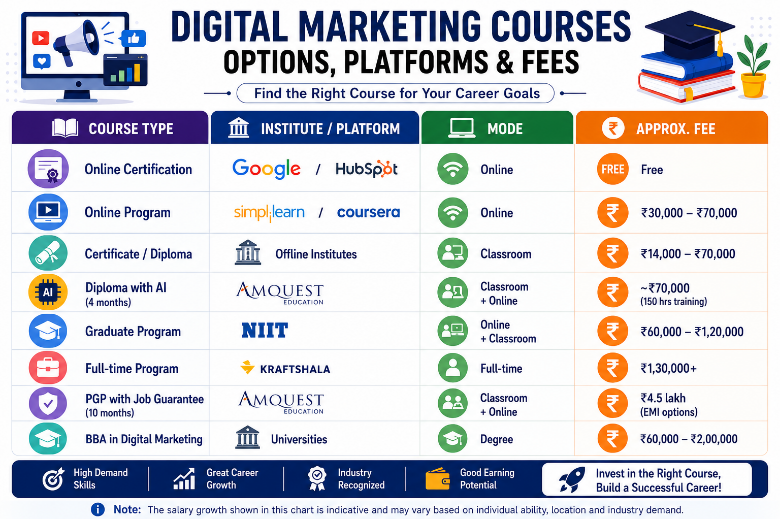
Digital Marketing Course Fee
Fees for digital marketing courses tend to differ based on the course structure, delivery, and practical experience. Often, the variance in fees is due to mentorship, projects, and placements.
Keep in mind, cheaper options can be good for learning basics, but programs tend to be more expensive because they emphasise things like placement and mentoring.
Course Fee Comparison Table
| Course Type | Institute / Platform | Mode | Approx. Fee |
| Online Certification | Google / HubSpot | Online | Free |
| Online Program | Simplilearn / Coursera | Online | ₹30,000 – ₹70,000 |
| Certificate / Diploma | Offline Institutes | Classroom | ₹14,000 – ₹70,000 |
| Diploma with AI (4 months) | Amquest Education | Classroom + Online | ~₹70,000 (150 hrs training) |
| Graduate Program | NIIT | Online + Classroom | ₹60,000 – ₹1,20,000 |
| Full-time Program | Kraftshala | Full-time | ₹1,30,000+ |
| PGP with Job Guarantee (10 months) | Amquest Education | Classroom + Online | ₹4.5 lakh (EMI options) |
| BBA in Digital Marketing | Universities | Degree | ₹60,000 – ₹2,00,000 |
Disclaimer: The fees mentioned above are approximate and may vary based on factors such as location, company, individual skills, educational background, and market demand.
Eligibility for Digital Marketing Course After 12th
Digital marketing course after 12th eligibility is quite flexible, which is why students from different backgrounds consider it after Class 12. There are no entrance exams or strict academic cut-offs in most cases.
Students assume they need a technical or coding background, but that is not required. What matters more is your willingness to learn tools, experiment, and improve through consistent practice.
Eligibility Criteria Table
| Criteria | Details |
| Education requirement | You need to have completed Class 12 from a recognised board. The stream does not matter, students from Arts, Commerce, and Science can all enter this field. This flexibility allows students to switch into a skill-based career without changing their academic background. |
| Minimum marks criteria | Some institutes may ask for around 50 percent marks, but this varies. In most cases, marks are not a deciding factor for admission. Institutes usually focus more on your interests and ability to learn rather than academic scores. |
| Basic technical understanding | You should be comfortable using a computer, browsing the internet, and handling basic digital tools. This is enough to get started with most courses. As you progress, you will naturally become familiar with advanced tools through practice. |
| Communication skills | Since digital marketing involves content and communication, a basic understanding of English helps. You do not need advanced fluency, but clarity in writing and comprehension is useful. Over time, these skills improve as you work on real campaigns and content. |
| No coding requirement | Most digital marketing roles do not require programming knowledge. Technical skills can be learned gradually if needed, but they are not mandatory at the entry level. This makes the field accessible even to non-technical students. |
Digital Marketing Career Opportunities in 2026
Nowadays, career growth in digital marketing course after 12th is noticeable everywhere, ranging from e-commerce to technology to healthcare, finance, and even real estate.
In many cases, it’s not the generalists that businesses are interested in. It’s rather specialists in particular areas like paid promotion, SEO, analytics, automation, and others. In addition, the rise of remote work has expanded employment opportunities, allowing professionals to work with organisations and clients across different locations.
Digital Marketing Executive Roles
This is the typical starting role for fresh graduates. This requires working on several channels such as SEO, social media marketing, email, and paid ads, simultaneously.
Often, this role is a good one to learn how the different components of digital marketing work together.
- Execute campaigns and track performance
- Support content and ad activities
- Learn tools and reporting basics
- Entry-level salary: ₹2.5 to ₹4.5 LPA
This role helps you decide which area to specialise in later.
Read Also: Digital Marketing Executive Job Description
Social Media Manager Roles
Social media jobs have evolved. You are required to manage brand accounts, campaigns, and engage with the audience. Businesses want you to be aware of trends, make use of AI and drive revenue through social commerce.
- Handle audience engagement
- Use AI tools for scheduling and insights
- Work on paid social campaigns
- Salary: ₹2.5 to ₹3.5 LPA (₹5 to ₹8 LPA with experience)
In practice, success depends on engagement quality and consistency.
SEO Executive Roles
SEO jobs are concerned with organic search optimisation. This can involve keyword research, technical optimisation, and content optimisation.
Note that now SEO also optimises content for AI search. In this role, you need to conduct keyword research and optimisation. You also need to perform technical SEO and audits.
- Use tools like GA4, SEMrush, Ahrefs
- Work on GEO and AI visibility
- Salary: ₹2.5 to ₹3.5 LPA
SEO delivers long-term, and consistent traffic growth.
Performance Marketing and PPC Roles
Performance marketing is concerned with paid marketing with measurable results. It is among the fastest-growing digital marketing jobs.
Usually, this role offers faster salary growth because it directly impacts business revenue. Under this role, you need to manage Google ads and Meta Ads. You also need to optimise campaigns for conversions.
- Handle budgets and targeting
- Use automation and AI tools
- Salary: ₹3 to ₹6 LPA (₹5 to ₹18 LPA growth)
This role rewards analytical thinking and optimisation skills.
Content Marketing and Strategist Roles
Content roles now involve more than just writing or creating videos. You are expected to plan, distribute, and optimise content strategically.
Frequently, companies look for people who can combine creativity with AI tools and data insights. Under this role, you need to plan content strategy and calendars. You also need to create blogs, videos, and campaigns depending on the audience.
- Use AI tools for content creation
- Focus on storytelling and branding
- Salary: ₹2.5 to ₹5 LPA
Content works when it supports both visibility and conversions.
Email Marketing and CRM Roles
Email marketing focuses on customer communication and retention. It involves sending targeted messages based on user behaviour.
Automation tools are used to manage campaigns efficiently and improve engagement. This role requires you to manage email campaigns and newsletters. It also wants you to segment and personalise communication.
- Use tools like Mailchimp and HubSpot
- Set up automation workflows
- Salary: ₹2.5 to ₹4 LPA
This role is key for long-term customer engagement.
Marketing Analyst Roles
Marketing analysts focus on data and performance tracking. They help businesses understand what is working and what needs improvement.
This role suits students who prefer working with numbers and insights rather than content. With this role, people can analyse campaign performance and work with all the analytics tools present in the market.
- Generate reports and insights
- Salary: ₹3 to ₹6 LPA
Data-driven roles are growing as businesses focus on measurable outcomes.
Influencer Marketing Manager Roles
Influencer marketing has become a major channel for brands. This role involves managing collaborations with creators and tracking campaign performance.
It requires understanding both branding and audience psychology. This role can help identify and collaborate with influencers.
- Track engagement and ROI
- Manage brand partnerships
- Salary: ₹3 to ₹6 LPA
This role is growing with the creator economy.
E-commerce Marketing Specialist Roles
E-commerce marketing involves promoting sales via channels such as Amazon, Flipkart, or any company website. It is the point of convergence between paid marketing and organic marketing efforts, and you will always have to balance out both aspects.
However, the position requires more than just being a “paid marketer.” You will be putting effort into optimising your product listings, ensuring they look good and drive conversions.
Often, minor changes to product titles, images, and prices might affect results significantly. You would typically:
- Run marketplace campaigns
- Analyse sales performance and listing metrics
- Salary: ₹3 to ₹6 LPA
This role is closely tied to direct revenue, so your impact is usually visible and measurable.
Conversion Rate Optimisation (CRO) Specialist Roles
CRO focuses on improving how a website performs by increasing the percentage of visitors who take action. It is a more analytical, testing-heavy role compared to other marketing functions.
Many times, what looks like a minor change such as a button placement or headline tweak can significantly improve results. So, a large part of the work involves observing user behaviour and testing hypotheses rather than making random changes.
You would typically:
- Work with data, heatmaps, and user behaviour tools
- Run A/B tests and improve landing pages
CRO directly impacts business profitability.
Marketing Automation Specialist Roles
Automation roles are centred around setting up systems that handle repetitive marketing tasks. This usually includes email workflows, lead nurturing sequences, and CRM integrations.
This role requires both technical understanding and strategic thinking. It is not just about setting up tools but also about designing workflows that make sense for the business.
You would typically:
- Manage lead nurturing processes
- Set up and optimise automation workflows
- Work with tools like HubSpot or N8N
Automation improves efficiency and scalability.
Video Marketing Specialist Roles
Video marketing has become a core part of digital strategy. This role focuses on creating and optimising video content for different platforms.
Short-form content and AI tools play a major role here. Create video content for platforms and optimise all the videos for engagement.
- Use AI video tools
- Analyse video performance
- Salary: ₹3 to ₹6 LPA
Video content drives higher engagement compared to static formats.
Growth Marketing Roles
Growth marketing focuses on scaling user acquisition and revenue through experimentation. It combines multiple channels and data-driven strategies.
This role involves testing different approaches and optimising based on results. People can easily work across multiple sectors and can easily manage their job responsibilities. The roles that they need to follow are:
- Analyse user funnels
- Focus on scaling results
- Salary: ₹4 to ₹10 LPA
Growth roles require both creativity and analytical thinking.
Freelance Digital Marketing Opportunities
Freelancing helps professionals to be independent and work for many different customers. Freelancing provides you with flexibility and the option to earn income depending on your skills.
Freelancers usually combine services such as SEO, social media, and advertising to manage multiple clients. In this profession, people can easily handle different campaigns from their clients, and also provide SEO, content, and ad services.
- Work with global clients
- Set flexible pricing
- Earnings: ₹20,000 to ₹1 lakh+ per month
Freelancing income depends on consistency, skills, and client acquisition.
Disclaimer: The salary ranges mentioned above are approximate and may vary based on factors such as location, company, individual skills, educational background, and market demand. These figures are indicative of entry-level roles and should not be considered guaranteed compensation.
Read Also: 10 Basic Digital Marketing Interview Questions
How to Choose the Right Digital Marketing Course After 12th
You can enrol in a digital marketing course immediately after completing Class 12. Choosing the right course depends on factors such as curriculum quality, practical training, industry relevance, and your career goals.
While course fees and duration are important considerations, they should not be the only deciding factors. A good course should provide hands-on experience, exposure to real-world projects, and training in key digital marketing areas.
The focus should be on how effectively the course prepares you to apply digital marketing concepts and work on actual campaigns.
Curriculum relevance
It is important to have a curriculum that includes traditional topics such as SEO, but also more advanced topics such as GEO, AI visibility, paid advertising, social media strategy, email workflows, and analytics tools.
If a program doesn’t cover AI tools or automation, it is already somewhat out of date.
Practical exposure and live work
Look for programs that involve working on real projects with real brands, not simply assignments or case studies. There’s a shift in your understanding when you deal with real data and problems. You understand how different choices impact results.
This also provides early confidence. Often, students who have managed small campaigns, find it easier to transition.
Placement and internship support
Instead of relying on general claims, it helps to look at specific details like placement rates, hiring partners, and starting salary ranges.
Institutes highlight placements without showing what roles students actually get or which companies are involved. It is worth noting that verifying recent hiring data gives you a clearer picture.
Internships, even short ones, make a noticeable difference. In practice, they help you understand how work flows in a real team setup and how expectations are managed.
Certification support
A good course should prepare you for recognised certifications such as Google Ads, GA4, HubSpot, and Meta. These are not just add-ons; they act as basic validation of your skills.
When you are starting out, certifications help bridge the gap between learning and employability. They show that you have at least worked with industry-standard tools.
That said, their value increases when combined with practical exposure, because employers usually look for both knowledge and application.
Trainer and mentor background
Trainers who have worked on real campaigns tend to approach teaching differently. They explain not just what works, but why it works and what usually does not in real scenarios.
This becomes clear when you face practical problems. Experienced trainers can share examples that are much closer to what happens in the industry.
This also helps you avoid common mistakes early, since you are learning from someone who has already dealt with similar situations.
AI and automation training
In 2026, knowing tools is not optional. You should be actively using multiple AI and automation tools during the course, not just watching demonstrations.
Students are shown tools but not given enough practice time. This creates a gap when they try to use those tools independently later.
Hands-on usage during training helps you become comfortable with workflows, which is what employers expect from day one.
Conclusion
Digital marketing after Class 12 provides an opportunity to gain practical skills and enter the workforce early. Unlike many traditional career paths, it focuses heavily on hands-on learning, real-world projects, and industry-relevant experience.
At the same time, success in digital marketing requires continuous learning. The industry evolves rapidly, with new platforms, tools, automation technologies, and Artificial Intelligence (AI) shaping how businesses connect with customers.
Professionals who regularly update their skills and adapt to changing trends are often better positioned for career growth. With the right training, practical exposure, and a commitment to ongoing learning, digital marketing can become a rewarding and sustainable long-term career.
FAQs
Yes, you can start after 12th from any board. There are no specific criteria, and the courses are typically for beginners.
This varies according to the type and level of course. A certificate course could take from 2-6 months, a diploma course could take from 6-12 months, and a degree course could take 3 years.
Freshers generally earn between ₹2.5 to ₹5 LPA, with entry-level monthly ranges around ₹15,000 to ₹25,000. With 2 to 3 years of experience, this can grow to ₹5 to ₹10 LPA depending on the role.
There is no single course that works best for everyone, as the right choice depends on your goals, time availability, and budget.
Yes, digital marketing continues to be a strong career option as businesses increasingly depend on online channels for growth.
 Beware of Scammers
