




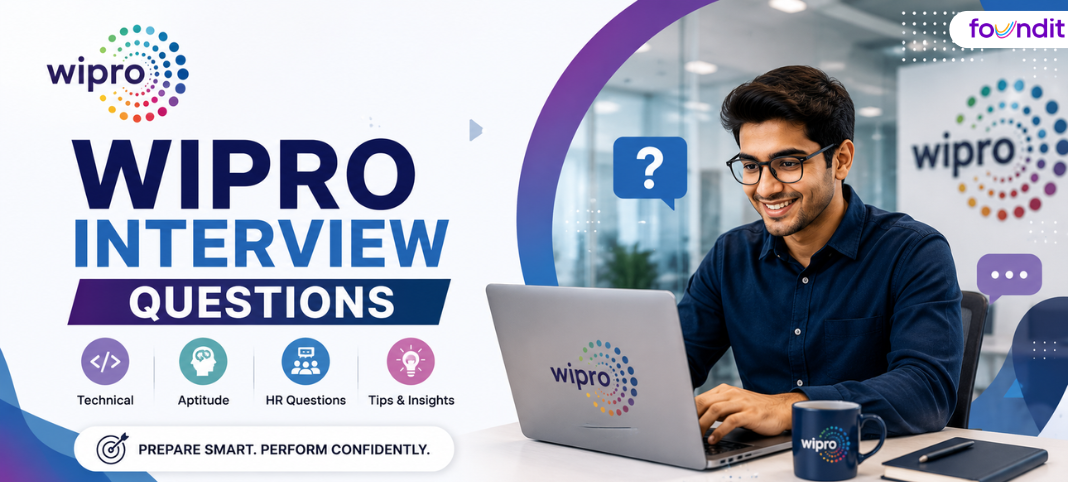
Wipro interview questions are carefully crafted combinations of aptitude, technical, coding, and HR interview questions. This is done to evaluate the candidate’s readiness for working in Wipro.
As you will observe, these questions go beyond textbook knowledge. Rather, these questions help evaluate the clarity of thinking and answering of the interviewee.
Many people, especially those who have prepared for such interviews, can answer the questions easily. The problem arises when one tries to provide the explanation.
This article takes us through various Wipro company interview questions and answers and provides tips on how to answer them.
Understanding the Wipro Interview Process
The Wipro interview process typically has three stages. Each stage checks a different skill set.
The first stage is the online assessment. It includes aptitude, logical reasoning, and sometimes basic coding.
On paper, this looks manageable. In practice, time pressure makes it challenging for many candidates.
The technical interview is the second round. Your subject matter expertise is put to the test in this round.
Usually, questions start from fundamental concepts and proceed further from there. Once you clarify the basics, the interview flows smoothly.
The final stage is the HR interview. This round focuses on communication, attitude, and overall fit.
Worth noting, many times this round influences the final decision more than expected.
Read Also: What are Different Types of Interview Processes
Aptitude and Logical Questions
These questions form part of the assessment stage. They mainly test speed, accuracy, and clarity of thinking.
1. What is the Average of Numbers?
Essentially, average refers to an even distribution of numbers. All numbers are summed and then divided by the total count of the numbers considered. For instance, if we have 15, 25, and 35, then the sum is 75; dividing by 3 equals an average of 25.
However, in most cases, the question is usually modified a little bit. You will be required to calculate the missing figure.
2. How do time and work problems work?
This question checks how well you understand efficiency. It is not just about applying formulas.
Instead of total days, think in terms of work done per day. That makes the problem easier to handle.
For example, if a person finishes work in 8 days, their daily work is one eighth. This becomes the base for calculation.
When two people work together, their daily work is added. That helps you find total time quickly.
3. How are profit and loss questions solved?
This topic appears easy at first. Many times, confusion happens in percentage calculation.
The key is to always relate profit or loss to cost price. That keeps the calculation consistent.
For example, if cost price is 200 and selling price is 240, profit is 40. That means 20 percent profit.
In interviews, questions may include discounts. Clear basics help you handle such variations.
4. What is the difference between ratio and proportion?
The ratio is used to compare two quantities. The proportion is what shows us the relationship between these ratios.
When we want to solve a problem like this we need to divide the amount into parts based on the ratio. This will give us the values that we are looking for.
For example, if we have a ratio of 3 to 5 and the total amount is 40 we can find the values. The values will be 15 and 25. If we look at the ratio 3:5, each part is equal, to 5.
In practice, the concept of ratio and proportion is often used with other topics. So it is really important that we understand the ratio and proportion clearly.
5. How do you solve number series questions?
This is a question related to pattern detection. This particular question focuses more on observing than doing calculations mathematically. For example, the pattern of 3, 9, 27, 81 can be derived from the pattern of multiplication by 3. The final answer would therefore be 243.
Sometimes it might be hard for one to identify the pattern initially. It could be derived through differences or ratios among the numbers.
6. How are blood relation questions solved?
This topic tests logical thinking and clarity. It can feel confusing if you try to solve everything mentally, especially when multiple relationships are involved.
A simple and effective approach is to draw a diagram. This helps you visualise connections clearly. For example, if A is B’s sister and B is C’s father, then A is C’s aunt.
In practice, using visualisation reduces errors and saves time, especially in complex questions.
7. What are coding and decoding questions?
These questions involve identifying patterns in letters or numbers. They check how well you can spot changes in sequences and positions.
For example, CAT becomes DBU when each letter shifts forward by one position. In some cases, the pattern may involve reversing or rearranging characters. It helps to test different possibilities step by step instead of assuming the pattern too quickly.
8. How do direction sense questions work?
This is a test of how you know directions. You need to follow each step. For example, if you go north and then turn right, you will be facing east.
Complex directions can be confusing. Drawing a map can really help you get the question. It makes it easier to understand where you are going.
9. What is the difference between permutations and combinations?
This is a common area of confusion. The difference between the two is important. Permutations are used when order matters. Combinations are used when order does not matter.
For example, arranging books is permutation. Selecting books is a combination. Understanding this difference simplifies problem-solving.
10. How are Data Interpretation questions solved?
Data Interpretation section involves analysing charts, tables, or graphs. It tests how well you can interpret and extract useful information from data.
The key is to read the data carefully before solving, as many mistakes happen due to misinterpretation. In practice, accuracy matters more than speed in this section.
Read Also: Logical Reasoning Questions and Answers
Wipro Technical Interview Questions
This round tests your understanding of concepts. Interviewers look for clarity, not memorised definitions.
11. What is Object Oriented Programming?
Object oriented programming structures code using objects and classes. It models real-world entities. Instead of writing one large program, you break it into smaller parts.
Each part represents an object. For example, an Employee class can store name and salary. It can also include methods like calculateSalary.
In practice, this approach improves code structure and reuse.
12. What is a Class and Object?
A class is a blueprint. An object is an instance created from that blueprint. Think of a class as a design. The actual implementation of that design is the object.
For example, a Car class defines features. Individual cars are objects created from it. Using such examples makes the concept easier to explain.
13. What is Inheritance?
Inheritance is the ability for one class to utilise attributes that belong to another class. This means that the class Dog can be inherited from the class Animal.
This reduces duplication and improves the overall organisation of code. In practice, it helps maintain clean and reusable code structures.
14. What is Polymorphism?
Polymorphism allows the same function to behave differently. It depends on the input provided. For example, an addition function can work for both integers and decimal values.
The function name remains the same, but behaviour changes. This makes programs more flexible and scalable.
15. What is Encapsulation?
Encapsulation is about controlling access to data. It protects data from direct modification. Instead of accessing variables directly, methods are used. This ensures better control.
For example, salary data can be accessed through specific methods. In practice, this improves the security and structure of code.
16. What is a Stack?
A stack is a data structure that follows last in first out order. The last element added is the first one removed. This is the basic idea.
A simple example is a stack of books. The top book is removed first. Stacks are commonly used in programming tasks.
17. Difference between Stack and Queue
A stack follows last in first out. A queue follows first in first out.
A queue works like a line. The first element is processed first.
This difference determines how they are used in different scenarios.
Explaining with examples makes this clearer in interviews.
18. What is DBMS?
A database management system is software used to manage data. It stores data in a structured format, usually in tables.
This makes storing and retrieving information easier. For example, student records can be organised in a database.
19. What is Normalisation?
Normalisation organises data to reduce duplication.
Instead of storing repeated data, it is stored once and linked where needed.
This improves efficiency and consistency in databases.
In practice, it helps maintain clean data structures.
20. What is SQL?
SQL is the language we use to work with databases. It helps us handle data in an organised way.
When we use SQL, we can do things like get, add and even change existing data or remove it. We do these things all the time when we work with databases.
For example, we might write a query to get data from a table. We use SQL to do this. SQL is what we use to work with databases and get the data we need. This is quite common in real project work.
Worth noting, even a basic understanding of SQL signals that you are comfortable working with data. That matters in most technical interviews.
21. What is Operating System?
An operating system helps run both hardware and software parts. It makes sure everything works together.
It works like a connector between you and the computer. Without it, using hardware would be hard.
Some common operating systems are Windows, Linux and macOS. They all perform the same basic tasks regardless of the interface used.
In practice, it handles tasks like memory allocation and process scheduling. These functions ensure stable system performance.
22. What is Multithreading?
Multithreading allows a program to run multiple tasks at the same time. It improves how efficiently a system operates.
A simple example is downloading a file while browsing the internet. Both tasks continue without blocking each other.
Many times, this leads to better use of system resources. It also reduces waiting time for users.
In practice, applications that require speed and responsiveness rely heavily on multithreading.
23. What is Cloud Computing?
Cloud computing allows access to data and services over the internet. It removes the need to depend on local storage.
Instead of saving files on a device, data is stored on remote servers. You can access it whenever required.
This setup offers flexibility and scalability. Systems can expand or adjust based on demand.
Worth noting, cloud computing is now widely used across industries. It supports modern, data-driven applications.
24. Reverse a String Program
This problem is more concerned with your reasoning process than syntax. It evaluates how you tackle a relatively basic challenge. This problem is not hard at all. If you take the word “hello” and reverse it, you get “olleh.”
You can do this in two ways. You can start from the end and go back to the beginning of the string. Or else, you can swap the characters one by one. In practice, interviewers pay attention to how clearly you explain your logic. That often matters more than the code itself.
25. What is SDLC?
The software development life cycle is a structured way to build software. It ensures that development follows a clear process.
It includes stages like planning, design, development, testing, and deployment. Each stage has a defined role.
Planning focuses on requirements. Design outlines the structure. Development builds the solution, and testing checks for errors.
Finally, deployment releases the product. Many times, explaining this flow clearly shows that you understand real project work.
Read Also: Technical Interview Questions and Answers for Freshers
Coding Questions
Coding questions test how well you apply logic to solve problems. Interviewers are less concerned about syntax and more interested in your thought process.
26. How do you check if a number is prime?
A prime number has only two factors, one and itself. The simple approach is to check divisibility from 2 to the number minus one. However, this is not efficient.
A better approach is to check up the square root of the number. If a number has a factor greater than its square root, it must also have one smaller than it.
For example, to check if 29 is prime, you only check divisibility up to 5. This shows that you understand optimisation, which interviewers value.
27. How do you calculate the factorial of a number?
Factorial means multiplying all numbers from 1 to a given number. For example, factorial of 5 is 120.
The simplest approach is to use a loop that multiplies numbers step by step. Another method is recursion, where the function calls itself.
In interviews, explaining both approaches shows a deeper understanding.
28. How do you reverse a number?
This problem involves reversing the digits of a number. For instance, 123 is turned into 321. This requires that we pick out each digit and then build the new number accordingly.
For example, start with the last digit, and then add it to your new number.
It is more important to explain what you mean than to write fast.
29. How do you check whether a number or string is a palindrome?
A palindrome is a number or string that reads the same forward and backward. For example, 121 is a palindrome.
The approach is to reverse the number and compare it with the original. If both are equal, it is a palindrome.
In practice, interviewers may also ask for string-based palindrome checks.
30. How does the Fibonacci series work?
The Fibonacci series is a sequence where each number is the sum of the previous two. For example, 0, 1, 1, 2, 3, 5.
The simplest approach is to use a loop and keep track of the last two numbers. Another approach is recursion, but it is less efficient.
In interviews, mentioning efficiency shows a deeper understanding.
Wipro HR Interview Questions
Wipro HR interview questions assess your personality, communication, and overall fit with the company. In simple terms, this round looks at how you think and respond in real work situations.
For a broader understanding of the format and commonly asked questions, you can refer to our detailed guide on Wipro HR interview questions. It covers the basics in a clear and practical way.
Read Also: Top 16 HR Interview Questions & Answers for Freshers
Wipro Interview Preparation Strategy
Preparing for Wipro interview questions requires a balanced approach.
- Start with aptitude practice. Spend time daily solving questions to improve speed and accuracy.
- Move to technical preparation. Focus on basics first, then practise explaining concepts.
- Work on communication. Try speaking your answers aloud. This improves confidence and clarity.
- Mock interviews help a lot. They simulate real scenarios and highlight weak areas.
Read Also: How to prepare for a successful job interview
Skills Required for Wipro Jobs
Technical skills form the foundation. Coding, problem-solving, and logical thinking are essential for most roles.
Along with this, communication, teamwork, and adaptability are equally important. These skills help you work smoothly with others and handle tasks effectively.
In practice, a balanced skill set makes a real difference. It supports steady growth and helps you take on responsibilities with confidence.
Conclusion
Wipro interview questions do not only test knowledge. They assess how you think, respond, and solve problems in real situations.
Understanding the interview process and preparing the right way can improve your chances. Clarity and consistency matter more than memorisation.
With regular practice, strong basics, and clear communication, cracking the Wipro interview becomes achievable. Discipline and preparation play a key role.
Wipro Interview Questions FAQs
The most common Wipro questions are “Tell me about yourself,” “Why do you want to work here,” and “What are your strengths and weaknesses.”
The principles are integrity, respect, customer focus, and excellence.
You can say you want to join Wipro for learning opportunities, career growth, and exposure to real-world projects.
The Wipro Elite Test is an online assessment conducted for off-campus recruitment. Candidates who qualify in the test are shortlisted for further interview rounds such as technical interviews and HR discussions.
Candidates can apply for off-campus opportunities through the official Wipro Careers Portal.
 Beware of Scammers
