



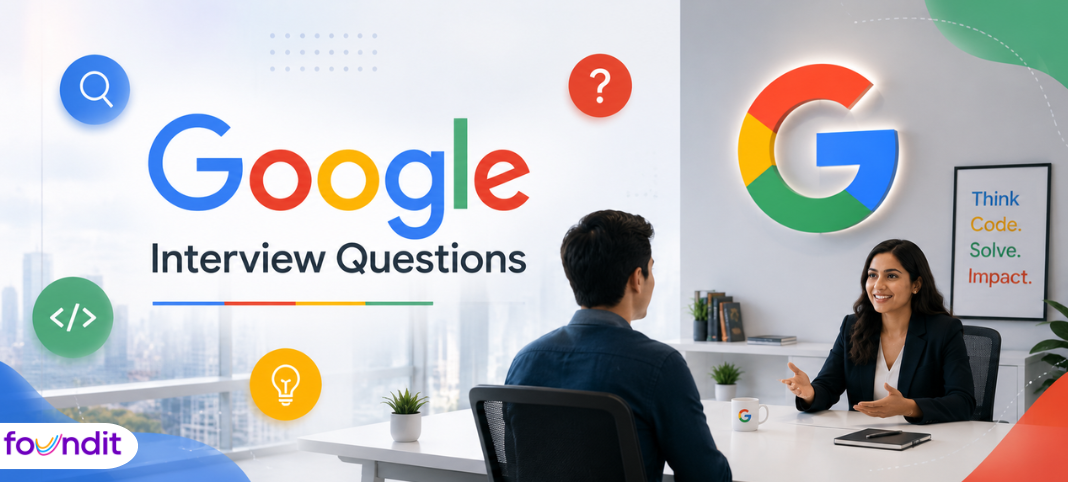
Google company interview questions require technical knowledge, problem-solving ability, communication skills, and decision-making across different workplace situations.
Candidates complete coding assessments, system design discussions, and behavioural interviews reflecting the collaborative nature of the Google workplace.
Interviewers also evaluate how applicants handle practical challenges involving Google products, large-scale platforms, and Google Search services effectively.
Strong technical skills alone are insufficient during Google interviews because structured thinking and communication remain equally important throughout the course.
Many candidates also research Google’s culture and the company’s collaborative working style before preparing for interviews. Understanding the Google mission and how teams contribute to large-scale innovation can help candidates answer behavioural questions more effectively..
Understanding the Google Interview Philosophy
Before exploring Google company interview questions, candidates should understand the company’s overall hiring approach first.
Google workplace doesn’t want candidates to have rehearsed responses. Rather, it wants individuals who can comprehend a problem that is unknown to them in a coherent manner and then work their way around it logically.
The interviewer will also be keen on how well you communicate your thought process. In most instances, this counts for just as much as the correct response itself.
In general, there are three types of interviews. These include coding, system design, and behavioural/Googleyness interviews.
Section 1: Most Important Google Behavioural Questions
Behavioural questions are often underestimated by candidates. In practice, they carry significant weight in the final decision.
Google uses them to understand how you work in real situations. This includes ownership, collaboration, leadership, and adaptability.
Why do you want to work at Google?
This question appears in almost every Google interview process. The aim is not to hear praise for the company.
Instead, interviewers want to understand whether your motivation is genuine and specific. It should also align with the role you are applying for.
A weak answer is usually generic. It focuses only on reputation or brand value without personal context.
Strong answers connect three things. Your experience with Google products, your interest in the work, and your role fit. Many applicants also mention how Google workplace supports innovation and learning across teams.
Example answer
“I want to work at Google because I am interested in building systems that operate at a large scale. I have used products like Google Search and YouTube, and I find their performance very consistent.
In my current role, I work on backend systems and enjoy solving scalability issues. This role feels aligned with the kind of work I want to grow into. It combines large scale engineering with meaningful problem solving.”
Read Also: How to Be Yourself During the Job Interview
Tell me about a time you failed at work
This question is used to assess accountability and emotional maturity. Google does not expect perfection.
What matters more is how you respond when something goes wrong. The focus is on ownership and learning.
A good answer explains what happened, what you did about it, and what you learned from the situation.
Example answer
“I once released a feature without enough testing due to a tight deadline. After deployment, a bug was found in production.
I took responsibility immediately and worked with the team to resolve it quickly. Once the issue was fixed, I updated my process to include a proper testing checklist before release.
Since then, I have been more careful with validation before deployment.”
Tell me about a time you dealt with conflict
This question tests how you handle disagreement in a professional setting. Conflict is common in collaborative teams.
Google looks for candidates who stay calm and communicate clearly during such situations.
The best answers focus on understanding the other person’s perspective and finding a balanced solution.
Example answer
“There was a misunderstanding between me and a teammate regarding task ownership. This created some confusion in delivery.
I initiated a conversation to understand his perspective. We realised the issue came from unclear responsibility boundaries.
We clarified ownership and documented it properly. After that, collaboration improved significantly.”
Tell me about a time you showed leadership
Leadership does not always mean managing a team. In practice, it means taking initiative without being asked.
Google values candidates who identify problems early and take responsibility for solving them.
Example answer
“In my previous team, onboarding was slow because documentation was scattered. This was affecting productivity for new members.
I created a centralised documentation system and encouraged the team to contribute. Over time, onboarding became faster and more structured.
This improved overall efficiency for the team.”
Read Also: 5 Skills Every Leader Should Have for Efficient Leadership
Tell me about a time you worked under pressure
This question evaluates how you behave in stressful situations. The focus is on clarity and prioritisation.
Google expects candidates to stay structured even when timelines are tight or conditions are uncertain.
Example answer
“We once had a tight deadline due to delays in dependencies. We had limited time to complete the release.
I prioritised tasks based on impact and focused on critical issues first. I also worked closely with QA to optimise parallel testing.
We delivered the release on time without compromising stability.”
Section 2: Google Coding Interview Questions
Coding interviews assess how you approach unfamiliar problems. The emphasis is on logic, clarity, and structure. A typical Google coding interview also evaluates communication, optimisation, and how clearly candidates explain trade-offs while solving technical problems. Many Google engineers focus heavily on structured thinking during these discussions.
How Do You Solve the Binary Tree Maximum Path Sum Problem?
This problem evaluates recursion and tree traversal understanding.
The idea is to calculate the maximum contribution from left and right subtrees at each node. Negative values are ignored to avoid reducing the total sum.
Example explanation
“I would use depth first search to traverse the tree. At each node, I calculate contributions from the left and right subtrees.
If any value is negative, I ignore it. I also maintain a global variable to track the maximum path sum across all nodes.”
How Can the Decode String Problem Be Solved Efficiently?
This problem uses stack based logic to handle nested patterns.
A stack helps manage both numbers and strings while decoding.
Example explanation
“I would use two stacks, one for numbers and one for strings. When I encounter a closing bracket, I pop values and build the decoded string.
I then repeat it based on the stored number and push it back into the stack. This handles nested patterns efficiently.”
How Is the Word Ladder Problem Solved Using Breadth First Search?
This is a graph problem solved using breadth first search.
Each word is treated as a node, and edges represent one character transformation.
Example explanation
“I would build a graph where each word connects to words that differ by one character.
Then I would use BFS to find the shortest path from the start word to the end word. BFS ensures the shortest transformation is found first.”
Read Also: Top 50 Programming Interview Questions and Answers
Section 3: Google System Design Questions
System design interview questions test how you think about scale, reliability, and trade offs.
How Would You Design Google Drive?
This question focuses on distributed storage systems.
Example explanation
“I would design Google Drive using a distributed storage system. Files would be split into chunks and stored across multiple servers.
Metadata like ownership and permissions would be stored separately in Google’s database systems to support scalability and faster retrieval. A caching layer would improve access speed for frequently used files.”
How Would You Design YouTube?
This question tests scalability and content delivery design.
Example explanation
“I would design YouTube using a distributed storage system for videos. Videos would be encoded into multiple formats for different devices.
A CDN would handle fast streaming, and a recommendation system would personalise content based on user behaviour.”
How Would You Design a URL Shortener?
This is a basic system design question focused on mapping and retrieval.
Example explanation
“I would generate a short unique code using base62 encoding. This code would map to the original URL in a database.
When the short URL is accessed, the system retrieves the original link and redirects the user.”
How Would You Design WhatsApp?
This question tests real-time messaging systems and scalability.
Example Explanation
“I would use persistent socket connections for real-time messaging between users. Messages would first go to messaging servers and then be delivered to recipients.
Undelivered messages could be stored temporarily until users come online. End-to-end encryption would help maintain privacy and security.”
How Would You Design an Instagram Feed?
This question focuses on feed generation, ranking, and caching systems.
Example Explanation
“I would use feed generation services to collect posts from followed accounts. Frequently used feeds could be cached to improve loading speed.
A ranking system would organise posts based on engagement, recency, and user activity.”
How Would You Design Netflix?
This question evaluates large-scale video streaming architecture.
Example Explanation
“I would use distributed storage systems to store video content and CDNs to stream videos quickly across different regions.
Videos would be available in multiple resolutions for different devices and internet speeds. Caching and load balancing would help manage high traffic.”
How Would You Design a Chat Application?
This question focuses on real-time communication systems.
Example Explanation
“I would use WebSocket connections for real-time messaging. Messaging servers would manage delivery, retries, and user status updates.
Databases would store chat history, while notification services would alert offline users about new messages. Similar scalable collaboration systems are also used in tools like Google Docs for real-time updates and syncing.”
How Would You Design an Online Food Delivery System?
This question tests real-time tracking and order coordination systems.
Example Explanation
“I would separate the system into services for users, restaurants, delivery partners, and payments.
Real-time location tracking would monitor deliveries, while order management systems would handle assignments and updates.”
How Would You Design a Search Engine?
This question focuses on indexing, ranking, and distributed systems.
Example Explanation
“I would use web crawlers to collect webpage data and indexing systems to organise searchable content.
Ranking algorithms would sort results based on relevance, keywords, and user behaviour. Distributed systems would handle large search traffic efficiently.”
How Would You Design an E-Commerce Platform?
This question evaluates scalability, inventory handling, and transaction systems.
Example Explanation
“I would separate services for products, inventory, payments, orders, and recommendations.
Caching systems would improve product search speed, while distributed databases would support high transaction volumes.”
How Would You Design a Ride-Sharing Application Like Uber?
This question tests real-time location tracking and matching systems.
Example Explanation
“I would use location tracking systems to monitor drivers and riders in real time. Matching services would connect nearby drivers with riders based on location and availability.
Payment systems, route optimisation, and real-time updates would also be important parts of the system.”
How Would You Design a Notification System?
This question focuses on scalability and asynchronous processing.
Example Explanation
“I would use message queues to process notifications asynchronously and handle traffic spikes efficiently.
Separate services could manage email, SMS, and push notifications independently for better scalability and reliability.”
Read Also: Top 30 System Design Interview Questions
Section 4: Google Googleyness Interview Questions
These questions focus on your leadership, teamwork, problem-solving, and motivation. They also assess what is often called “Googleyness.” This includes traits like curiosity, collaboration, and a structured way of thinking.
How Should Candidates Approach Googleyness Interview Questions?
A simple way to keep answers clear is the STAR method. It’s widely used, and for good reason.
- Situation: Set the context briefly
- Task: Clarify what was expected from you
- Action: Explain what you actually did
- Result: Share what changed because of your actions
Basically, this keeps you from going off track. Many times, candidates spend too long on background and miss the outcome. That’s something to watch for.
Also, keep your answers grounded. Focus on your role. Avoid vague statements like “we worked on it.” Instead, explain your contribution.
Examples for Common Questions
1. Tell me about a time when you came up with a creative solution
In one of my previous roles, content approvals were taking longer than expected. There were too many manual steps, and it slowed everything down.
My responsibility was to improve the turnaround time without affecting quality.
So, I introduced a shared dashboard to track content status. I also simplified the review process by setting clear guidelines.
As a result, approval time dropped by around 30%. The team could move faster, and rework reduced noticeably.
2. Tell me about a time you led a team through a difficult situation
There was a project where timelines shifted suddenly due to new requirements. The team was under pressure, and priorities were unclear.
I had to step in and bring some structure.
I broke the work into smaller tasks and reset priorities. We also started short daily check-ins to stay aligned.
In practice, this helped stabilise things quickly. We delivered on time, and the team handled the pressure better than expected.
3. Tell me about a time you created something from scratch
At one point, there was no clear system to track content progress. Work was getting missed or delayed.
I took the initiative to build a simple tracking process.
I created a central sheet, defined stages, and aligned the team on how to use it.
Worth noting, even a basic system can make a difference. In this case, visibility improved, and errors reduced over time.
4. What makes a good or bad professional in your role?
A good professional is usually clear in communication and takes ownership of work. They stay consistent and focus on solutions.
On the other hand, a poor approach often shows up as lack of accountability or unclear thinking.
In practice, the difference is not always skills. Many times, it comes down to how responsibly someone handles their work.
5. If you had coffee with Sundar Pichai, what would you talk about?
I would focus the conversation on decision-making at scale.
For example, how large teams stay aligned while moving fast. Or how leaders handle uncertainty when there is no clear answer.
Basically, these are areas that shape long-term impact. Learning that directly from leadership would be valuable.
6. How would you approach a complex problem with no clear solution?
When the problem is unclear, the first step is to break it down. Trying to solve everything at once usually doesn’t work.
I start by dividing it into smaller parts. Then I gather relevant data and look at possible approaches.
If needed, I discuss it with others to get different perspectives. After that, I test one approach on a smaller scale.
In practice, this reduces risk. You learn quickly and adjust before scaling the solution.
Simple Takeaway
Keep your answers structured. Stay specific. Focus on what you did and what changed because of it.
At the end of the day, these questions are less about perfect answers and more about clear thinking.
Google Interview Preparation Strategy
In practice, candidates who do well at Google usually follow a structured technical interview preparation plan. They do not jump randomly between topics. Instead, they build skills step by step, and each stage supports the next one.
Below is a simple breakdown of how this preparation typically works.
1. Build Strong Fundamentals
This is the starting point. Many candidates underestimate this stage, but it is the base for everything else.
At this stage, the focus is on understanding core concepts properly.
What you should focus on:
- Arrays, strings, linked lists, stacks, queues
- Trees and graphs basics
- Recursion fundamentals
- Sorting and searching
- Time and space complexity
How it works in practice:
You start with simple problems and make sure you understand how each data structure works. For example, you learn how a tree is traversed or how recursion breaks a problem into smaller parts.
Why it matters:
If your basics are weak, you will struggle to explain solutions clearly in interviews, even if you know the answer.
2. Learn Problem Patterns
Once basics are clear, the next step is to focus on patterns. Most Google company interview questions follow repeatable patterns.
Common patterns:
- Sliding window technique
- Two pointers
- BFS and DFS problem
- Backtracking
- Dynamic programming
- Binary search
How it works in practice:
Instead of solving random questions, you group problems by pattern. For example, you solve multiple sliding window problems until you recognise when to use it automatically.
Why it matters:
In Google interviews, the goal is not just solving the problem, but quickly identifying the right approach.
3. Practice Timed Problem Solving
After you are comfortable with patterns, you start solving problems under time pressure.
What you do here:
- Solve problems in 30–45 minutes
- Speak your thought process while solving
- Write clean and structured code
- Avoid overthinking
How it works in practice:
You pick a question, set a timer, and simulate an interview. You explain your approach before coding, just like in a real interview.
Why it matters:
Many candidates fail not because they don’t know the solution, but because they cannot structure it quickly under pressure.
Read Also: Problem-Solving Skills for a Successful Interview
4. Mock Interviews
Mock interview practice is one of the most important steps in preparation.
What happens in mock interviews:
- You are given a question by another person
- You must think out loud
- You must ask clarifying questions
- You explain your full approach before coding
How it works in practice:
You realise where you are strong and where you struggle. Many candidates discover that they understand concepts but cannot explain them clearly.
Why it matters:
Google interviews test communication as much as coding. This stage prepares you for that.
5. Review and Improve
This is where real improvement happens.
What you do:
- Review mistakes after every practice session
- Check if your approach was correct
- Improve weak topics
- Repeat difficult problems
How it works in practice:
If you struggle with recursion or graphs, you go back and revise them instead of moving forward blindly.
Why it matters:
Without review, practice does not improve performance. It only repeats the same mistakes.
Read Also: How to prepare for a successful job interview
Google Interview Process and Evaluation Criteria
Before preparing for Google interview questions and answers, it is important to understand how Google evaluates candidates. In practice, the company looks beyond technical knowledge. Interviewers usually assess communication, problem-solving, leadership, collaboration, and adaptability across different interview rounds.
For technical hiring, a Google software engineer interview may include multiple coding, system design, and behavioural rounds depending on experience level.
1. Resume Screening
The hiring process usually starts with resume screening. Recruiters review technical skills, projects, work experience, and role fit. Many times, candidates add too many tools without explaining actual impact.
Strong resumes usually highlight clear contributions and measurable results instead of generic responsibilities.
2. Recruiter or Phone Screening
After shortlisting, candidates usually attend a recruiter screening or phone interview. This round focuses on communication skills, career goals, motivation, and basic technical understanding.
For technical roles, there may also be a coding assessment or introductory technical discussion. Candidates who explain their experience clearly often perform better here.
3. Coding Interview Rounds
Coding interviews focus on algorithms, data structures, optimisation, and logical thinking. However, interviewers are not only checking the final answer. In practice, they also evaluate how candidates approach problems and explain their reasoning. Communication during coding matters a lot.
Common coding interview questions include arrays, trees, graphs, recursion, BFS, DFS, and dynamic programming. Follow-up optimisation questions are also very common in Google interviews.
4. System Design Interviews
For experienced candidates, system design interviews are extremely important. These rounds test scalability, reliability, database decisions, caching, APIs, and distributed systems understanding.
Interviewers usually expect candidates to clarify requirements before discussing architecture. Many times, simple and well-explained designs perform better than overly complex solutions.
5. Behavioural or Googleyness Interviews
Behavioural interviews evaluate leadership, ownership, teamwork, adaptability, and communication style. Google often refers to this as “Googleyness.”
Interviewers usually look for real examples from previous work experiences. Strong answers clearly explain the situation, actions taken, and final outcome.
What Google Interviewers Usually Evaluate
1. Structured Problem-Solving
Interviewers prefer candidates who think step by step instead of rushing into answers. They usually evaluate how clearly candidates approach and break down problems.
2. Communication Skills
Communication is important in every interview round. Candidates are expected to explain technical ideas clearly and discuss their reasoning throughout the interview.
3. Adaptability and Learning Ability
Google interviews often include unfamiliar problems. Interviewers want to see how candidates respond under uncertainty and improve their approach gradually.
Some rounds may also include Google’s hypothetical questions designed to test decision-making, prioritisation, and structured thinking in unfamiliar scenarios.
4. Ownership and Accountability
Google behavioural rounds focus heavily on accountability. Interviewers usually prefer candidates who openly discuss mistakes, learning experiences, and problem-solving efforts.
5. Optimisation and Scalability Thinking
Interviewers frequently ask follow-up questions related to performance, scalability, and optimisation. This helps them evaluate engineering depth and practical thinking.
Common Mistakes Candidates Make in Google Interviews
Many candidates struggle in Google interviews because of avoidable mistakes rather than lack of technical knowledge.
1. Jumping Into Coding Too Quickly
Candidates often start coding before fully understanding the problem. Interviewers usually expect candidates to clarify requirements and discuss approaches first.
2. Not Explaining the Thought Process
Communication is extremely important in Google interviews. Many candidates solve problems silently, which makes it difficult for interviewers to evaluate their reasoning.
3. Ignoring Optimisation
A working solution is not always enough. Interviewers often expect candidates to improve time and space complexity after solving the initial problem.
4. Giving Vague Behavioural Answers
Behavioural answers without real examples often feel weak. Interviewers usually prefer practical situations with clear actions and measurable outcomes.
5. Neglecting System Design Preparation
Experienced candidates sometimes focus only on coding and ignore system design preparation. In practice, system design rounds carry major importance for mid-level and senior roles.
6. Panicking Under Pressure
Google interviews are designed to test structured thinking under pressure. Candidates who stay calm and explain their reasoning clearly often perform better than candidates who rush through answers.
Conclusion
Google company interview questions are not about memorising answers. They are about structured thinking and clear communication under pressure.
The candidates who score well usually try to comprehend the question before giving an answer. They make sure that they provide their reasoning one by one rather than quickly jumping to the answer.
Ultimately, in most cases, it is not knowledge but clarity of thought and consistency in explanation that matter. Many successful candidates also spend time understanding how Google employees collaborate across teams and how products like Google Home connect with the company’s larger ecosystem and user-focused innovation approach.
Google interview questions FAQs
Focus on data structures and algorithms. Practice coding daily, learn basic system design, and do mock interviews. Explain your thinking clearly and solve problems step by step under time limits.
Resume screening, phone screen, coding interview, system design interview, and behavioural round. Each round checks coding skills, problem solving, design thinking, and communication ability.
Common questions include arrays, strings, trees, graphs, dynamic programming, system design, and behavioural questions on leadership, failure, conflict, and teamwork. They test logic and clear communication.
Questions include coding problems, system design tasks, and behavioural questions. Topics cover leadership, conflict, failure, teamwork, pressure handling, and problem solving in real work situations.
Hard questions include system design at scale, graph problems, dynamic programming, unknown problem solving, and behavioural questions on failure, conflict, and leadership under pressure.
 Beware of Scammers
