






After 12th biology, most students think of MBBS first. But that’s only one option. There are several career options in biology after 12th, including healthcare, research, biotechnology, nutrition, and environmental science.
Each path leads to a different kind of role. Some focus on patient care, some on lab work, and others on applied science and industry-based careers. Knowing how these options differ makes it easier to decide what to pursue next.
This article explains biology courses after 12th, the careers they lead to, and how to choose the right direction based on your interest and long-term plans.
Quick Overview of Biology Career Options After 12th
| Career Area | Popular Courses | Suitable For | Career Direction |
|---|---|---|---|
| Medical | MBBS, BDS, BHMS, BAMS | Students interested in diagnosis, treatment, and patient care | Doctor, dentist, specialist, medical practitioner |
| Allied Healthcare | Nursing, Physiotherapy, Medical Lab Technology | Students who want clinical or hospital-based roles | Nurse, physiotherapist, lab technologist, healthcare professional |
| Life Sciences and Research | Biotechnology, Microbiology, Genetics, Biochemistry | Students interested in labs, research, and scientific study | Research associate, lab scientist, biotechnologist |
| Food, Nutrition and Wellness | Nutrition and Dietetics, Food Science | Students interested in health, diet, and lifestyle science | Dietician, nutrition consultant, food quality professional |
| Environment and Agriculture | Environmental Science, Agriculture, Horticulture | Students interested in ecology, farming, sustainability, and natural resources | Agriculture officer, environmental consultant, research professional |
Important: Each career path in biology leads to different roles and growth patterns.
Medical careers require longer study and structured progression, while research and applied science fields offer more flexibility and multiple entry paths.
Related: High Salary Courses After 12th Science
Types of Career Options in Biology After 12th
Summary: Career options in biology after 12th can be grouped into medical, healthcare, research, and non-medical fields, each offering different roles and career paths.
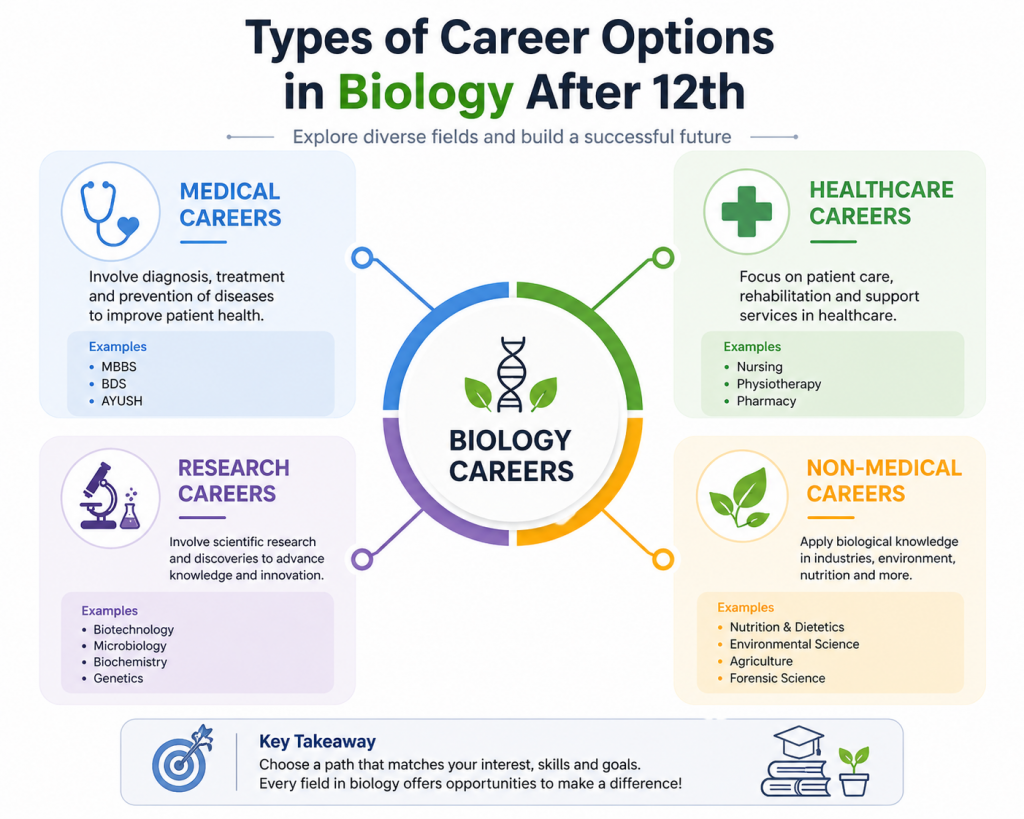
Biology is not limited to medical careers. Students who complete 12th with biology can explore multiple career paths depending on their interests, strengths, and long-term goals. Understanding these categories helps in choosing the right direction instead of focusing on a single option.
The main career options in biology after 12th can be grouped into medical, healthcare, research, and non-medical biology fields. Each category offers different types of roles and career progression.
| Career Category | Focus Area | Example Careers | Nature of Work |
|---|---|---|---|
| Medical | Diagnosis and treatment | Doctor, Dentist, Specialist | Patient care, clinical decision-making |
| Allied Healthcare | Support and therapy | Nurse, Physiotherapist, Lab Technologist | Clinical support, rehabilitation, diagnostics |
| Research and Life Sciences | Scientific study and innovation | Biotechnologist, Microbiologist, Scientist | Lab work, experiments, research projects |
| Non-Medical Biology | Environment, nutrition, agriculture | Dietician, Environmental Scientist, Agriculture Officer | Consulting, field work, research |
How These Career Categories Differ
Each category of biology careers requires a different type of training and leads to different career outcomes. Medical careers require entrance exams and longer study duration, while allied healthcare and research-based careers offer more flexible entry paths.
- Medical careers: Require competitive exams and long-term study but offer structured growth
- Allied healthcare: Focus on practical roles in hospitals and clinics
- Research careers: Suitable for students interested in science and experimentation
- Non-medical biology careers: Offer diverse options outside traditional healthcare roles
Choosing the Right Category
Before selecting a course, students should decide which category matches their interests. This helps narrow down the biology courses after 12th and avoid confusion between too many options.
- If you are interested in patient care → consider medical or healthcare fields
- If you prefer lab-based work → research and life sciences are suitable
- If you want broader options → explore non-medical biology careers
Related: Complete List of Medical Courses After 12th
Medical Career Options After 12th Biology
Summary: Medical careers focus on diagnosing and treating diseases and require formal education and licensing after completing 12th biology.
Medical careers are one of the most recognised career options in biology after 12th. These roles focus on diagnosing and treating diseases and usually require formal education and licensing.
Students who want to work directly with patients and are willing to prepare for competitive exams often choose this path.
| Course | Career Role | Work Area |
|---|---|---|
| MBBS | Doctor | Hospitals, clinics |
| BDS | Dentist | Dental clinics |
| BAMS | Ayurvedic Practitioner | Alternative medicine |
| BHMS | Homeopathic Doctor | Holistic healthcare |
Each of these paths involves specialised training. Students should explore course details, entrance requirements, and career scope before choosing a medical field.
Allied Healthcare Careers After 12th Biology
Summary: Allied healthcare careers support medical professionals and provide practical roles in hospitals, diagnostics, and rehabilitation.
Allied healthcare careers are another important set of biology career options after 12th. These roles support medical professionals and focus on patient care, diagnostics, and rehabilitation.
These courses are suitable for students who want practical roles in hospitals without pursuing long-duration medical degrees.
| Course | Career Role | Work Area |
|---|---|---|
| BSc Nursing | Nurse | Hospitals |
| Physiotherapy | Physiotherapist | Rehabilitation centres |
| Medical Lab Technology | Lab Technologist | Diagnostic labs |
| Radiology | Imaging Technician | Hospitals, diagnostic centres |
Allied healthcare careers offer structured roles in the healthcare system and provide opportunities for growth with experience and specialisation.
Related: How to Choose Right Career Opportunities after 12th
Research and Life Science Careers After 12th Biology
Summary: Research and life science careers involve laboratory work, experiments, and scientific analysis, often requiring higher studies for advanced roles.
Research-based roles are a key part of career options in biology after 12th. These careers focus on scientific study, experiments, and innovation rather than patient care.
Students interested in laboratory work, analysis, and higher studies often choose life science fields.
| Course | Career Role | Work Area |
|---|---|---|
| Biotechnology | Biotechnologist | Research labs, industry |
| Microbiology | Microbiologist | Laboratories, pharma companies |
| Biochemistry | Research Analyst | Scientific research |
| Genetics | Geneticist | Medical and research fields |
These fields usually require higher studies for advanced roles, but they offer strong opportunities in research, pharmaceuticals, and biotechnology industries.
Non-Medical Career Options in Biology
Summary: Non-medical biology careers include fields like nutrition, environmental science, and agriculture, offering flexible career options beyond healthcare.
Many biology career options after 12th are not directly linked to medicine or laboratories. These fields focus on applied science, sustainability, and lifestyle-related areas.
Students who prefer flexible career paths or industry-based roles can explore these options.
| Course | Career Role | Work Area |
|---|---|---|
| Nutrition and Dietetics | Dietician | Hospitals, wellness centres |
| Environmental Science | Environmental Consultant | Government, NGOs, industry |
| Agriculture | Agriculture Officer | Farming, agribusiness |
| Food Technology | Food Technologist | Food industry |
| Public Health | Health Program Officer | Community health projects |
These careers are suitable for students who want to apply biology knowledge in real-world industries without choosing a medical path.
Related: High-Salary Courses after 12th Non-medical
Biology Courses After 12th: Duration, Eligibility and Career Path
Summary: Biology courses after 12th vary in duration, eligibility, and career outcomes, making it important to compare options before choosing a path.
Students exploring career options in biology after 12th should compare course duration, eligibility, and the type of career each course leads to. This helps in choosing a path that fits both interest and time commitment.
| Course | Duration | Eligibility | Career Path |
|---|---|---|---|
| MBBS | 5.5 years | 12th PCB | Doctor → Specialist → Consultant |
| BSc Nursing | 4 years | 12th PCB | Nurse → Senior Nurse → Healthcare Manager |
| BSc Biotechnology | 3 years | 12th PCB | Researcher → Scientist → R&D Specialist |
| BPharma | 4 years | 12th PCB/PCM | Pharmacist → Analyst → Industry Roles |
| Nutrition & Dietetics | 3 years | 12th PCB | Dietician → Consultant → Wellness Expert |
Each course leads to a different career path in biology field after class 12. Medical courses take longer but follow structured progression, while research and applied science courses offer more flexibility.
Skills Required for Biology Careers
Summary: Biology careers require analytical thinking, observation skills, communication, and problem-solving abilities for long-term success.
Most biology careers after 12th are not just about what you study. They also depend on how you approach problems, how patient you are, and how well you handle details.
Some skills become more important as you move forward, especially in fields like healthcare and research.
- Attention to detail: small mistakes can matter, especially in labs or clinical settings
- Observation skills: noticing patterns or changes is a big part of biology work
- Communication: whether it’s explaining something to a patient or working in a team
- Patience: results don’t always come quickly, especially in research
- Problem-solving: applying what you learn to real situations
These skills are useful across most career options in biology after 12th, no matter which path you choose.
Future Scope of Biology Careers
Summary: The future scope of biology careers is expanding due to demand in healthcare, biotechnology, research, and environmental sectors.
The scope of biology career options after 12th is expanding due to rising demand in healthcare, biotechnology, and environmental sectors.
Healthcare continues to grow, but at the same time, fields like biotechnology, environmental science, and public health are opening up new opportunities.
- Healthcare roles remain in steady demand
- Biotechnology and pharma industries are expanding
- Environmental and sustainability roles are increasing
- Research and innovation are getting more attention
This means students are not limited to one path. Biology now connects to multiple industries, which gives more flexibility in the long run.
Do Biology Careers Offer High Salary?
Summary: Biology careers can offer strong earning potential over time, depending on specialisation, experience, and career progression.
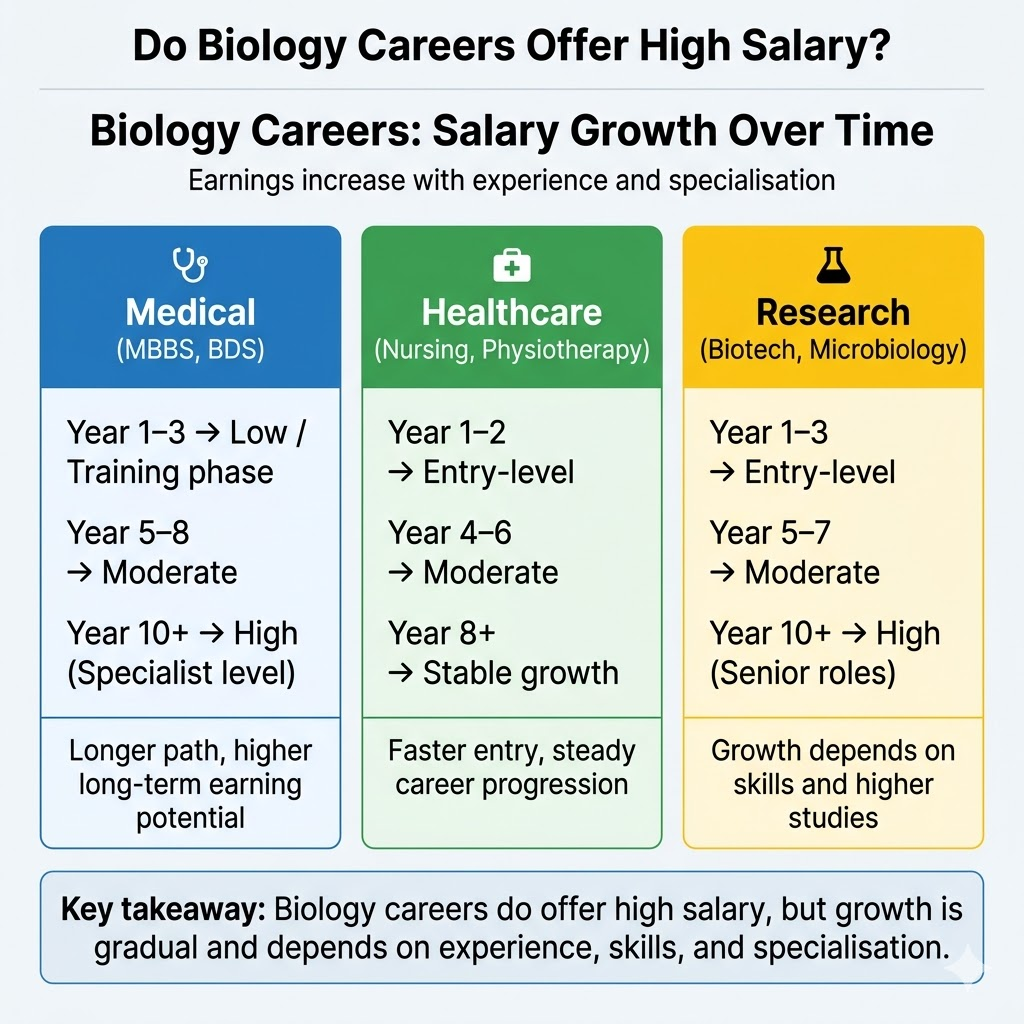
Some career options in biology after 12th offer strong earning potential, especially in medical and specialised fields. However, salary depends on experience, skills, and career progression.
Medical careers often take longer to reach higher income levels, while research and applied science roles provide steady growth over time.
Students should focus on choosing the right career path first, and then evaluate salary based on long-term growth.
How to Choose the Right Biology Career After 12th
Summary: Choosing the right biology career depends on your interests, study duration preference, and long-term career goals.
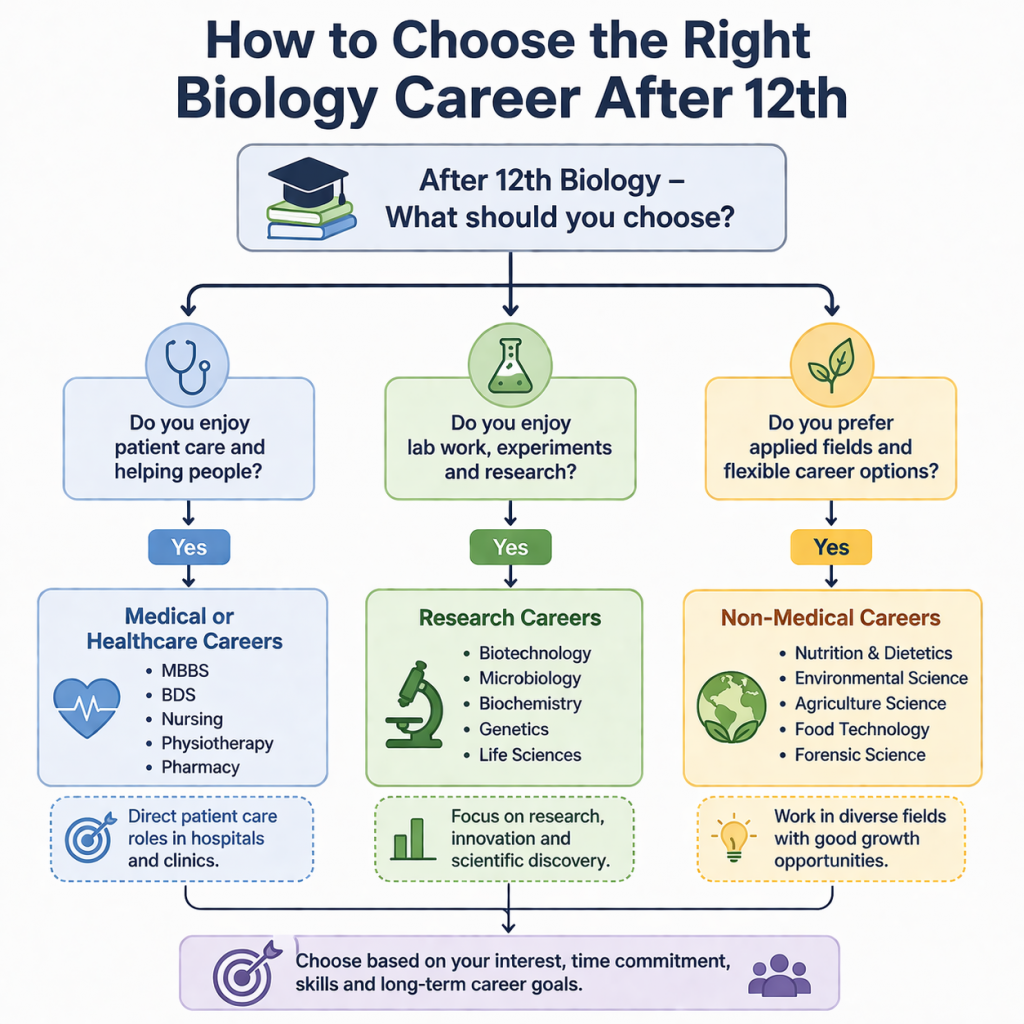
There isn’t one “best” option when it comes to career options in biology after 12th. What works for one student may not work for another. The right choice depends on what you enjoy studying and how you see yourself working in the future.
Instead of picking a course based on popularity, try to understand what the day-to-day work actually looks like. That usually makes the decision clearer.
Start with what interests you
- If you’re comfortable around patients and like direct interaction, medical or healthcare roles make sense
- If you enjoy experiments and theory, research-based fields like biotechnology or microbiology are a better fit
- If you prefer applied science, areas like nutrition, environment, or agriculture can work well
Think about how much time you want to invest
- Medical careers take longer and require consistent preparation
- Courses like nursing, pharmacy, or biotech are comparatively shorter
- Some applied science roles allow quicker entry into the workforce
There’s no right or wrong choice here. It’s more about what fits your pace and priorities.
Look at where the course leads
Before deciding, check what kind of roles the course opens up. A degree is only useful if you understand the career path that follows it.
Once you connect the course to a real job role, choosing between different biology courses after 12th becomes much easier.
FAQs on Career Options in Biology After 12th
🔽 Can I build a career in biology without becoming a doctor?
Yes, there are many non-medical careers such as research, biotechnology, nutrition, and environmental science.
🔽 Which biology course has good future scope?
Courses in biotechnology, healthcare, and environmental science have strong future demand due to industry growth.
🔽 Are biology careers stable?
Biology careers are generally stable, especially in healthcare and research fields where demand remains consistent.
🔽 What skills are important for biology careers?
Analytical thinking, observation, communication, and problem-solving are important for success in biology-related careers.
 Beware of Scammers
