






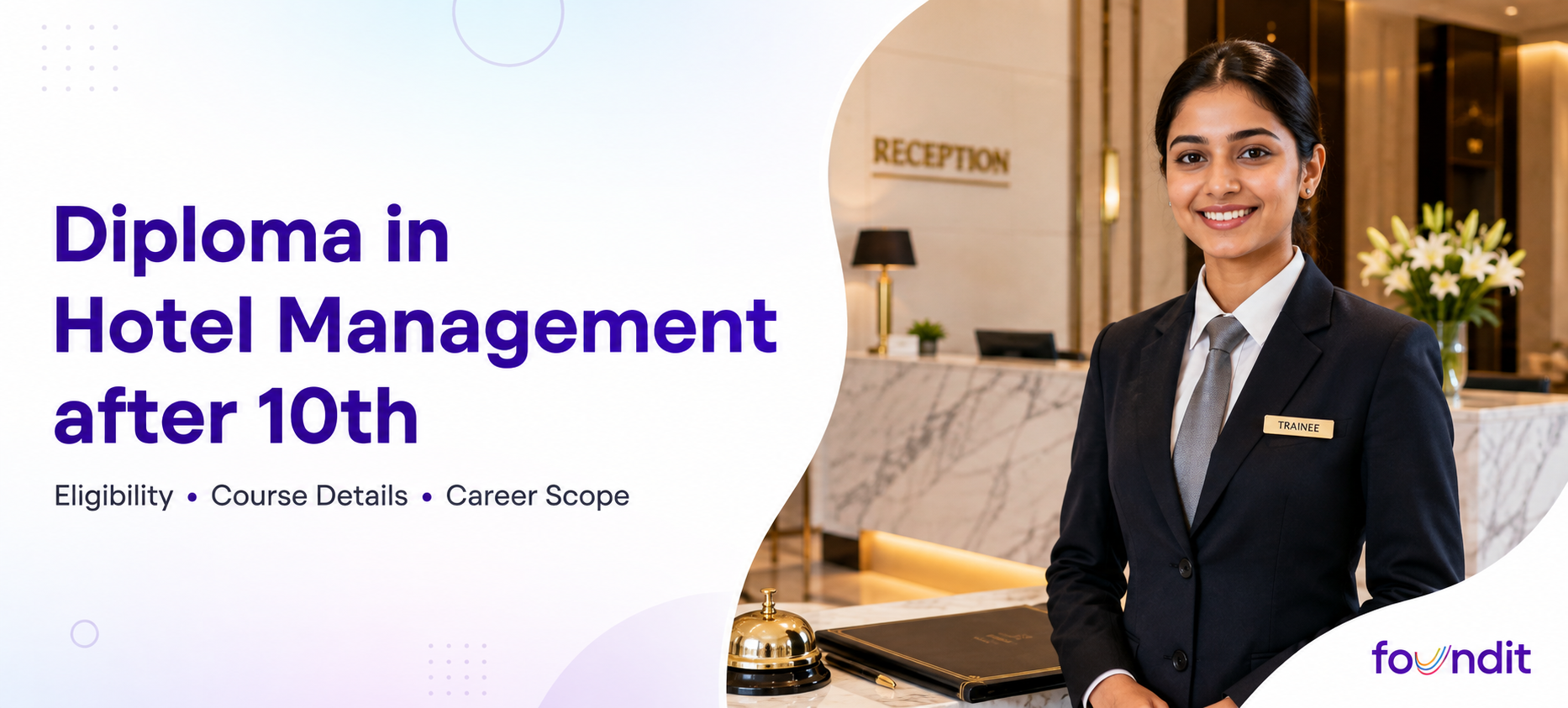
A Diploma in Hotel Management after 10th allows students to enter the hospitality business early. It enables them to begin professional training without waiting to complete Class 12.
India’s tourist and hotel industry is still expanding quickly, generating a lot of job possibilities. The World Travel & Tourism Council projects that by 2030, the industry will boost India’s GDP by more than USD 250 billion.
Beginning a diploma course after Class 10 gives students an early professional advantage. Enrolling in a three-year program that starts at age sixteen allows students to get industrial experience and professional capabilities early.
A hotel management career after 10th can open opportunities to hotels, restaurants, airlines, and other hospitality sectors.
This article describes hotel management diploma programs, prerequisites, costs, employment opportunities, earnings data, and the top Indian colleges.
What is a Diploma in Hotel Management?
A Diploma in Hotel Management is a professional programme that provides training in hotel operations, hospitality services, and customer service. It covers the core functions required to work in the hospitality industry.
Important topics like food production, housekeeping, food and beverage service, front desk operations, and guest relationship management are taught to students. These abilities aid students in comprehending how hotels and other hospitality-related organisations operate on a daily basis.
Hotel management courses after 10th place more emphasis on hands-on learning and industry exposure than degree programs do.
Kitchen training, front desk practice, hospitality activities, and required internships are all included in the curricula of the majority of institutions.
Why Choose Hotel Management After 10th? Key Benefits & Industry Scope
Unlike many professional courses that require students to complete Class 12, a diploma in hotel management can be pursued after Class 10. This allows students to enter the hospitality industry earlier, gain practical experience sooner, and begin building their careers at an early stage.
Early Career Advantage: Why Starting at 16 Pays Off
The following are the main advantages of selecting a diploma in hotel management after 10th:
- Earlier Industry Entry: You have a real employability advantage over degree holders who enter at age 21 or 22 if you finish your three-year diploma by the age of 19.
- Make Money While You Study: A lot of diploma programs offer paid industrial training, which enables students to get stipends while completing internships.
- Faster Return on Investment: You start to recoup your educational investment considerably sooner due to lower costs and a shorter time frame.
- Higher Education Options: Diploma holders can continue their academic path by pursuing a Bachelor of Hotel Management (BHM) or Bachelor of Hospitality and Hotel Administration (BHH).
- No Stream Restriction: Hotel management after 10th accepts students from any academic stream, science, arts, or commerce.
Read Also: Food And Beverage Manager Job Description
Types of Hotel Management Courses You Can Pursue After 10th
Many students are unaware of the range of hotel management courses available after Class 10, from short-term certificate programmes to diploma programmes. The table below provides an overview of the main course options.
| Course Type | Duration | Approximate Annual Fees | Key Focus Areas |
| Diploma in Hotel Management | 1–3 years | ₹47,000 | All hotel operations |
| Certificate in Front Office | 6 months | ₹49,000 | Front desk, reservations |
| Certificate in Food Production | 6 months | ₹10,000 | Cooking, kitchen operations |
| Certificate in Housekeeping | 6 months | ₹50,000 | Room management, laundry |
| Vocational Training Programme | 6 months–2 year | ₹10,000–₹80,000 | Basic hotel service skills |
Disclaimer: Fees are indicative and subject to change. The actual course fee may vary by the institute, location, and academic year. Applicants should verify the latest fee details with the respective institution before applying.
Diploma in Hotel Management (1–3 Years)
A Diploma in Hotel Management is one of the most comprehensive and widely recognised qualifications for aspiring hospitality professionals. It equips students with industry-relevant knowledge and practical skills, preparing them for a wide range of roles in hotel operations and the hospitality sector.
Government-run programmes, particularly those offered by Institutes of Hotel Management (IHMs), are widely recognised and respected across the hospitality industry.
Certificate Courses in Hotel Management
Certificate programmes are suitable for students who want to develop specific hospitality skills in a shorter duration. They provide introductory training and can serve as a pathway to entry-level roles, such as front office assistant or commis chef, or to further studies in hotel management.
Vocational Training Programmes
Vocational programs emphasise practical job-readiness and are provided by polytechnic colleges and government skill development efforts under the National Skill Development Corporation (NSDC). They can be finished in six months to a year and are usually the most economical choice.
Read Also: Duty Manager Job Description
Diploma in Hotel Management After 10th: Specialisations & Curriculum
A hotel management diploma’s true worth is found in its specialisations, each of which equips students for a unique profession in the hospitality sector.
Before letting students concentrate on their chosen speciality, the majority of three-year programs cover all of the key subjects.
Hotel Management Diploma Syllabus: Core Subjects
The typical hotel management diploma syllabus includes:
- Food and beverage service
- Front office operations
- Housekeeping management
- Food production and culinary arts
- Communication skills and business English
- Hotel accountancy and cost control
- Tourism and travel fundamentals
- Computer applications in hospitality
Front Office Operations
Students gain knowledge of property management systems (PMS), visitor enquiries, check-in and check-out procedures, and reservation administration. Jobs like front desk assistant, receptionist, and guest relations executive are directly related to this speciality.
Food & Beverage Management
Service methods, restaurant operations, bar management, and banqueting are all covered in this topic. In both hotel and independent restaurant settings, students with training in food and beverage are highly sought after.
Housekeeping Management
Room preparation, linen management, floor supervision, and upholding hygienic standards are all included in housekeeping training. Because luxury hotels have very high criteria for presentation, this specialism is very beneficial there.
Food Production & Culinary Arts
Students learn about menu planning, food safety, kitchen operations, and traditional and modern cooking techniques. The course prepares them for entry-level roles in commercial kitchens and provides a foundation for a career as a chef.
Read Also: Housekeeper Job Description
Eligibility Criteria for Diploma in Hotel Management After 10th
The eligibility requirements for a diploma in hotel management after 10th are accessible for most students. The criteria vary slightly between government and private institutions but follow a broadly consistent pattern.
Minimum Marks Required
To get admitted to most institutions, candidates must have completed Class 10 (Secondary School Certificate) from a recognised board, such as the CBSE, ICSE, or any state board.
Government IHM colleges may have somewhat higher criteria; however minimum marks usually fall between 40% and 50% overall. Some private institutions accept students with a pass certificate regardless of percentage.
Age & Stream Requirements
- Minimum age: Typically, 16–17 years at the time of admission
- Maximum age: Generally, 22–25 years (varies by institution)
- Stream: Students in the arts, sciences, and commerce are all eligible; there is no stream of requirement.
- English Proficiency: Since guest-facing communication is a requirement of hospitality positions, most institutions anticipate basic English communication skills.
Since Diploma in Hotel Management eligibility requirements may change each academic year, students should always check the latest admission criteria with their chosen institute before applying.
Read Also: Front Office Manager (Hospitality Sector)
Hotel Management Diploma Fees & Admission Process
Knowing how much a hotel management diploma fees costs and how the admissions process works can help students and families make more assured preparations. Fees at private and public universities differ greatly.
Diploma Fee Structure: Government vs Private Colleges
The table below provides a general comparison of typical fee ranges. These figures are indicative only and should be verified directly with each institution.
| College Type | Total Programme Cost (3 Years) |
| Government IHM College | ₹50,000–₹1,00,000 |
| State Government College | ₹30,000 – ₹1,50,000 |
| Private Affiliated College | ₹1,20,000- ₹4,00,000 |
| Premium Private Institute | ₹4,00,000–₹6,00,000 |
Disclaimer: Fees are indicative and subject to change. The actual course fee may vary by the institute, location, and academic year. Applicants should verify the latest fee details with the respective institution before applying.
Read Also: Front Desk Representative Job Description
Step-by-Step Admission Process
The admission process for most hotel management diploma programmes follows these stages:
- Check Eligibility: Verify that you fulfil the requirements for your selected program in terms of age, education, and minimum grades.
- Shortlist Colleges: Look into state polytechnics, private schools, and government IHM colleges in the city or state of your choice.
- Gather Application Forms: In accordance with the deadlines for Class 10 board results, most colleges distribute application forms between March and June.
- Submit Required Documents: Typically, these comprise a Class 10-mark sheet, a school leaving certificate, proof of age, and passport-sized photo.
- Attend the Entrance Exam (if applicable): Some government institutions employ state-level hospitality entry exams or administer their own written exams.
- Attend Counselling or an Interview: Some organisations use in-person interviews or group discussions to shortlist applicants.
- Verify Admittance and Pay Fees: After being chosen, finish the enrolment procedure and make the first fee payment by the deadline.
Read Also: Career Planning Process: Complete Step-by-Step Guide
Top Hotel Management Colleges in India for Diploma After 10th
Your industry connections, internship prospects, and training quality are all greatly impacted by your choice of institution. An outline of reputable government and private institutions is provided here.
Government Hotel Management Colleges
The Ministry of Tourism and the National Council for Hotel Management and Catering Technology (NCHMCT) oversee government IHM colleges. They provide globally known credentials, reasonable rates, and solid placement records.
| College | Location | Notable Feature |
| IHM Pusa (Institute of Hotel Management, Catering Technology & Applied Nutrition) | New Delhi | One of India’s oldest and most respected IHMs |
| IHM Mumbai | Mumbai | Strong industry connections with leading hotel chains |
| IHM Chennai | Chennai | Well-regarded in South India; active placement cell |
| IHM Kolkata | Kolkata | Established government institute with affordable fees |
| IHM Bangalore | Bengaluru | Located in a major hospitality hub with strong internship access |
Top Private Institutes for Diploma
Private universities have more flexible admissions procedures, sophisticated infrastructure, and, in certain circumstances, greater international placement networks.
| College | Location | Notable Feature |
| Lovely Professional University (LPU) | Phagwara, Punjab | Large campus; industry-connected curriculum |
| IIHM (International Institute of Hotel Management) | Pan-India | International affiliations; placement-focused |
| Amity School of Hospitality | Noida | Part of established Amity Group; good alumni network |
| ITM Institute of Hotel Management | Navi Mumbai | Industry-linked training; strong regional reputation |
| Manipal Academy of Higher Education | Manipal, Karnataka | Well-regarded private university with hospitality department |
Read Also: Train To Be A Chef!
Career Options After Diploma in Hotel Management: Roles & Growth Path
A Diploma in Hotel Management can serve as the foundation for long-term career growth in the hospitality industry. With the right skills and experience, professionals may progress from entry-level roles to managerial positions over time.
Entry-Level Roles After Diploma
Most diploma graduates begin their careers in front-line positions such as these:
- Front Office Assistant / Receptionist: Manage check-ins, reservations and guest enquiries at the hotel front desk.
- Food and beverage service assistants: They are responsible for serving visitors in hotel restaurants, banquet halls, and room service.
- Commis Chef/Kitchen Assistant: Helping a senior chef prepare food in kitchen operations.
- Room Attendant / Housekeeping Assistant: Ensures room cleanliness, linen management and floor presentation.
- Guest Relations Executive: Handling concierge requests, VIP guest experiences and complaints.
- Reservations Agent: They deal with the telephone and internet reservations and work with the front office personnel.
Mid-Level and Senior Career Progression
Diploma holders usually advance into management and supervisory positions after two to five years of experience.
Many people advance their careers by transitioning to hotel sales, revenue management, food and beverage management, or event management. To advance into senior positions more quickly, some people seek a part-time degree in hotel management.
Read Also: How to Become a Food Inspector in 2026: Step-by-Step Guide
Salary After Hotel Management Diploma: What to Expect in 2026
At the starting level, hotel management diploma holders usually make between ₹12,000 and ₹25,000 per month. Within three to five years, compensation can reach ₹40,000–₹60,000 per month with experience, expertise, and advancement into supervisory positions.
| Job Role | Approximate Average Fresher Monthly Salary |
| Front Office Assistant | ₹14,575 |
| Food & Beverage Service Staff | ₹15,508 |
| Commis Chef / Kitchen Assistant | ₹14,257 |
| Housekeeping Attendant | ₹14,069 |
| Guest Relations Executive | ₹16,000–₹36,000 |
| Reservations Agent | ₹19,480 |
Disclaimer: The salary figures provided above are approximate average monthly salaries for freshers and may vary based on the employer, location, qualifications, skills, experience, and type of hospitality establishment. Actual compensation may also include additional benefits and incentives.
Read Also: What does a Restaurant Manager do?
Hotel Management After 10th vs After 12th: Which Path is Right for You?
Both paths lead to fulfilling hospitality employment, but the timing, expense, and starting career trajectory vary significantly. Your objectives, financial status, and desired rate of entry into the workforce will all influence your decision.
To assist you in making an informed choice, the two solutions are compared side by side in the table below.
| Factor | After 10th (Diploma) | After 12th (Degree/Diploma) |
| Minimum qualification | Class 10 pass | Class 12 pass |
| Duration | 1–3 years | 3–4 years (degree) |
| Fees | Lower (₹30K–₹3L total) | Higher (₹1L–₹8L+ total) |
| Industry entry age | 17–19 years | 20–22 years |
| Career scope | Strong; supervisory roles achievable | Broader; faster management entry |
| Higher study option | Can pursue BHM after diploma | Can pursue BHM or MBA directly |
| Entrance exams | Fewer; mostly institution-level | NCHMCT JEE for IHM degree programmes |
When to Choose Hotel Management After 10th
- You want to enter the workforce and start earning as early as possible.
- Budget is a significant consideration, and you want to minimise education costs.
- You have a clear interest in hospitality and do not want to spend two more years in school.
- You are comfortable starting at the frontline and building your career progressively.
When to Choose Hotel Management After 12th
- You want to pursue a full bachelor’s degree in hotel management for faster management entry.
- To gain admission to prestigious government IHM degree programs, you are thinking about taking the NCHMCT JEE (National Council for Hotel Management and Catering Technology Joint Entrance Examination).
- You want to explore specialised areas of hospitality before choosing a specific career path.
- You are considering an MBA in Hospitality Management later and want a stronger academic foundation.
Read Also: Best Courses After 10th: High-Salary Diploma & Career Options 2026
Skills You Need to Succeed in Hotel Management
Recruiters in the hotel industry seek a highly specific set of interpersonal and technical skills in addition to the diploma. Candidates who cultivate these attributes in addition to their official qualifications perform better than those who only use their academic credentials.
Technical Skills vs Soft Skills in Hotel Management
When it comes to hiring, both skill categories are crucial, and the hospitality sector is one of the few where soft skills are just as important as technical expertise.
Technical Skills:
- Functioning of property management systems (PMS) (such as Opera, IDS)
- Managing point-of-sale (POS) systems
- Fundamentals of HACCP (Hazard Analysis and Critical Control Points) and food safety
- Standard operating procedures (SOPs) for housekeeping
- Fundamental billing and accounting processes
- Techniques for plating and presenting food (for jobs involving the kitchen)
Soft Skills:
- Guest Service Orientation: The capacity to regularly anticipate and surpass guests’ expectations.
- Communication: Proficiency in both spoken and written English is crucial for positions involving guests; being multilingual is a big plus.
- Emotional Intelligence: Maintaining composure, professionalism, and empathy in the face of difficult circumstances or complaints from visitors.
- Teamwork: Hotel operations operate as tightly coordinated teams, and cross-departmental cooperation is essential.
- Attention to Detail: Even little mistakes in food service, room presentation, or billing can have a direct impact on one’s reputation in the luxury hospitality industry.
- Adaptability: In the hospitality industry, flexibility is essential due to shift work, busy seasons, and unpredictable guest volumes.
- Time Management: It takes careful prioritisation to handle several jobs at busy check-in times or banquet events.
Read Also: Soft Skills: Definitions, Importance, And Examples 2026
Conclusion
A Diploma in Hotel Management after 10th is a recognised professional qualification that equips students with industry-relevant skills and prepares them for entry-level opportunities in the hospitality sector.
It is one of the most feasible vocational paths available after Class 10, with low fees, easy eligibility, and high job demand.
Whichever your specialism, whether front office, food and beverage, culinary arts or housekeeping, the skills you develop on a diploma course form the foundation for a career that can eventually progress to senior management.
Begin by exploring government IHM colleges and reputed private institutes, then compare the fees, placement records and depth of the curriculum before applying.
FAQs
Yes, there are many employment options in hotel management following Class 10, with positions available in hotels, resorts, restaurants, and other hospitality-related establishments.
New graduates often make between ₹12,000 and ₹25,000 a month. Salaries can rise with experience through opportunities with reputable hotel brands, specific talents, and promotions
Yes, students who have finished Class 10 from an accredited board are accepted into many diploma and certificate programs without needing to have completed Class 12.
Front desk operations, food production, housekeeping, food and beverage service, communication skills, accounting, tourism, and hospitality technology are all covered in the curriculum.
Reputable private institutions and government IHM colleges are well-liked options. Fees, location, course design, and placement prospects all play a role in selecting the best institution.
 Beware of Scammers
