







Cyber Security Courses After 12th train students in protecting networks, systems, and digital infrastructure from cyber threats and data breaches. The field has grown rapidly as cyber security in India becomes essential for government agencies, banks, hospitals, and enterprise organisations that rely on digital systems.
Many learners assume that cyber security careers are limited to hacking or coding. However, the domain covers broader areas such as network security, risk management, data protection, and threat analysis.
Professionals in this field play a key role in safeguarding modern digital infrastructure by identifying vulnerabilities and preventing cyber attacks. Information security courses after 12th are designed to build these practical skills across multiple security domains.
This blog covers eligibility, courses, fees, salaries, career opportunities, and future scope in cyber security.
Why Cyber Security Has Become an Important Career Option
As businesses deal with client data, payment systems, and cloud platforms, cyberattacks are becoming more frequent across all industries. Businesses also handle private company data online, which calls for robust security and ongoing monitoring mechanisms.
To put it simply, cyber security experts stop ransomware attacks, internet fraud, data theft, and system breaches. In today’s regular business situations, their labour helps companies maintain seamless operations without significant disruptions.
Digital banking, e-commerce, fintech, healthcare technology, and remote work technologies have all grown quickly in India. IT organisations can offer possibilities to new hires with the appropriate technical knowledge, practical skills, and certifications.
Read Also: The Future of Cybersecurity Jobs in India
Cyber Security Courses After 12th Qualification Criteria
Students frequently worry about their eligibility for after-school cyber security classes. The good news is that students from various educational streams are now accepted into various programs.
The majority of undergraduate degree programs require students to graduate from a recognised board with a Class 12 diploma.
For entrance requirements alone, some universities favour students from the Science stream who have a background in mathematics.
Others, however, also welcome students in the arts and commerce, depending on the course of eligibility requirements.
Here is a simple breakdown of common qualification criteria:
| Course Type | Eligibility | Typical Duration |
| BSc Cyber Security | Class 12 with science preferred | 3 years |
| BTech Cyber Security | PCM in Class 12 | 4 years |
| Diploma Courses | Class 12 pass from any stream | 1-2 years |
| Certification Courses | Basic computer knowledge | Few months |
| Ethical Hacking Courses | Class 12 or graduation | 3-12 months |
Additionally, some universities have minimum score requirements, often ranging from 50% to 60% on Class 12 exams. Private schools might provide more accommodating admissions standards than public ones.
Students shouldn’t give up if they don’t know a lot about coding. Most beginner-level courses begin with fundamental networking, operating system, and programming ideas before progressing to more advanced topics.
Read also: 20 Essential Tips to Improve Cyber Security Skills With Practical Examples
Cyber Security Courses After 12th Process
Choosing an appropriate course based on job aspirations is the first step in cyber security courses after 12th grade.
Students should consider academic background, interest level, and overall budget before making a final decision carefully. They must choose between a skill-focused certification programme and a full-time degree programme.
Degree courses typically offer students superior long-term job advancement options and more extensive academic instruction.
Certification programmes help in the quicker development of work preparedness and concentrate more on real industrial skills.
Additionally, some institutions do not require entrance exams and instead provide direct admissions based on Class 12 grades.
Best Cyber Security Courses After 12th in India
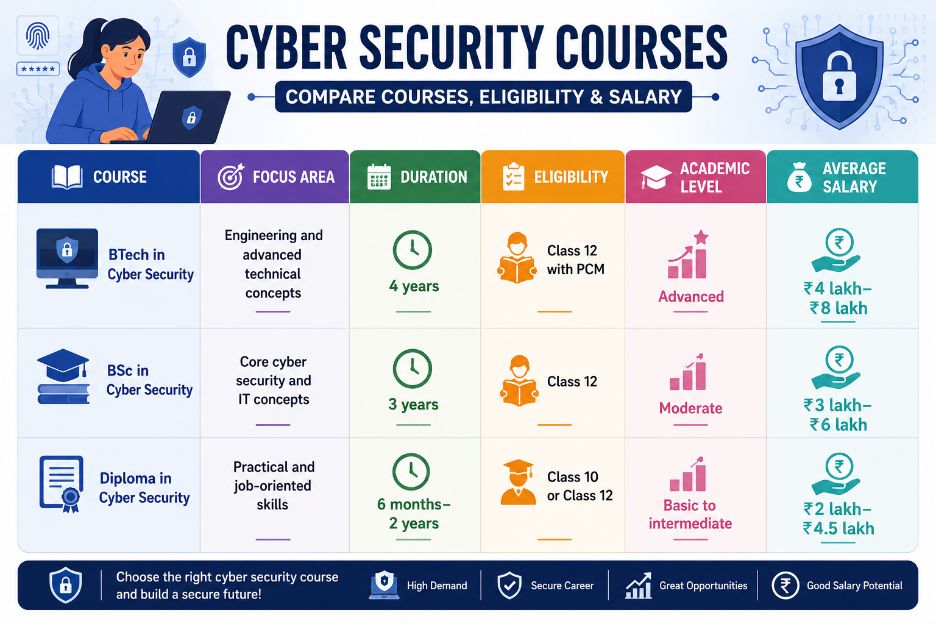
Students now have several educational courses in India for entering the cyber security field. Each course offers a different career roadmap depending on technical depth, duration, and specialisation.
| Course | Focus Area | Duration | Eligibility | Academic Level | Average Salary |
| BTech in Cyber Security | Engineering and advanced technical concepts | 4 years | Class 12 with PCM | Advanced | ₹4 lakh–₹8 lakh |
| BSc in Cyber Security | Core cyber security and IT concepts | 3 years | Class 12 | Moderate | ₹3 lakh–₹6 lakh |
| Diploma in Cyber Security | Practical and job-oriented skills | 6 months–2 years | Class 10 or Class 12 | Basic to intermediate | ₹2 lakh–₹4.5 lakh |
BTech in Cyber Security
BTech programmes offer in-depth technical expertise in networking, programming, security systems, and computers. Students that appreciate sophisticated technical subjects, logical problem-solving, and mathematics are typically well suited for these courses.
- Eligibility: Class 12 with Physics, Chemistry, and Mathematics from a recognised board. Entrance exams may apply.
- Duration: 4 years
- Fees: Approximately ₹3 lakh–₹12 lakh
- Scope: Roles in ethical hacking, cloud security, cyber security analysis, and digital risk management.
- Average Salary: Approximately ₹4 lakh–₹8 lakh annually
BSc in Cyber Security
A BSc programme focuses on essential cyber security ideas rather than the in-depth engineering framework of BTech courses. Because it provides useful security knowledge with reasonable academic complexity, this option is preferred by many students.
- Eligibility: Class 12 from a recognised board. Some colleges may prefer science or computer-related subjects.
- Duration: 3 years
- Fees: Approximately ₹1 lakh–₹5 lakh
- Scope: Opportunities in IT support, cyber security operations, and system administration.
- Average Salary: Approximately ₹3 lakh–₹6 lakh annually
Diploma in Cyber Security
Diploma programmes are shorter and concentrate more on helping students develop their practical skills. These courses give students industry-relevant security skills and knowledge that help them enter the workforce more quickly.
- Eligibility: Class 10 or Class 12 from a recognised board, depending on institution requirements.
- Duration: 6 months–2 years
- Fees: Approximately ₹30,000 –₹2 lakh
- Scope: Entry-level roles in technical support, network monitoring, and security assistance.
- Average Salary: Approximately ₹2 lakh–₹4.5 lakh annually
Ethical Hacking Certification Courses
Students who take ethical hacking classes learn how experts find weaknesses in systems before attackers may take advantage of them. Because businesses use ethical hackers to carefully test security solutions, this area is often preferred.
Network scanning, malware analysis, vulnerability assessment, and penetration testing are all thoroughly understood by the students.
These courses are very hands-on and usually combine real-world projects with simulation-based teaching methods.
At all times, industry compliance standards and appropriate security procedures are key components of professional training.
Read Also: Cyber Security Skills
Cyber Security Courses After 12th Syllabus
The curriculum for cyber security courses offered by various institutions, universities, and certification programmes differs after the 12th grade. However, most programmes offer students a combination of technical, analytical, and security-focused courses.
The primary goal is to assist students in comprehending how digital systems function in actual settings. Additionally, it describes how cyber threats target systems and how experts mitigate such security concerns.
Here is an overview of common subjects included in cyber security programmes:
| Subject Area | Topics Covered |
| Networking | Transmission Control Protocol/Internet Protocol, routers, switches, firewalls |
| Programming | Python, Java, C++, scripting basics |
| Ethical Hacking | Penetration testing, vulnerability analysis |
| Operating Systems | Linux, Windows security management |
| Digital Forensics | Cybercrime investigation methods |
| Cryptography | Encryption and data protection |
| Cloud Security | Cloud infrastructure protection |
| Cyber Laws | Data privacy and compliance regulations |
| Database Security | Secure database management |
| Malware Analysis | Threat detection and response |
Students also work on assignments, simulations, case studies, and practical labs. Practical learning becomes extremely important because cyber security professionals solve live technical problems daily.
Some advanced programmes also include artificial intelligence, machine learning security, blockchain security, and IoT protection modules.
Cyber Security Courses After 12th Exam Requirements
The cyber security courses after 12th exam process depend on the institute and course level. Engineering colleges often conduct national or state-level entrance examinations.
BTech programmes: Students may appear for exams such as JEE Main, state engineering entrance tests, or university-specific assessments.
BSc and diploma programmes: Provide direct admissions based on Class 12 scores. However, reputed universities may still conduct aptitude tests or interviews.
Students looking for certification courses usually do not face strict entrance requirements. Basic computer knowledge and interest in technology are often enough to begin.
Skills Required for a Career in Cyber Security
In cyber security, technical expertise is insufficient on its own. Practical thinking, flexibility, and problem-solving skills are also valued by employers.
In reality, security experts operate in dynamic settings where risks are constantly evolving. This implies that ongoing education becomes a part of the work.
Some important skills required in cyber security include:
Analytical Thinking – H3
Cyber professionals examine unusual activity, security alerts, and system vulnerabilities carefully. Strong analytical ability helps them identify risks before major damage happens.
Problem-Solving Skills
Many times, professionals must respond quickly during security incidents. The ability to investigate problems calmly and find solutions matters greatly.
Communication Skills
Cyber security experts often explain technical risks to non-technical teams. Clear communication helps businesses understand security recommendations better.
Technical Knowledge
Students should gradually build knowledge in networking, operating systems, coding, cloud platforms, and security tools. Practical exposure improves confidence significantly.
Ethical Responsibility
Security professionals handle sensitive systems and confidential information regularly. Ethical conduct and responsible behaviour are extremely important in this field.
Career Path in Cyber Security After 12th
Depending on their interests and chosen specialisations, students entering the field of cyber security can pursue a variety of professional routes.
While some students choose careers in technological security, others choose careers in management, consulting, or auditing. Typically, the professional path starts with entry-level technical experience in organisations and fundamental training.
A typical career roadmap may look like this:
| Career Stage | Common Roles |
| Beginner Level | Security Support Executive, Junior Analyst |
| Mid-Level | Security Analyst, Ethical Hacker |
| Advanced Level | Security Consultant, Incident Responder |
| Senior Level | Security Architect, Cyber Security Manager |
| Leadership Roles | Chief Information Security Officer |
Career growth in cyber security can be strong because organisations increasingly prioritise digital protection strategies.
Students who continue upgrading skills through cyber security certifications, projects, and practical learning usually progress faster in the industry.
Read Also: How To Become a Cyber Security Analyst: A Step-by-Step Guide for Beginners
Job Roles Explained in Cyber Security
The cyber security industry includes several specialised job roles. Understanding these positions helps students choose suitable learning paths and career planning strategies.
Security Analyst
Every day, security analysts keep an eye on networks, look into questionable activities, and react fast to security events. They typically operate in security operations centres, where alarms and system monitoring are continuous operations.
Students who appreciate system analysis, network monitoring, and researching odd technical behaviour patterns are well suited for this position.
Ethical Hacker
To find weak points before actual attackers take advantage of them, ethical hackers lawfully examine systems vulnerabilities.
They enhance overall protection levels and fortify security systems by simulating cyberattacks in controlled settings.
Additionally, ethical hackers must always operate in permitted testing environments and adhere to regulatory requirements.
Digital Forensics Expert
Experts in digital forensics investigate questionable online activity, security lapses, and cybercrimes across networks and systems.
To determine how attacks occurred, they painstakingly recover digital data and examine hacked systems.
This discipline combines technical research skills with legal procedures and real-world compliance needs.
Cloud Security Specialist
Cloud platforms are now necessary for modern enterprises to store data and execute vital web applications. Cloud security experts defend online infrastructure, storage systems, and cloud apps against cyberattacks.
Demand for this position is steadily rising across industries as more businesses use cloud services.
Security Consultant
Security consultants advise organisations on risk management, compliance strategies, and security improvements. They often work with multiple clients across industries.
This position usually requires both technical expertise and strong business understanding.
Read Also: 25 Cyber Security Jobs in 2026: Skills, Responsibilities And Salary
Salary Structure in Cyber Security
The region, company type, practical abilities, education, and certifications all affect the cyber security pay scale.
When compared to several established job fields, new hires with solid degree programs or certificates can start with attractive starting pay.
Here is a general salary overview in India:
| Job Role | Average Starting Salary |
| Security Analyst | ₹3-6 LPA |
| Ethical Hacker | ₹4-7 LPA |
| Network Security Engineer | ₹4-8 LPA |
| Cyber Security Consultant | ₹5-10 LPA |
| Digital Forensics Analyst | ₹4-7 LPA |
Professionals with more experience who specialise in threat intelligence, penetration testing, and cloud security are paid more.
Certifications and real-world experience often have a greater influence on wage growth than academic credentials.
Government Jobs in Cyber Security After 12th
Cyber security opportunities are available across several government departments and public sector organisations, including:
- Defence Research and Development Organisation (DRDO)
- Indian Army cyber and information security divisions
- Indian Computer Emergency Response Team (CERT-In)
- Public sector banks and financial institutions
Most government cyber security positions require candidates to complete graduation before applying.
Demand for cyber security professionals within defence and national security sectors is also increasing because of rising digital security challenges.
Read Also: DRDO Internship: Eligibility, Application Process, Labs, & Selection Tips
Industry Demand and Future Opportunities
In the current global digital economy, one of the technology industries with the greatest rate of growth is cyber security. Instead of viewing cyber security as an optional technical support role, businesses today view it as a fundamental requirement.
It is anticipated that this high industry demand would persist as digital technologies gradually spread across several industries.
Nowadays, a lot of businesses would rather create internal security teams than contract out all security functions to outside contractors.
Future opportunities are especially strong in areas such as:
- Cloud security
- Artificial intelligence security
- Threat intelligence
- Digital forensics
- Blockchain security
- IoT security
- Risk management
Professionals frequently advance into advising, security leadership, consulting, or compliance management roles.
Additionally, cyber security allows professionals to work in a variety of sectors and companies with ease.
They can work for international technological companies, government agencies, financial institutions, private businesses, and defence agencies.
How to Choose the Right Cyber Security Course
Students often feel confused because there are so many professional courses available in cyber security these days.
When choosing a programme, careful assessment of training quality, long-term professional worth, and course material is required.
Instead of depending only on advertisements when choosing courses, students should consider several important learning and career factors.
Here are some useful aspects to consider:
Course Curriculum
A good curriculum should blend theoretical learning with strong practical application to enhance industrial preparedness.
Students may not be sufficiently prepared for real-world cybersecurity challenges by theory-only courses.
Hands-On Learning
Cybersecurity is very practical and necessitates frequent practical experience with actual tools and systems.
Through labs, simulations, projects, and internships, students can acquire confidence and job-ready technical abilities.
Industry Certifications
Certain educational institutions train students for accredited certifications such as CISSP (Certified Information Systems Security Professional), CompTIA Security+, or CEH (Certified Ethical Hacker). These certifications can improve job eligibility.
Placement Support
Strong placement assistance and internship opportunities help students gain early industry exposure.
Faculty Experience
Trainers with industry experience often provide more realistic learning compared to purely academic instruction.
Read Also: AI in Cybersecurity 2026: A Complete Guide
Common Challenges Students Face in Cyber Security
Although cyber security may appear fascinating from the outside, students should be aware of the difficulties involved.
Professionals cannot rely only on outdated knowledge. Some students initially struggle with networking concepts, Linux systems, or programming basics. That is completely normal.
In practice, consistent practice matters more than immediate expertise. Time management also becomes important because many learners balance certifications, projects, internships, and academic coursework together.
Another challenge involves information overloading. Students frequently observe that there are just too many online resources, tutorials, and learning pathways available today.
Using a systematic career planning guide keeps learning more structured and less confusing. The good news is that learning is now made simpler via online laboratories, mentorship programmes, and cyber security forums.
Practical training and assistance are now far more accessible than they were in the past due to these platforms.
Exam Preparation Tips for Cyber Security Students
Students who are getting ready for technical certifications or admission tests should concentrate on developing regular study habits every day.
In actuality, last-minute research is typically ineffective for technical areas like cyber security.
Learning cyber security gets simpler when ideas are grasped rather than just being mechanically memorised.
Many times, interviewers also ask practical job interview questions instead of purely theoretical definitions. Students should therefore learn how concepts work in real environments.
Top Career Options Beyond Traditional IT Roles
A common misconception is that cyber security professionals only work in IT companies. The field supports several top career options across industries.
Banks require fraud prevention specialists. Hospitals need data privacy professionals. Manufacturing companies secure industrial systems.
E-commerce platforms safeguard consumer details and payment information.
Additionally, government organisations hire cyber security experts for cybercrime investigation, intelligence analysis, and digital protection.
For those interested in technology and problem-solving, cyber security is a great long-term career choice because of its flexibility.
Read also: Cyber Security Vs Data Science: Choose the Right Fit
Conclusion
Cyber security courses after 12th offer pupils a solid route into a rapidly expanding field. Nowadays, an extensive range of degree programmes, certificate courses, certifications, and specialised training alternatives are available to students.
These educational alternatives assist students in selecting appropriate professional pathways beyond Class 12 and support a variety of career ambitions.
For students contemplating their post-secondary education, cybersecurity remains a cutting-edge and relevant career option.
With the right course selection, practical training, and focused learning, students may build a stable career.
FAQs
Yes, you can study cyber security after 12th through degree, diploma, and certification courses options available
Yes, cyber security is part of IT industry focused on protecting systems networks and data security.
After 12th grade, entry-level cyber security positions pay between three and six lakh rupees a year.
Mathematics is compulsory for BTech cyber security programmes but not always required for BSc or diploma courses.
BTech offers deeper technical and engineering knowledge, while BSc focuses on practical cyber security concepts with moderate complexity.
Common entrance examinations include JEE Main, CUET (Common University Entrance Test), state-level engineering entrance tests, and institution-specific admission exams.
 Beware of Scammers
