






High salary courses after 12th PCB include doctor-level careers, healthcare roles, pharmacy, biotechnology, genetics, forensic science, and life science fields. These options differ in salary growth, study duration, entrance requirements, and career path.
This page is for PCB students who want to compare career options based on earning potential and long-term growth. It does not explain every course in detail. Instead, it helps you understand which PCB career path may offer better salary outcomes and what kind of work each option leads to.
Quick answer: MBBS usually offers the highest long-term salary potential after 12th PCB, followed by specialised healthcare, pharmacy, biotechnology, genetics, and research-based careers. Shorter courses may offer faster entry, while doctor-level careers usually need more time and specialisation.
Quick Overview of High Salary Courses After 12th PCB
| Course | Duration | Career Path | Salary Growth Potential | Best Suited For |
|---|---|---|---|---|
| MBBS | 5.5 years | Doctor → Specialist → Consultant | Very High | Students aiming for clinical practice |
| BDS | 5 years | Dentist → Specialist → Practice Owner | Moderate to High | Students interested in dental care |
| BPharma | 4 years | Pharmacist → Pharma / Clinical Roles | Moderate to High | Students interested in medicines and pharma |
| BSc Nursing | 4 years | Nurse → Senior Nurse → Healthcare Manager | Moderate | Students interested in patient care |
| BPT | 4.5 years | Physiotherapist → Rehab Specialist | Moderate | Students interested in rehabilitation |
| Biotechnology | 3–4 years | Research Associate → Scientist / Industry Roles | Moderate to High | Students interested in research and labs |
| Genetics / Forensic Science | 3 years | Specialist → Research / Investigation Roles | Moderate to High | Students interested in specialised science careers |
Key insight: Higher salary after 12th PCB usually depends on specialisation, experience, and the type of role. Doctor-level careers take longer but offer stronger long-term salary potential, while healthcare and life science careers can offer earlier entry with steady growth.
Related: Medical Courses After 12th
Top High Salary Courses After 12th PCB
Top high salary courses after 12th PCB include MBBS, BDS, BPharma, nursing, physiotherapy, biotechnology, genetics, forensic science, and selected allied healthcare courses. The earning potential differs based on course duration, specialisation, skills, and career path.
For PCB students, the best choice is not always the course with the highest starting salary. Some careers start slowly but offer stronger long-term growth, while others provide faster entry into the healthcare or life science field.
| Course | Career Direction | Salary Growth Pattern | Best For |
|---|---|---|---|
| MBBS | Clinical practice and specialisation | Slow start, very high long-term growth | Students aiming to become doctors |
| BDS | Dental care and specialised practice | Moderate start, strong growth with practice | Students interested in dentistry |
| BPharma | Pharmaceutical and clinical roles | Steady growth with experience | Students interested in medicines and pharma |
| BSc Nursing | Patient care and hospital roles | Stable growth | Students interested in healthcare service |
| BPT | Rehabilitation and therapy | Moderate growth with specialisation | Students interested in recovery and movement science |
| Biotechnology | Research, lab, and industry roles | Growth depends on higher studies and skills | Students interested in research and innovation |
| Forensic Science | Investigation and scientific analysis | Moderate to strong growth in specialised roles | Students interested in investigation and lab work |
Key insight: MBBS usually has the strongest long-term salary potential after 12th PCB, but courses like pharmacy, nursing, physiotherapy, and biotechnology can offer more practical entry points depending on your goals.
If your priority is the highest long-term salary, doctor-level careers usually make sense. If you want earlier entry into work, healthcare and allied science courses may be a better fit.
Related: Medical Courses After 12th
Doctor-Level Careers After 12th PCB
Doctor-level careers are usually considered the highest salary path after 12th PCB. These careers require longer study duration, entrance exams, internships, and specialisation, but they offer strong long-term earning potential and career stability.
Summary: MBBS, BDS, and specialised medical fields offer some of the strongest salary growth opportunities for PCB students over time.
| Course | Career Direction | Study Commitment | Long-Term Salary Potential |
|---|---|---|---|
| MBBS | Doctor → Specialist → Consultant | Very High | Very High |
| BDS | Dentist → Specialist → Practice Owner | High | Moderate to High |
| BAMS / BHMS | Alternative medicine practice | High | Moderate |
MBBS
MBBS is one of the highest paying career options after 12th PCB in the long run. It prepares students for clinical diagnosis, treatment, and specialised medical practice.
- Requires NEET qualification
- Includes internship and further specialisation pathways
- Longer study duration compared to other PCB careers
- Higher earning potential after postgraduate specialisation
Best suited for: Students willing to invest significant time into medical education and clinical practice.
Reality check: MBBS usually has a slower earning start compared to some shorter courses, but salary growth becomes stronger after specialisation and experience.
BDS
BDS is a specialised dental career path that combines healthcare with clinical procedures. It is often preferred by students interested in oral healthcare and independent practice opportunities.
- Focuses on dental diagnosis and treatment
- Can lead to private practice opportunities
- Specialisation improves salary growth
- Requires NEET in most colleges
Best suited for: Students interested in dentistry and procedure-based healthcare careers.
BAMS and BHMS
BAMS and BHMS are medical career paths based on traditional treatment systems. These careers are different from allopathic medicine but still belong to the healthcare field.
- BAMS focuses on Ayurveda
- BHMS focuses on Homeopathy
- Career growth depends on practice, experience, and specialisation
- Usually require NEET for admission
Best suited for: Students interested in holistic or traditional treatment approaches.
Key insight: Doctor-level careers usually require the highest study commitment after 12th PCB, but they also offer some of the strongest long-term salary growth opportunities.
If your priority is maximum long-term earning potential and clinical practice, doctor-level careers are usually the strongest PCB career path.
Healthcare and Allied Careers After 12th PCB
Healthcare and allied careers after 12th PCB offer stable career options with faster entry compared to doctor-level courses. These fields focus on patient care, rehabilitation, diagnostics, and hospital support.
Summary: Nursing, physiotherapy, medical lab technology, radiology, and other allied healthcare courses can offer steady salary growth without the long academic path required for MBBS.
| Course | Career Direction | Entry Speed | Salary Growth Pattern |
|---|---|---|---|
| BSc Nursing | Hospital and patient care roles | Medium | Stable growth |
| BPT | Physiotherapy and rehabilitation | Medium | Moderate growth with specialisation |
| Medical Lab Technology | Diagnostics and lab roles | Fast to medium | Steady technical growth |
| Radiology and Imaging | Imaging and diagnostic support | Fast to medium | Steady growth with experience |
BSc Nursing
BSc Nursing is a strong option for PCB students who want a patient-care career with steady demand. It leads to hospital, clinical, and healthcare management roles over time.
- Focuses on patient care and clinical support
- Offers opportunities in hospitals and healthcare centres
- Career growth improves with experience and specialisation
- Suitable for students who prefer structured healthcare roles
Best suited for: Students who are comfortable with patient interaction and want stable healthcare careers.
Physiotherapy
Physiotherapy is suitable for students interested in recovery, rehabilitation, and movement-based treatment. It can lead to careers in hospitals, sports clinics, rehabilitation centres, and private practice.
- Focuses on rehabilitation and physical recovery
- Useful in injury recovery, sports medicine, and long-term care
- Growth improves with specialisation and practical experience
- Offers scope for independent practice later
Best suited for: Students interested in therapy-based healthcare and non-surgical treatment methods.
Diagnostics and Allied Health Roles
Diagnostics and allied health roles support doctors through testing, imaging, and clinical reporting. These careers are more technical and often involve less direct patient interaction than nursing or physiotherapy.
- Medical lab technology
- Radiology and imaging technology
- Operation theatre technology
- Cardiovascular technology
Best suited for: Students who prefer technical healthcare roles and want practical entry into the medical field.
Key insight: Allied healthcare careers may not always offer the highest starting salary, but they provide stable demand, practical training, and earlier entry into healthcare roles.
If you want a PCB career with quicker entry and steady growth, healthcare and allied courses can be a better fit than long doctor-level pathways.
Related: Medical Courses After 12th Without NEET
Pharmacy Careers After 12th PCB
Pharmacy careers after 12th PCB combine healthcare knowledge with medicine, drug safety, and pharmaceutical industry roles. These careers are suitable for students interested in medicines and healthcare systems without pursuing doctor-level clinical practice.
Summary: Pharmacy offers steady career growth through hospital roles, pharmaceutical companies, clinical support, research, and drug-related operations.
| Course | Career Direction | Study Duration | Salary Growth Potential |
|---|---|---|---|
| BPharma | Pharmaceutical and clinical roles | 4 years | Moderate to High |
| DPharma | Retail and hospital pharmacy support | 2 years | Moderate |
| MPharma (after BPharma) | Research and specialised pharma roles | 2 additional years | High with specialisation |
BPharma
BPharma is one of the most popular PCB career options for students interested in medicines and the pharmaceutical industry. It focuses on drug development, medicine safety, pharmaceutical chemistry, and healthcare support.
- Opportunities in hospitals and pharmaceutical companies
- Useful for students interested in medicine-related careers
- Can lead to clinical, production, or research support roles
- Career growth improves with experience and higher studies
Best suited for: Students interested in medicines, healthcare systems, and pharma industry roles.
Reality check: Pharmacy careers usually offer steadier and more gradual salary growth compared to doctor-level careers, but they often require less study duration.
DPharma
DPharma is a shorter pharmacy pathway that allows faster entry into pharmacy-related roles. It is commonly chosen by students looking for quicker employment opportunities in healthcare support.
- Shorter duration compared to BPharma
- Useful for hospital and retail pharmacy support roles
- Can act as a starting point for further pharmacy studies
- Offers earlier entry into the workforce
Best suited for: Students looking for faster job entry into pharmacy-related careers.
Higher Growth Through Specialisation
Salary growth in pharmacy careers improves significantly with specialisation, industry experience, and advanced qualifications.
- Clinical pharmacy
- Drug research and development
- Regulatory affairs
- Quality control and pharmaceutical production
Key insight: Pharmacy careers usually balance moderate study duration with steady long-term growth, making them practical PCB career options for students interested in healthcare and medicines.
If you want a healthcare-related career without the long doctor-level route, pharmacy can provide strong long-term opportunities across hospitals and the pharmaceutical sector.
Related: Career Options in Biology After 12th
Research and Life Science Careers After 12th PCB
Research and life science careers after 12th PCB are suitable for students interested in laboratories, scientific innovation, genetics, biotechnology, and investigation-based work. These careers focus more on research, analysis, and specialised scientific applications rather than direct patient treatment.
Summary: Biotechnology, microbiology, genetics, forensic science, and nutrition are among the major life science fields that can offer strong long-term growth after higher studies and specialisation.
| Course | Career Direction | Growth Pattern | Best For |
|---|---|---|---|
| Biotechnology | Research and biotech industry roles | Strong after higher studies | Students interested in scientific innovation |
| Microbiology | Lab research and testing | Moderate to High | Students interested in laboratory science |
| Genetics | Genetic analysis and specialised research | High in specialised roles | Students interested in DNA and hereditary science |
| Forensic Science | Scientific investigation and analysis | Moderate to High | Students interested in investigation-based careers |
| Nutrition and Dietetics | Health and dietary planning | Steady growth | Students interested in wellness and nutrition |
Biotechnology
Biotechnology combines biology with technology to support healthcare, pharmaceuticals, agriculture, and research. It is one of the fastest-growing life science fields for PCB students.
- Useful in pharmaceutical and biotech industries
- Research-focused career path
- Growth improves with postgraduate specialisation
- Suitable for laboratory and innovation-driven roles
Best suited for: Students interested in scientific research and emerging technologies.
Genetics and Microbiology
Genetics and microbiology focus on disease research, microorganisms, DNA analysis, and laboratory science. These careers are highly specialised and often linked with healthcare and scientific research.
- Laboratory and diagnostic research
- Genetic analysis and specialised testing
- Healthcare and scientific applications
- Research-oriented career progression
Best suited for: Students who enjoy lab work, analysis, and scientific investigation.
Forensic Science
Forensic science applies biology and laboratory analysis to criminal investigation and evidence examination. It combines science with analytical and investigative work.
- Crime laboratory and investigation support
- Evidence analysis and reporting
- Laboratory-based scientific work
- Specialised investigation roles
Best suited for: Students interested in science-based investigation and analytical careers.
Nutrition and Dietetics
Nutrition and dietetics focus on food science, health planning, and wellness management. These careers are increasingly relevant in preventive healthcare and lifestyle management.
- Diet planning and wellness support
- Healthcare and fitness industry opportunities
- Hospital and consultation-based roles
- Growth through certification and specialisation
Best suited for: Students interested in health, wellness, and preventive care.
Key insight: Research and life science careers usually grow more strongly after higher studies, specialised skills, and laboratory experience.
If you are interested in science, analysis, and innovation rather than direct patient treatment, research and life science careers can offer strong long-term growth after 12th PCB.
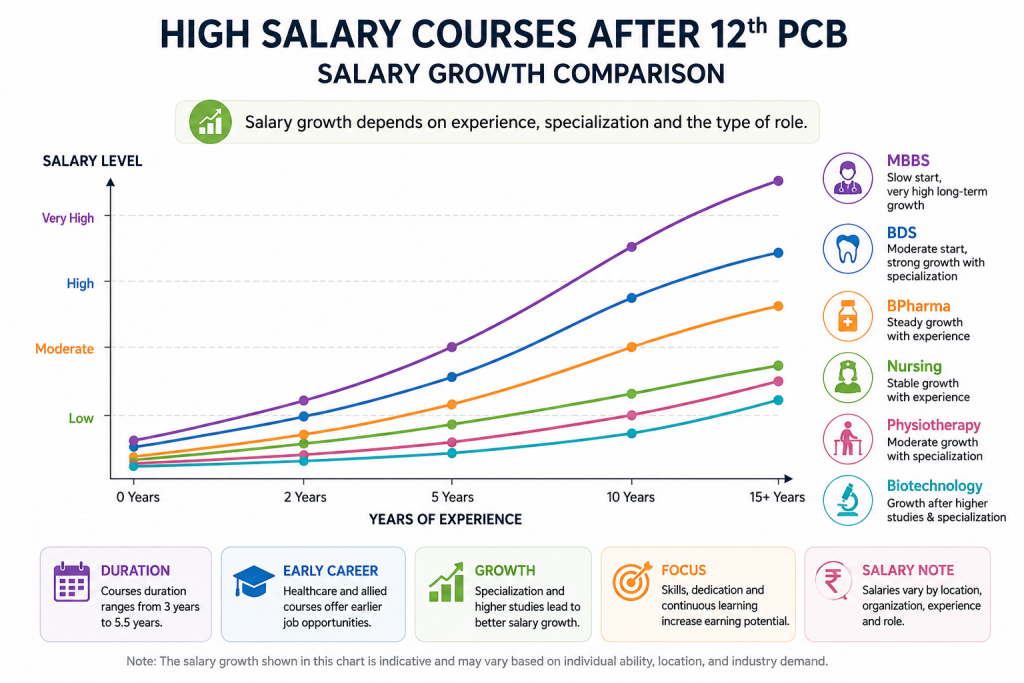
Salary Comparison Across PCB Careers
Salary after 12th PCB depends on the career path, level of specialisation, practical experience, and industry demand. Doctor-level careers usually offer the strongest long-term earning potential, while healthcare and life science careers provide steadier entry with gradual growth.
Summary: Longer study duration does not always mean higher starting salary, but specialised careers generally offer stronger long-term growth.
| Career Path | Entry Speed | Long-Term Salary Potential | Growth Depends On |
|---|---|---|---|
| MBBS / Doctor-Level Careers | Slow | Very High | Specialisation and experience |
| BDS | Slow to Medium | High | Specialisation and practice growth |
| Pharmacy | Medium | Moderate to High | Industry role and higher studies |
| Nursing | Medium | Moderate | Experience and healthcare management roles |
| Physiotherapy | Medium | Moderate to High | Specialisation and private practice |
| Diagnostics and Allied Health | Fast to Medium | Moderate | Technical expertise and experience |
| Biotechnology / Research | Medium | Moderate to High | Higher studies and research expertise |
Which PCB Career Has the Highest Salary Potential?
Doctor-level careers generally offer the highest long-term salary potential after 12th PCB. However, they also require the highest academic commitment and longer training periods.
Specialised healthcare, pharmacy, biotechnology, and research careers can also offer strong growth over time, especially after postgraduate studies or industry experience.
Fast Entry vs Long-Term Growth
Some PCB careers provide quicker entry into the workforce, while others take longer but may offer stronger earning potential later.
- Faster entry: diagnostics, allied healthcare, diploma-based healthcare roles
- Long-term growth: MBBS, BDS, specialised research, pharmacy specialisation
Reality check: Higher salary usually comes with either longer study duration, advanced specialisation, or years of practical experience.
What Actually Increases Salary in PCB Careers?
Salary growth in PCB careers is rarely based only on the degree itself. Long-term earnings usually improve through:
- Specialisation and higher studies
- Clinical or industry experience
- Technical expertise
- Independent practice or leadership roles
- Research and niche skills
Key insight: Students should choose PCB careers based not only on starting salary, but also on long-term growth, work style, and career sustainability.
If your priority is the highest long-term earning potential, doctor-level and specialised healthcare careers usually lead the list. If you want balanced growth with faster entry, pharmacy, allied healthcare, and life science careers can be practical alternatives.
NEET vs Without NEET PCB Career Options
PCB students can choose both NEET-based and non-NEET career paths depending on their goals, study commitment, and preferred work environment. NEET careers usually lead to doctor-level roles, while non-NEET options provide alternative healthcare, pharmacy, diagnostics, and life science careers.
Summary: NEET-based careers generally offer stronger long-term salary potential, while non-NEET careers often provide faster entry into the workforce and shorter study duration.
| Factor | NEET-Based Careers | Without NEET Careers |
|---|---|---|
| Common Courses | MBBS, BDS, BAMS, BHMS | Pharmacy, Nursing, Physiotherapy, Diagnostics |
| Study Duration | Longer | Shorter to Medium |
| Entry into Workforce | Slower | Faster |
| Salary Growth Potential | Very High (long-term) | Moderate to High |
| Work Type | Clinical diagnosis and treatment | Support, diagnostics, rehabilitation, pharma |
NEET-Based Career Paths
NEET-based careers are best suited for students aiming for doctor-level clinical practice. These careers involve diagnosis, treatment, surgery, and specialised medical care.
- Usually require longer academic commitment
- Need internships and further specialisation
- Offer stronger long-term salary growth
- More competitive admission process
Best suited for: Students willing to invest several years into medical education and specialisation.
Without NEET Career Paths
Without NEET career options focus more on healthcare support, rehabilitation, diagnostics, pharmacy, and life sciences. These careers usually provide earlier entry into the workforce.
- Shorter or moderate study duration
- Broader entry routes through merit or institute-level admissions
- Useful for healthcare, technical, and industry roles
- Career growth improves with skills and experience
Best suited for: Students looking for healthcare and science careers without the doctor-level route.
Which Option Is Better?
There is no single best PCB career path for every student. The better option depends on your interest, financial planning, study commitment, and long-term goals.
- If you want clinical authority and highest long-term salary → NEET-based careers
- If you want faster entry into healthcare or science roles → non-NEET careers
- If you prefer research and innovation → life science and biotechnology fields
Key insight: PCB students should choose between NEET and non-NEET careers based on work style and long-term career direction, not only based on salary comparisons.
If you are confused between NEET and without NEET options, compare the study duration, career growth, and type of work before deciding.
How to Choose the Right High Salary PCB Career
Choosing the right high salary career after 12th PCB depends on your interest, study commitment, career goals, and preferred work environment. The highest paying option is not always the best fit for every student.
Summary: Students should compare PCB careers based on long-term growth, type of work, study duration, and personal interest rather than salary alone.
Start with the Type of Work You Prefer
Different PCB careers lead to very different working styles.
- If you want direct patient treatment → doctor-level careers
- If you prefer healthcare support roles → nursing and allied healthcare
- If you are interested in medicines and pharma → pharmacy careers
- If you enjoy research and labs → biotechnology, genetics, and life sciences
- If you prefer rehabilitation and recovery → physiotherapy
Key insight: Students who choose careers based only on salary often lose interest later if the work style does not match their preference.
Consider Study Duration and Academic Commitment
Some PCB careers require longer education and specialisation before salary growth becomes strong.
| Career Type | General Study Commitment |
|---|---|
| Doctor-level careers | Very high |
| Healthcare and allied roles | Medium |
| Pharmacy and life sciences | Medium to high |
| Diagnostics and technical healthcare | Short to medium |
Reality check: Careers with the highest long-term salary often require years of education, internships, and practical experience.
Think About Long-Term Career Growth
Long-term salary growth after 12th PCB usually depends on specialisation, skills, and experience. Some careers grow steadily over time, while others depend heavily on postgraduate studies or independent practice.
- MBBS and BDS grow strongly after specialisation
- Pharmacy improves with industry expertise and higher studies
- Biotechnology and research careers grow after advanced qualifications
- Healthcare support roles offer steady and stable demand
Choose Based on Your Strengths
PCB careers require different skill sets and personality traits.
- Clinical careers need patience and decision-making ability
- Research careers require analytical thinking
- Healthcare support roles require communication and consistency
- Technical healthcare careers require accuracy and attention to detail
Key insight: The best PCB career is the one that matches your interest, strengths, and long-term goals while still offering stable growth.
If you are unsure which PCB course to choose, shortlist careers based on work style first and salary second. This usually leads to better long-term satisfaction and career stability.
FAQs on High Salary Courses After 12th PCB
MBBS is generally considered the highest salary course after 12th PCB because doctor-level careers can offer strong long-term earning potential after specialisation and experience.
Yes. PCB students can pursue pharmacy, nursing, physiotherapy, biotechnology, diagnostics, and allied healthcare careers without NEET. Salary growth depends on skills, specialisation, and experience.
Diagnostics, allied healthcare, DPharma, and some paramedical courses usually offer faster entry into the workforce compared to doctor-level careers.
Yes. Biotechnology can be a strong career option for students interested in research, laboratories, healthcare innovation, and scientific development. Career growth often improves after higher studies and specialisation.
MBBS is usually better for students aiming for clinical practice and higher long-term salary potential, while pharmacy is more suitable for students interested in medicines, healthcare systems, and faster entry into industry roles.
Nursing, diagnostics, physiotherapy, pharmacy, and allied healthcare roles are practical PCB career options for students looking for stable growth without the long study duration required for doctor-level careers.
No. NEET is mainly required for doctor-level medical courses such as MBBS and BDS. Many healthcare, pharmacy, diagnostics, and life science careers are available without NEET.
Biotechnology, microbiology, genetics, forensic science, and life science fields are suitable for PCB students interested in research, laboratory work, and scientific analysis.
 Beware of Scammers
