






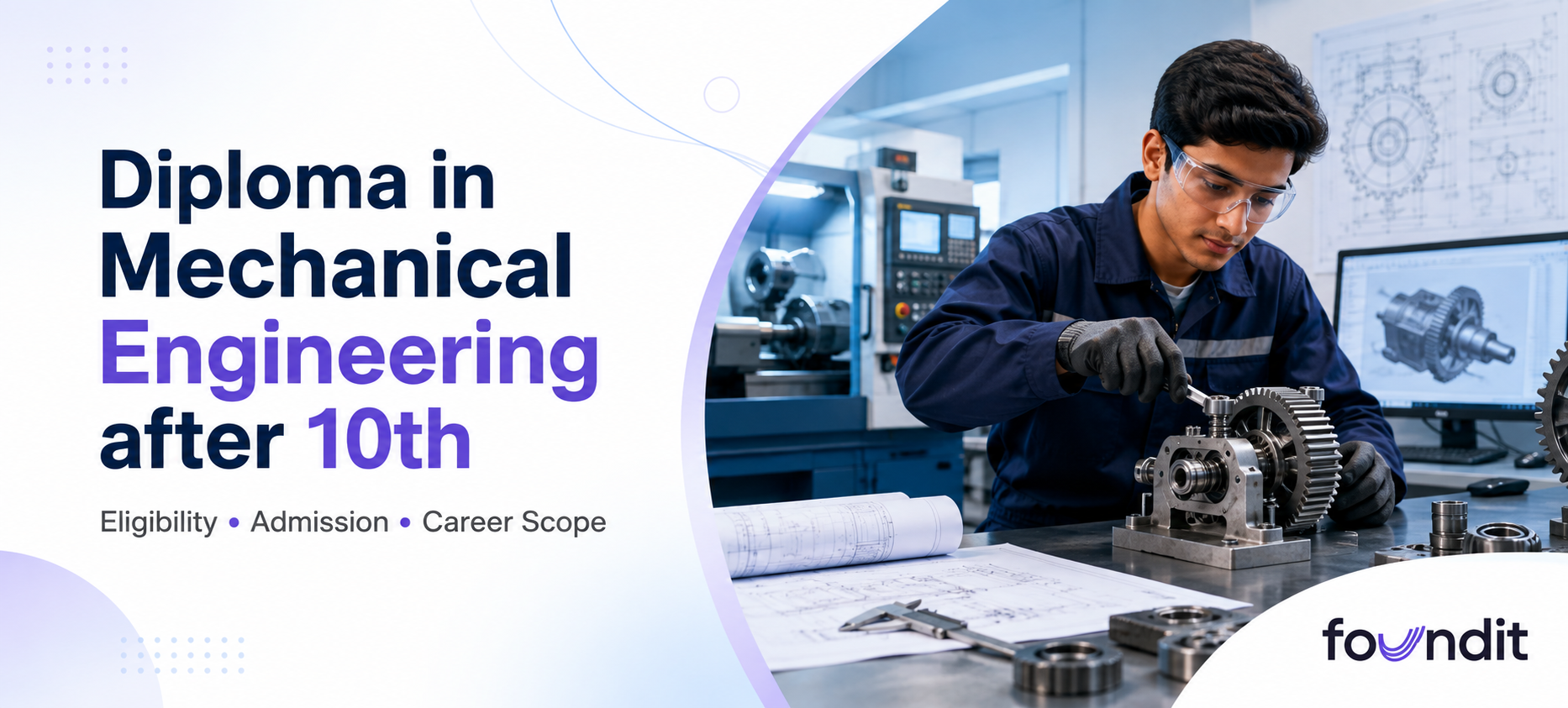
A Diploma in Mechanical Engineering after 10th is one of the fastest ways to enter India’s engineering workforce. It lets students skip the traditional four-year degree wait and start building technical skills right after Class 10.
In recent years, the importance of skilling programs has increased for diploma holders in mechanical engineering, since the government has made it an important priority to focus more on employment-related skilling programs, apprenticeships, and vocational courses.
As per the PIB press release on “Skilling India for a Future-ready Workforce,” programs such as PMKVY 4.0, CTS, PM–SETU, and NAPS 2.0 are aimed at filling skill gaps, enhancing practical learning and making candidates more employable within sectors related to manufacturing, maintenance, automobile, and new technologies.
This guide covers all about mechanical engineering courses, subjects, salary, job routes and admissions process. You will learn everything about this career path and how it leads you there.
Diploma in Mechanical Engineering at a Glance
The table below summarises the mechanical engineering diploma course details.
| Feature | Details |
| Programme Name | Diploma in Mechanical Engineering |
| Also Known As | Polytechnic Mechanical Engineering |
| Duration | 3 years (6 semesters) |
| Eligibility | Class 10 pass with Mathematics and Science |
| Minimum Marks | Generally, 35%–50% (varies by state and college) |
| Mode of Study | Full-time (most colleges); some offer part-time options |
| Affiliation | State Board of Technical Education / AICTE approved |
| Lateral Entry Option | Yes – eligible for direct second-year B.Tech admission |
| Job Eligibility | Immediately after completing the diploma |
Core Subjects and Syllabus: What You’ll Study in This 3-Year Program
The mechanical engineering diploma syllabus builds theoretical knowledge and practical skills side by side. Students move from foundational engineering concepts in year one to advanced manufacturing and design by year three.
Year 1 – Foundation
- Engineering Mathematics
- Engineering Physics and Chemistry
- Engineering Drawing and Graphics
- Basic Workshop Practice
- Communication Skills and English
- Computer Fundamentals
Year 2 – Core Engineering
- Engineering Mechanics and Strength of Materials
- Thermodynamics and Heat Engines
- Manufacturing Processes (casting, welding, machining)
- Fluid Mechanics and Hydraulic Machinery
- Electrical and Electronics Technology
- Machine Drawing using CAD/CAM (Computer-Aided Design)
Year 3 – Applied and Specialised
- Theory of Machines and Machine Design
- Computer-Aided Manufacturing (CAM) and CNC (Computer Numerical Control) Programming
- Metrology and Quality Control
- Industrial Management and Entrepreneurship
- Refrigeration and Air Conditioning
- Industrial Training / Project Work
The exact subjects may differ slightly by state board or institution. Students should refer to the official syllabus document from their State Board of Technical Education for the most accurate information.
Read Also: Mechanical Engineer Job Duties & How to become a Mechanical Engineer?
Career Options After a Mechanical Engineering Diploma: Jobs, Roles & Salaries
The table below gives an overview of career after diploma in mechanical engineering, common roles and approximate salary after a diploma in mechanical engineering ranges. Salary data is indicative and based on general market trends.
| Job Role | Industry / Sector | Approximate Starting Salary (Per Annum) |
| Junior Mechanical Engineer | Manufacturing, Construction | ₹3.3 LPA -₹3.7 LPA |
| CNC Machine Operator / Programmer | Automotive, Precision Engineering | ₹3.8 LPA – ₹4.3 LPA |
| Design Engineer (CAD) | Product Design, Industrial Equipment | ₹4.8 LPA – ₹5.4 LPA |
| Quality Control Inspector | Manufacturing, Pharmaceuticals | ₹3.0 LPA – ₹3.3 LPA |
| Production Supervisor | FMCG, Heavy Industry | ₹3.4 LPA – ₹3.7 LPA |
| Maintenance Engineer | Facilities, Plant Operations | ₹4.2 LPA – ₹4.6 LPA |
| HVAC Technician | Building Services, Hospitality | ₹3.5 LPA – ₹3.8 LPA |
| Automobile Service Engineer | Automotive Dealerships, OEMs | ₹3.5 LPA – ₹3.9 LPA |
With experience (3–5 years), many professionals advance to senior engineer or team lead roles.
Disclaimer: Salary figures are approximate and based on general market observations. Actual compensation varies by employer, industry, location, skills, and market conditions.
Read Also: Best Diploma Courses After 10th in 2026
Government Job Opportunities After Diploma in Mechanical Engineering
For diploma holders in mechanical engineering, Government jobs are still one of those highly sought after career options. They usually come with a clear career progression, decent and competitive pay, strong job security, plus chances to work on big public infrastructure and engineering projects.
Graduates with mechanical diplomas are employed by central government departments, PSU, railways, the defence department, and state government departments. Employment opportunities usually depend upon entrance exams, technical qualifications, and documentation.
Various examinations that employ graduates in mechanical engineering diploma are as follows:
- SSC JE (Staff Selection Commission Junior Engineer): Recruitment exam for hiring candidates with diploma qualification in various departments of central government, CPWD (Central Public Works Department), MES (Military Engineer Services), and other engineering departments.
- RRB JE (Railway Recruitment Board Junior Engineer): Recruitment of diploma engineers for technical posts in Indian Railway system.
- DRDO (Defence Research and Development Organisation): Periodic recruitment of diploma holders for technical, apprenticeship, and laboratory posts.
- BHEL (Bharat Heavy Electricals Limited): Employment of diploma engineers as apprentices, supervisors, and technical assistants.
- State PSU (Public Sector Undertaking): Recruitment of engineers with diploma qualification in various infrastructure, irrigation, transport, water supply, and power departments.
- Defence Sector: Recruitment of engineers with civilian qualifications for technical jobs in defence departments and Ordnance Factories.
Many government employers also offer extra perks such as pension plans (if available), medical services, housing facilities, leaves, and training programs that foster the candidate’s career advancement in the long term.
Students who are preparing for exams like SSC JE and RRB JE should have a basic knowledge of mechanical engineering topics apart from quantitative aptitude, reasoning, and general knowledge. Practice on regular basis and knowing the pattern of past examinations will help students prepare better.
Read Also: High Paying Government Jobs in India: Top Roles, Salaries & How to Apply in 2026
Scope and Future Growth: Why Mechanical Engineering Demand is Rising in 2026
The scope of mechanical engineering diploma holders is expanding well beyond traditional manufacturing because of India’s move towards ‘Make in India,’ electric vehicles, and defence manufacturing.
Emerging Industries Hiring Mechanical Diploma Graduates
- Electric Vehicles (EVs) and Battery Manufacturing: The rise of the Indian EV industry is leading to opportunities in assembly, battery manufacturing, testing, maintenance, and manufacturing support roles within auto companies and their suppliers.
- Aerospace and Defence: Expansion of aircraft manufacturing, defence manufacturing, and maintenance activities results in more openings for technicians and mechanical engineers skilled in manufacturing and maintenance.
- Robotics and Automation: The trend towards smarter factories and automated production lines using robotics and other Industry 4.0 technologies offers new opportunities to those familiar with CAD/CAM, CNC, and robotics/mechatronics.
- Renewable Energy: Installation, maintenance, inspection and quality assurance in wind energy, solar equipment manufacturing and clean energy initiatives will require mechanical engineers.
- Building Services and HVAC: Commercial building construction, smart buildings, healthcare facilities and data centres will continue to provide openings for HVAC (Heating, Ventilation, and Air Conditioning) professionals who can design, install, commission and maintain these systems.
- Food Processing and Pharmaceutical Industries: These sectors depend on precision machinery, production and packaging equipment and preventive maintenance; hence, consistent demand for mechanical diploma-holders can be expected.
- Oil and Gas: Refineries, petrochemical complexes and pipeline operations need mechanical engineers to maintain equipment, operate plants, inspect and perform reliability engineering tasks.
- Industrial Equipment Manufacturing: Companies that make heavy machinery, pumps, compressors, machine tools, and industrial equipment regularly hire diploma engineers for various roles.
Mechanical engineering still offers diverse career options in both conventional and new-age technological sectors. Diploma in mechanical engineering students who keep themselves updated with technology and have industrial experience will be in a good position for their career.
Read Also: Most Asked Mechanical Engineering Interview Questions & Answers: Top 40 2026
Higher Education After Diploma: Can You Do B.Tech After Mechanical Diploma?
It is not necessary that the diploma becomes the final destination in your academic journey. Many diploma holders opt for lateral entry to complete their full B.Tech program.
This process is economically sound and strategically beneficial since the holder of the diploma directly enters year two of the course and finishes the course in three years instead of four years.
Lateral Entry to B.Tech: How It Works
Step 1 – Complete Your Diploma
Finish the three-year programme with a minimum passing percentage, usually 45%–60% depending on the state.
Step 2 – Check Lateral Entry Eligibility
Confirm your diploma is from an AICTE-recognised institution; most states require this.
Step 3 – Apply Through State Entrance Examination
Many states conduct separate lateral entry entrance examinations for diploma holders, such as AP EAMCET (Andhra Pradesh Engineering, Agriculture and Medical Common Entrance Test) and MHT CET (Maharashtra Common Entrance Test).
Step 4 – Submit Application to Participating Colleges
Apply to AICTE-approved colleges offering lateral entry seats. These seats are a fixed percentage of total intake, so competition exists.
Step 5 – Enrol in Second Year B.Tech
On admission, you join year two of the B.Tech Mechanical Engineering programme directly.
Read Also: Top Career Options after Class 10th in 2026
ITI vs Diploma in Mechanical Engineering: Which is Right for You?
Many Class 10 students face this exact decision: ITI or polytechnic diploma? Both are valid technical qualifications, but they serve different career goals.
| Factor | ITI (Industrial Training Institute) | Diploma in Mechanical Engineering |
| Duration | 1–2 years (trade-specific) | 3 years |
| Eligibility | Class 8 pass (some trades require Class 10) | Class 10 pass with Science and Maths |
| Focus | Hands-on trade skills (machinist, fitter, welder) | Engineering concepts + practical training |
| Qualification Level | National Trade Certificate (NTC / NCVT) | Diploma (State Board / AICTE) |
| Entry-Level Roles | Skilled tradesperson, technician | Junior engineer, design assistant, supervisor |
| Government Job Eligibility | Limited (apprenticeship, trade-level posts) | SSC JE, RRB JE, PSUs, state technical boards |
| Higher Education Option | Bridging courses available (limited) | Direct lateral entry to B.Tech 2nd year |
| Best Suited For | Students who want to work hands-on in a specific trade quickly | Students who want broader career options and room to grow |
| Course Cost | Lower (government ITIs are heavily subsidised) | Moderate (government polytechnics are affordable) |
On the other hand, if your aim is to get into the workforce quickly in a specific trade, then ITI is typically faster as well as cheaper. But if you prefer wider possibilities, government job eligibility, or you’re thinking about a path toward B.Tech, then the diploma feels like the stronger long-term investment.
Read Also: Best ITI Courses After 10th: Fee, Duration, Salary 2026
How to Get Admission in a Mechanical Engineering Diploma After 10th
Getting admission to a polytechnic mechanical engineering course is much simpler than one can think. The application process is handled by the respective state boards of technical education, and the application process takes place once a year, post Class 10 results.
Step 1 – Check Eligibility
Check whether you have passed class 10 with Mathematics and Science. The minimum percentage differs in each state and typically is 35%-50%.
Step 2 – Search for AICTE Approved Colleges
Find out the list of government and AICTE approved private polytechnic institutes in your state.
Government colleges will genrally have low fees and good placement opportunities.
Step 3 – Registration for Entrance Exam/Merit
Certain states have entrance examinations for polytechnic admission, including JEECUP (Joint Entrance Examination Council, Uttar Pradesh) and some states give admission on the basis of merit in Class 10 examination.
Step 4 – Filling Up Application Form
Apply online through the respective state’s online portal for polytechnic admissions and complete the fee payment process along with other mandatory documents.
Step 5 – Counselling/Seat Allotment
You will be called for counselling depending upon your entrance merit score.
Step 6 – Admission Formalities
Complete the admission process in allotted colleges through payment of course fees and submission of original documents.
Read Also: Career Planning Process: Complete Step-by-Step Guide
Conclusion
Diploma in Mechanical Engineering after 10th is an organised and systematic study course for three years that leads to multiple opportunities in areas including manufacturing, governments, design, and even new-age sectors such as electric vehicles and robotics.
The salary expectations are moderate when you first join, but do increase substantially with your experience. For those with long-term career aspirations, pursuing a B.Tech through lateral entry can further expand career opportunities.
If you feel ready to proceed, then start by looking up polytechnic colleges approved by AICTE in your respective states.
FAQs
Yes. You can directly get admission into the second year of a B.Tech in Mechanical Engineering by opting for lateral entry. Thus, you would get your degree in just three years
After getting a diploma in Mechanical Engineering, you can try for multiple govt jobs using exams like SSC JE, RRB JE, BHEL, DRDO and also various PSU recruitments. These options are often chosen because the work feels more settled, there is clear career progress, and the pay scale tends to be quite solid, too.
This is mainly based on what you want to do next. ITI is shorter and more practical, meant for a particular trade directly. On the other hand, a Diploma in Mechanical Engineering gives wider career pathways, better scope for long term growth, and it also helps you become eligible for lateral entry into B.Tech, so the options open up later.
The diploma programme is 3 years long, divided into six semesters. Students can join directly after passing Class 10 with Mathematics and Science.
Starting salaries vary based on the employer, job role, industry, location, and individual skills. With experience and relevant technical expertise, earning potential generally increases over time.
 Beware of Scammers
