






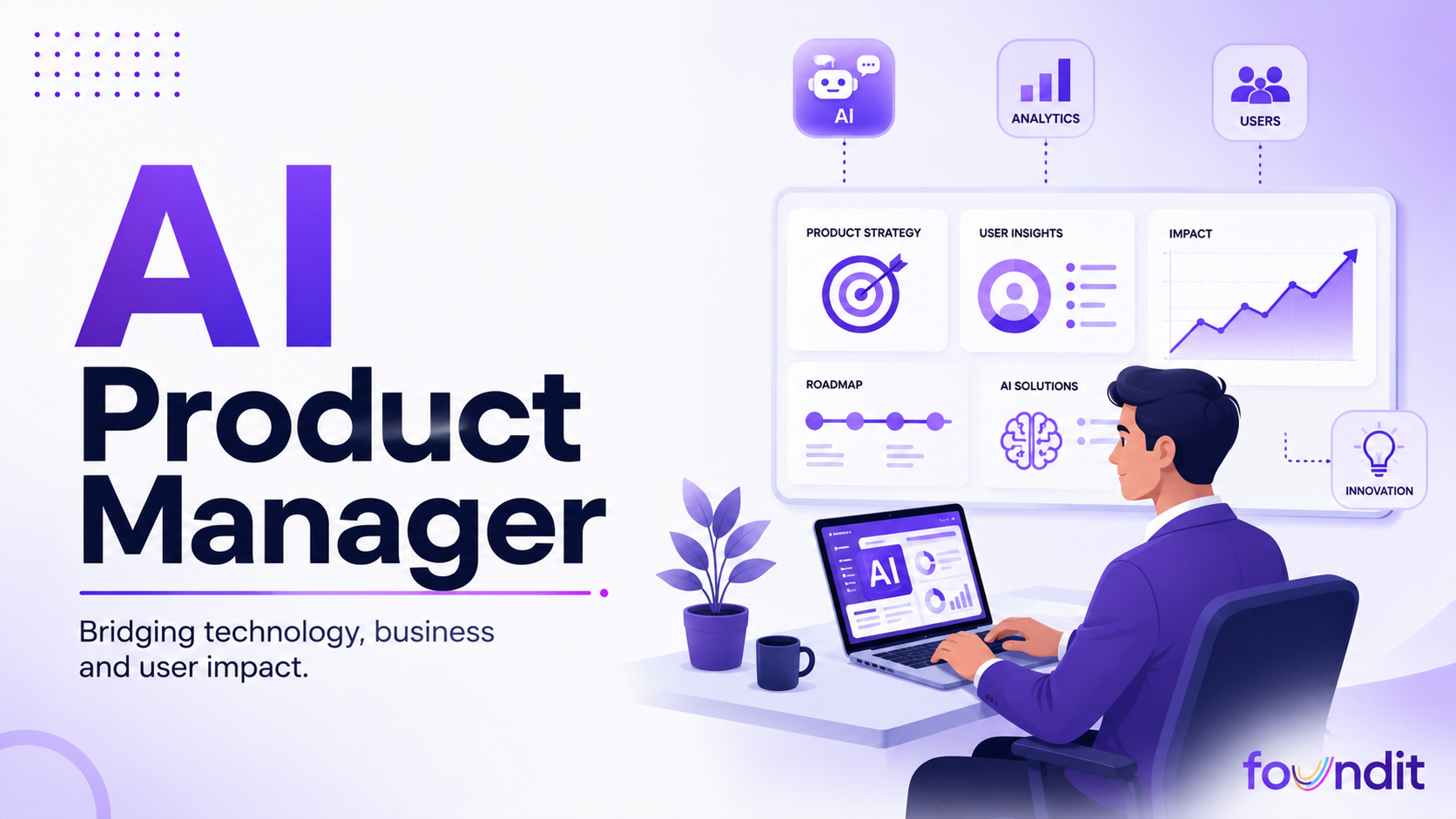
An AI product manager oversees the creation of products that incorporate artificial intelligence (AI) and machine learning technologies. This position requires understanding of data science, machine learning ideas, and product management approaches for AI solutions.
AI product managers work with data scientists, machine learning engineers, and other technical teams during the development process.
The demand for skilled AI product managers is rising as more companies in India and around the world are embracing AI.
Nearly 70% of AI product management jobs are meant for professionals with over six years of experience, showing that employers often look for experienced candidates in this role.
The article covers the role of an AI product manager, detailing necessary duties, required skills, and estimated salaries in 2026.
Understanding AI Product Management: The Field Behind the Role
Understanding AI product management clarifies the responsibilities and significance of this emerging technology role. To create AI-powered solutions, AI product management integrates software engineering, data science, and product management.
Unlike traditional software, which follows predefined rules and produces the same output for the same input, AI systems learn from data. They analyse patterns and continuously improve their predictions or recommendations as they receive more information.
For example, a streaming platform or e-commerce website may recommend different movies or products to different users based on their browsing history, preferences, and past interactions.
AI product managers oversee the entire lifecycle of AI products, from identifying customer needs and defining product strategy to working with engineering and data science teams to develop, launch, and improve AI-powered features. They also monitor AI model performance, ensure high-quality data, and continuously refine the product based on user feedback.
Product managers must also consider data privacy, security, fairness, regulatory compliance, and AI bias to ensure responsible AI adoption.
The demand for AI product managers is rising as more companies continue to employ artificial intelligence. According to LinkedIn’s 2024 Jobs on the Rise report, AI-related product roles saw strong annual growth worldwide.
The AI Product Manager Role: Responsibilities and Day-to-Day Work
An AI product manager is responsible for defining the product’s vision, strategy, and roadmap for AI-powered features or standalone AI products. The day-to-day work differs from traditional product management in several ways.
Here are the core AI product manager responsibilities:
- Defining the Problem Statement: Before any model is built, the PM (product manager) identifies whether AI is the right solution. Not every business problem needs machine learning.
- Collaborating with ML Engineers and Data Scientists: The AI product manager translates business goals into clear product requirements and works closely with data scientists and machine learning engineers to develop AI solutions.
- Curating and Evaluating Training Data: Data quality directly affects model performance. The PM works with data engineers to ensure datasets are clean, representative, and free from bias.
- Managing the Product Backlog for AI Features: A product backlog of AI workflow differs from traditional sprint planning because model training cycles do not follow standard two-week sprints.
- Setting Success Metrics Beyond Accuracy: While data scientists focus on technical metrics such as accuracy, precision, and recall, AI product managers define business success metrics such as increased conversions, higher user engagement, customer satisfaction, revenue growth, or cost reduction to measure the overall impact of AI solutions.
- Monitoring Model Performance Post-Launch: After deployment, AI product managers track the performance of AI models to ensure they continue to deliver accurate and reliable results. They identify and address performance issues early before they affect users or business outcomes.
- Communicating Trade-Offs with Stakeholder: AI product managers explain how AI models work, their limitations, and errors to business leaders and other stakeholders. Clear communication helps teams make informed decisions and use AI responsibly.
Read Also: AI Jobs for Freshers in India 2026: A Complete Guide
Key Skills Every AI Product Manager Needs in 2026
The AI product manager skills go beyond a standard product manager. Here is a breakdown of technical and non-technical categories.
Technical Skills
- Data Literacy: AI product managers should understand how data is collected, organised, and analysed. They should be able to read basic SQL queries, understand data pipelines, and interpret data insights, even if they do not write production code themselves.
- ML Fundamentals: Learn about supervised and unsupervised learning, classification and regression, overfitting, and assessment metrics such as the F1 score and AUC-ROC (Area Under the Receiver Operating Characteristic Curve). Asking the proper questions is more important than creating models.
- Experience with AI/ML Tools: Know the fundamentals of ML monitoring tools like MLflow or Weights & Biases, as well as AI/ML tools like TensorFlow and PyTorch.
- Experimentation Design: It is critical to understand the statistical importance and limitations of testing probabilistic systems before conducting A/B tests for AI features.
- Understanding Responsible AI Principles: Understand bias, explainability, and privacy-preserving strategies such as federated learning and differential privacy.
Non-Technical Skills
- Cross-Functional Communication: AI product managers use plain communication to connect technical teams and business stakeholders. This is one of the most important skills, as it translates technical concepts into business terms.
- Strategic Thinking: They choose what to build themselves and what to buy from third parties depending on their business objectives. Each decision should be consistent with the organisation’s long-term goals and product strategy.
- User Empathy: AI features should be easy for all types of users to learn and use. Product managers build trust by being more open and improving the experience for users.
- Setting Priorities in Ambiguous Circumstances: AI initiatives are unclear and do not always produce the desired outcomes. Product managers should closely monitor development and discontinue projects that demonstrate limited results after proper testing.
Programming expertise is not required to become an AI product manager. Strong analytical thinking, business expertise, and a willingness to understand machine learning principles are usually more important than coding skills.
Read Also: Technical Product Manager Skills: How Jobseekers Can Accelerate Career Growth
How the AI Product Lifecycle Works (And Why It Matters to PMs)
A traditional software development lifecycle is different from the AI product lifecycle. Understanding these characteristics is what distinguishes a good AI product manager.
Here are the key stages:
1. Problem Validation
When compared to rule-based logic or manual operations, the PM verifies if AI truly provides value. Many teams skip this stage and instead focus on model construction, which is a common and costly mistake.
2. Data Collection and Preparation
This stage often consumes 60-80% of the total project time. The PM coordinates data sourcing, labeling, and quality checks.
3. Model Development and Experimentation
Data scientists build and evaluate multiple models. The PM defines evaluation criteria based on business requirements, not just technical accuracy.
4. Testing and Validation
Beyond standard Quality Assurance (QA), AI products need fairness testing, edge case evaluation, and adversarial testing. The PM decides acceptable thresholds for each.
5. Deployment and Monitoring
Production ML models require continuous tracking. Model drift, which occurs when a model’s accuracy degrades over time due to changes in real-world data, is an ongoing problem. The PM establishes alert thresholds and retraining timetables.
6. Iteration and Improvement
AI programs need constant data updates and model upgrades, unlike traditional software where features are introduced and remain stable. Instead of being linear, their lifetime is continuous.
Understanding this lifecycle helps AI Product Managers set realistic timetables. Quarterly schedules are rarely followed by AI programs.
Experimentation is part of a data-driven product strategy because the results are never known.
Read Also: Top Product Management Tools to Use in 2026
AI Product Manager Salary: What to Expect in India and Globally
The salary of an AI product manager varies based on experience, location, size of the company, and the complexity of the AI systems being managed.
Below is a summary of salary ranges based on available market data:
| Experience Level | India (Estimated Annual, ₹)Annual, ₹) | United States (Estimated Annual, $) | United Kingdom (Estimated Annual, £) |
| Entry-level (0-2 years) | ₹12,00,000 | $95,402 | £33,000 – £43,000 |
| Mid-level (3-5 years) | ₹26,00,000 | $121,773 | £45,000 – £72,000 |
| Senior (6+ years) | ₹43,00,000 | $129,736- $157,018 | £730,000 – £100,000+ |
Disclaimer: The salary ranges mentioned above are approximate and may vary based on factors such as location, company, individual skills, educational background, and market demand. These figures are indicative of entry-level roles and should not be considered guaranteed compensation.
AI product manager salary in India has seen a substantial growth since 2023. Google, Microsoft, Flipkart, Swiggy, Razorpay and many other companies are active hirers for this role.
A generative AI product manager working on LLM-based products (chatbots, content generation tools, code assistants) may command a 15-25% premium over a standard AI product manager salary due to the specialised knowledge required.
Read Also: How to Get a Job in Artificial Intelligence in India: A Complete Guide
Which Industries Are Hiring AI Product Managers Right Now
AI product managers are no longer exclusive to technology organisations. AI is currently being used by many industries to improve goods, services, and routine business operations.
- Fintech and Financial Services: Banks and fintech companies employ AI for fraud detection, credit assessment, automation, and customised financial services. AI product managers are employed by organisations such as Razorpay, Paytm, and HDFC Bank.
- Healthcare and Health Technology: AI helps with patient care, medicine development, illness detection, and medical imaging. Companies such as Niramai and Qure.ai hire AI product managers for healthcare goods.
- E-commerce and Retail: Online retailers employ AI for product recommendations, customised shopping, demand forecasts, and pricing. Companies like Flipkart, Amazon India, and Myntra hire AI product managers.
- Automotive and Mobility: AI enhances driver assistance programs, predictive maintenance, and route planning. Businesses like Waymo, Ola, Tata Motors, and Tesla keep growing their AI product teams.
- Enterprise SaaS: AI is used by software firms to improve marketing, customer service, Customer Relationship Management (CRM), and HR systems. To oversee these AI products, businesses like Freshworks and Zoho employ AI product managers.
- Media and Content Platforms: AI improves content suggestions, search results, and content moderation. AI product managers work for companies like ShareChat, Dailyhunt, Spotify, and Netflix.
The demand for AI product managers is expanding across various industries. Opportunities for professionals with the necessary skills can be found in both established businesses and startups.
How to Become an AI Product Manager: A Step-by-Step Roadmap
Here is a practical five-step roadmap for professionals interested in learning how to become an AI product manager.
Step 1: Establish a Product Management Foundation
Learn the basics of product management like user research, roadmap planning, stakeholder communication, and agile methods.
Step 2: Learn ML and Data Science Fundamentals
This does not imply that PM becomes a data scientist. Focus:
- How machine learning models work conceptually
- Basic ML vocabulary (training data, features, labels, supervised learning, neural networks)
- How to read and interpret model evaluation metrics
- Understanding the basics of data-driven product strategy
Step 3: Use AI Products Practically
Discover how YouTube’s recommendation system works and look at existing AI solutions.
What trade-offs did Spotify make with its Discover Weekly feature? Write product descriptions with a focus on artificial intelligence.
Step 4: Earn a Relevant Certification
An AI PM certification adds credibility. Options include:
- Product School’s AI for Product Managers course
- Duke University’s AI Product Management Specialisation (Coursera)
- AIPM (Artificial Intelligence Product Manager) certification by various ed-tech platforms
These certifications help candidates stand out, particularly when transitioning from traditional PM roles.
Step 5: Apply and Network Strategically
AI products are actively being developed by target companies. Look for AI product manager jobs in India using platforms like foundit. Participate in product management and AI meetups. Interact with AI PM groups on Twitter and LinkedIn.
A beginner’s plan for an AI product manager should include six to twelve months of concentrated learning in addition to current work duties.
Read Also: 14 Product Manager Skills to Develop in 2026
Biggest Challenges AI Product Managers Face (And How to Overcome Them)
Every role comes with challenges. The following are some of the most typical issues in AI product management.
1. Data Quality and Availability
Poor AI models are caused by low-quality data. Before they start model building, AI product managers frequently spend time collecting clean and well labelled data.
2. Managing Stakeholder Expectations
Some stakeholders expect flawless outcomes from AI. But in real-world scenarios, AI models are rarely 100% correct. From the start, product managers should establish precise and reasonable expectations.
3. Model Drift and Performance Degradation
As data and user behaviour evolve over time, AI models may become less accurate. Product managers should keep track of model performance and update models, as necessary.
4. Ethical and Regulatory Constraints
AI products in businesses such as healthcare, banking, and recruiting must fulfil legal and ethical requirements. Throughout the development process, product managers should also prioritise fairness, openness, and data privacy.
5. Long and Uncertain Timelines
It could take many months for AI programs to provide meaningful outcomes. Product managers should plan experimentation and make investment decisions based on the outcomes.
Read Also: First Job Challenges: How to Conquer Them Like a Pro
Tools AI Product Managers Use Every Day
An AI product manager works across multiple tool categories. Here are the most common ones, grouped by function.
- Analytics and Data Exploration
- Looker, Tableau, or Metabase for dashboards and data visualisation
- SQL for querying databases directly
- Jupyter Notebooks (read-only) for reviewing data science team outputs
- Collaboration and Project Management
- Jira or Linear for sprint and backlog management
- Confluence or Notion for documentation
- Miro or FigJam for brainstorming and system design sessions
- Prototyping and Design
- Figma for UI/UX prototyping of AI-powered features
- Streamlit for quick internal demos of ML models
- ML Monitoring and Experiment Tracking
- MLflow for experiment tracking and model versioning
- Weights & Biases for model performance monitoring
- AI or Arize for production model drift monitoring
- Communication
- Slack or Microsoft Teams for daily coordination
- Loom for asynchronous video updates with stakeholders
The specific tools vary by company. What matters more is understanding what each category of tool does and when to use it.
Conclusion
AI product managers are responsible for developing and upgrading AI-powered solutions. This position demands product management abilities, a basic understanding of machine learning, and the ability to make sound decisions.
Professionals interested in this field should study product management and AI principles. The need for AI product managers will continue to increase as more companies use AI.
Gaining hands-on experience and ongoing learning may improve professional prospects in 2026 and beyond.
FAQs
An AI product manager oversees the planning, creation, and delivery of AI-powered solutions. The position integrates knowledge of machine learning principles, data comprehension, and product management abilities.
Yes, it is not necessary to have coding knowledge to work as an AI product manager. It is more crucial to have strong analytical skills, business understanding, and learning machine learning principles.
In India, AI product managers can make between ₹12 lakh and ₹55 lakh or more a year. Experience, the size of the company, the position, and the organisation's location all affect salary.
Traditional product managers mostly work with software that generates consistent outcomes from the same input. AI product managers deal with data-driven systems that can yield a variety of results. Understanding the differences in AI product manager vs traditional product manager roles helps professionals choose the right career path.
AI product managers are actively sought after by many organisations in a variety of sectors for business and technology solutions. Google India, Microsoft, Flipkart, Swiggy, Razorpay, Freshworks, Zoho, Ola, and AI companies are a few of these.
Experienced product managers may be able to transition to AI product management within six to twelve months. For specialists from other fields, it may require twelve to eighteen months of focused training.
Professionals can increase their understanding of AI product management and associated concepts by enrolling in several recognised courses. Duke University's AI Product Management Specialisation and Product School's AI for Product Managers are well-liked choices.
 Beware of Scammers
