




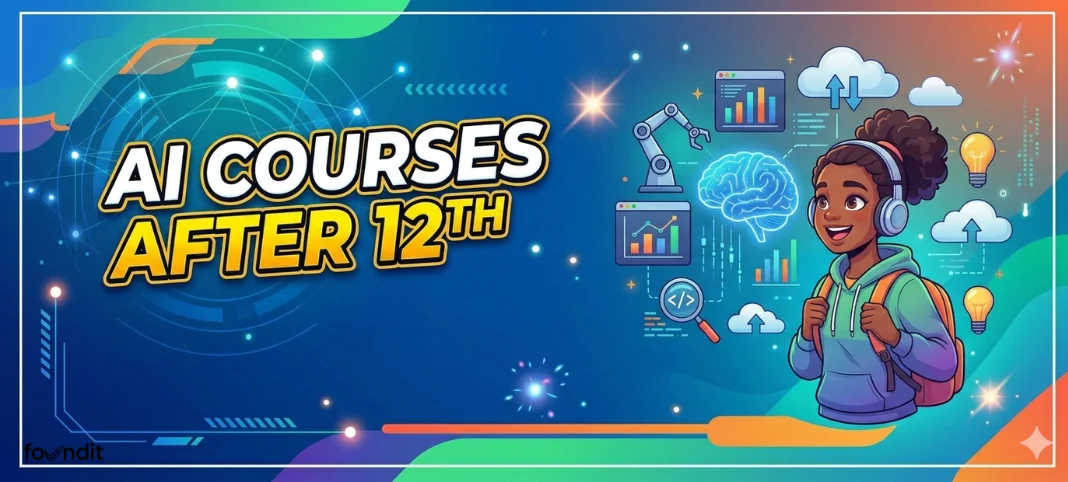
AI courses after 12th are gaining significant attention as the demand for skilled professionals continues to grow. The AI industry in India is expected to provide more than a million jobs by 2026. This increasing need is already reflected in current hiring practices in both technical and non-technical industries.
Those who start early are more likely to benefit in a fast-changing field like artificial intelligence. This guide covers the best AI courses after 12th, including course selection, eligibility, expected salaries, and entrance exams for AI courses.
Why Choose AI Courses After 12th
Here’s why AI courses after 12th may be a smart choice.
- Early Career Advantage
Starting after 12th gives students more time to build fundamentals, work on projects, and gain practical exposure before entering the job market.
- High Industry Demand
Organisations across sectors are actively hiring AI talent, but there is still a shortage of skilled professionals.
- Real-World Applications
AI is already used in healthcare, banking, e-commerce, and more, making it a practical and relevant career choice.
- Multiple Career Paths
Students can explore roles like data scientist, AI engineer, analyst, or move into industry-specific applications.
- Strong Salary Potential
AI roles offer competitive starting salaries with steady growth as experience increases.
- Future-Proof Skillset
As technology evolves, AI skills remain relevant and adaptable across different industries.
Read Also: AI courses for Beginners
AI Growth: What the Data Actually Shows
The following data show AI growth:
The following data show AI growth:
- The AI market in India is expected to cross $17 billion by 2027
- Demand for AI professionals has grown nearly four times in recent years
Over 75% of large organisations now have AI-focused teams
However, there is still a significant talent gap in the sector, between 60 and 70 percent. There are currently more open positions than there are applicants.
Types of AI Courses After 12th
The type of AI course a student chooses after 12th depends on their goals, academic background, and level of specialisation.
Degree Courses
These are long-term and structured. They offer depth and wider career flexibility.
- B.tech in AI or AI & ML
- BCA in Artificial Intelligence
- B.Sc. in AI or Data Science
B.tech is usually the comprehensive route, especially for PCM (Physics, Chemistry, and Mathematics) students. Although BCA may suit students who want a quicker entry and are willing to build skills alongside.
Read Also: Best courses for PCM students after 12th
Diploma Courses
These are shorter and more focused on practical skills.
- Diploma in AI & ML
- Advanced Diploma in Data Science
They are appropriate for people who want to start working early. But in the long run, they might not be as valuable as a full degree.
Online Certifications
These are flexible and widely accessible.
- Google AI Essentials
- Microsoft AI Fundamentals
- NPTEL and IIT-led courses
- Coursera and edX programmes
In practice, these don’t replace degrees in most hiring scenarios. But they are useful for skill-building and showing initiative.
Syllabus for AI Courses
The syllabus for AI courses after 12th generally covers a mix of programming, mathematics, and practical applications. While the exact subjects may vary by course and institution, most programmes include the following core areas:
| Subject Area | Topics Covered | Purpose |
| Programming | Python, basic coding concepts, data structures | Builds the foundation for writing AI models and algorithms |
| Mathematics | Linear algebra, probability, statistics | Helps in understanding how AI models work mathematically |
| Machine Learning | Supervised & unsupervised learning, model training | Core concept used in most AI applications |
| Deep Learning | Neural networks, CNNs, RNNs | Used in advanced AI tasks like image and speech recognition |
| Data Handling | SQL, data cleaning, data visualisation | Helps in working with real-world datasets |
| Computer Vision | Image processing, object detection | Used in applications like facial recognition and automation |
| Natural Language Processing | Text analysis, chatbots, language models | Enables machines to understand human language |
| AI Tools & Frameworks | TensorFlow, PyTorch, cloud platforms | Used for building and deploying AI solutions |
| Projects & Internships | Real-world applications, case studies | Provides practical exposure and strengthens job readiness |
AI Courses After 12th – Course Comparison
| Course Type | Duration | Best For | Average Fees | Career Outcome |
| B.Tech AI/ML | 4 years | PCM students aiming for core technical roles | ₹2–5L/year | AI Engineer, ML Engineer |
| BCA (AI) | 3 years | Students looking for quicker industry entry | ₹1–2L/year | Developer, Data Analyst |
| B.Sc AI/Data Science | 3 years | Balanced focus on theory and application | ₹1–3L/year | Data Scientist, Analyst |
| Diploma in AI | 1–2 years | Early job entry with practical skills | ₹50K–1.5L | Junior AI roles |
| Certifications | 3–12 months | Skill-building alongside degree or job | Free–₹1L | Portfolio-based roles |
Disclaimer: The fees mentioned are approximate estimates and may vary based on factors such as institution, course selection, location, and changes in fees. Actual expenses may differ at the time of admission.
Eligibility for AI Courses After 12th
The following section explains eligibility for AI courses after 12th:
PCM Students Commerce and Arts Students
There are potential options here as well.
- BCA in AI
- Diploma programmes
- Online certifications
Many universities now accept non-PCM students for certain data science courses. The only gap is mathematics. But in practice, this can be covered with basic self-study.
Biology Students
Students can apply for B.tech, B.Sc., BCA, and several other academic pathways. Entrance exams like JEE Main or state CETs will be part of the process.
Top Entrance Exams for AI Courses After 12th
| Exam | Purpose |
| JEE Main | Admission to B.Tech AI and related engineering courses |
| CUET | Entry into central universities for BCA, B.Sc programmes |
| State CETs | Admission to state-level engineering and degree colleges |
| VITEEE / SRMJEEE | Private university admissions for AI-related courses |
Top Colleges Offering AI Courses in India
Choosing the right college plays a major role in the quality of education and placement opportunities. Several institutions in India now offer specialised AI and data science programmes.
Some well-known options include:
- IITs (Indian Institutes of Technology)
Offer B.Tech programmes with AI and machine learning specialisations. Known for strong academic depth and placements.
- IIITs (Indian Institutes of Information Technology)
Focus more on computer science and AI-related research.
- Private Universities (VIT, SRM, UPES)
Provide dedicated AI courses with industry exposure and modern infrastructure.
- Central Universities (via CUET)
Offer B.Sc and BCA programmes in AI and data science.
Students should compare curriculum, faculty, infrastructure, and placement records before making a decision.
Best AI Course Based on Your Career Goal
Choosing the best AI tools for productivity and the right course depends largely on what a student wants to do in the long term.
- Technical Positions
For technical positions within AI/machine learning, students can pursue B.Tech in Artificial Intelligence or Artificial Intelligence and Machine Learning.
- Fast Track to Employment
Those who wish to enter the job market earlier generally opt for BCA courses or diploma courses with certification and project work.
- Career in Data
For careers within the field of data, such as data analysis and data science, students should consider opting for a B.Sc. in AI or Data Science.
- Exploration and Flexibility
Students who are exploring and are not sure about a career choice may initially opt for online certifications before moving to a degree program later.
No one course suits everyone. It depends upon the dedication, career aspirations, and willingness to develop practical skills along with education.
Key Skills Required
Skill set matters more than the course students want to pursue
Technical Skills
- Machine learning fundamentals
- Deep learning concepts
- Data handling and SQL
- Applied mathematics
Analytical Skills
- Problem-solving
- Data interpretation
- Pattern recognition
- Understanding bias in AI systems
These days, many courses cover topics like computer vision and generative AI. These fields are still evolving and growing quickly.
Career Scope After AI Courses
AI roles are no longer limited to a few job titles. The range has expanded significantly. Some common roles include:
- AI/ML Engineer
AI/ML Engineers design and develop machine learning models that help systems learn from data. They work on building algorithms, training models, and improving their performance over time.
- Data Scientist
Data Scientists analyse large datasets to extract meaningful insights and support decision-making. They use statistical methods, machine learning, and data visualisation techniques. This role is widely needed in finance, healthcare, and e-commerce.
- Data Analyst
Data Analysts focus on interpreting data and presenting it in a clear and structured way. They work with tools like Excel, SQL, and dashboards to identify trends and patterns. The role helps build data-related careers.
- NLP Engineer
NLP (Natural Language Processing) Engineers work on systems that understand and process human language. This includes chatbots, voice assistants, and language translation tools. The role combines linguistics with machine learning.
- Computer Vision Engineer
Computer Vision Engineers develop systems that can interpret visual data such as images and videos. Their work is used in areas like facial recognition, medical imaging, and autonomous vehicles.
Students can start a course based on their practical exposure and skill set.
Salary Expectations
Below are the expected ranges of salaries offered.
- Entry-Level (0–2 years)
₹4–8 LPA is common for most graduates. Top colleges or strong portfolios can push this higher.
- Mid-Level (3–5 years)
Salaries often range between ₹10–20 LPA depending on role and experience.
- High-Demand Roles
Specialised roles like ML Engineer or NLP Engineer often command higher packages due to limited talent availability.
Disclaimer: The salary figures mentioned are indicative and may vary based on factors such as experience, skills, location, and employer.
Industries Hiring AI Professionals
AI hiring is no longer limited to IT companies. People can see demand across industries:
- Software and IT services
- Banking and fintech
- Healthcare
- E-commerce
- Automotive
- EdTech
This diversification reduced dependency on a single sector and can improve long-term stability.
Choosing the Right AI Course
This choice involves a methodical approach. Students frequently make abrupt choices at this point, which leads to problems later.
Step 1: Start with Eligibility
Students should understand what their stream allows them to do. By doing this, unnecessary confusion is avoided.
Step 2: Choose the Course Type
Degree, diploma, or certification. Each serves a different purpose.
Step 3: Look at ROI
Comparisons shouldn’t be based solely on fees. More significant outcomes include learning exposure, placement prospects, and salary potential.
Step 4: Things to Consider
This is critical.
- Unrealistic placement claims
- No practical training
- Weak faculty background
- Very new courses without track record
In practice, these are common issues and must be checked carefully.
Mistakes Students Should Not Make When Choosing AI Courses
Most students usually tend to make this choice without being aware of its far-reaching consequences. The following mistakes are often made:
- Opting for a course solely based on its popularity or current trend in the market, irrespective of its content and syllabus.
- Neglecting the significance of math skills, AI productivity tools and logical analysis, which are required in most AI-based jobs.
- Believing exaggerated claims about job placement without researching their track record in the past.
- Undervaluing the aspect of practical experience, whether through project work, internships, or other avenues
- Picking an excessively new course without proper structure and legitimacy
Such mistakes must be avoided at all costs.
Free AI Learning Options
Cost should not be a barrier at the starting stage. Here are some courses to begin with:
- NPTEL and SWAYAM courses
These government-backed platforms offer structured courses from IITs and other top institutions. They cover fundamentals like machine learning, data science, and programming in a systematic way.
- Google and Microsoft resources
These platforms offer beginner-friendly AI courses designed for practical understanding. They focus on real-world applications such as AI basics, cloud tools, and automation. The content is usually aligned with industry demands.
- Kaggle practice platforms
Kaggle is widely used for hands-on learning and real-world datasets. It allows students to practice data analysis, participate in competitions, and learn from existing code shared by others.
- Coursera and edX free modules
These platforms provide courses from global universities and organisations. Students can learn topics like AI, machine learning, and data science at their own pace. The learning content is often available for free.
The most efficient strategy is a careful one. It involves learning the principles, putting them into practice, and creating small projects. This combination produces significant advancements.
Conclusion
Artificial intelligence career path offers strong job opportunities, but it requires consistent effort and clear decision-making. Instead of only obtaining qualifications, students should carefully choose their courses and concentrate on gaining useful abilities.
Long-term growth is mostly dependent on consistent learning and application. This strategy eventually boosts self-esteem and improves professional results.
As technology advances, building AI skills makes it possible for people to stay relevant and adjust to changes in the industry.
Read Also: How to Get an AI Job in India: Skills, Salary and Career Path
AI Courses After 12th FAQs
What are the best AI courses after 12th?
It depends on the person’s background. B.tech, BCA, B.Sc., diplomas, and certifications are all valid options.
Can I do AI without maths?
Yes. Many courses allow it. But students will need to learn basic math concepts along the way.
What salary can I expect?
Most freshers’ salary is expected to start between ₹4–8 LPA. But they depend on the specific role and skill sets.
Which stream is best?
PCM gives maximum options. But other streams can also be entered through alternative routes.
Are free courses useful?
Yes, especially when combined with projects. They help build real skills early.
 Beware of Scammers
